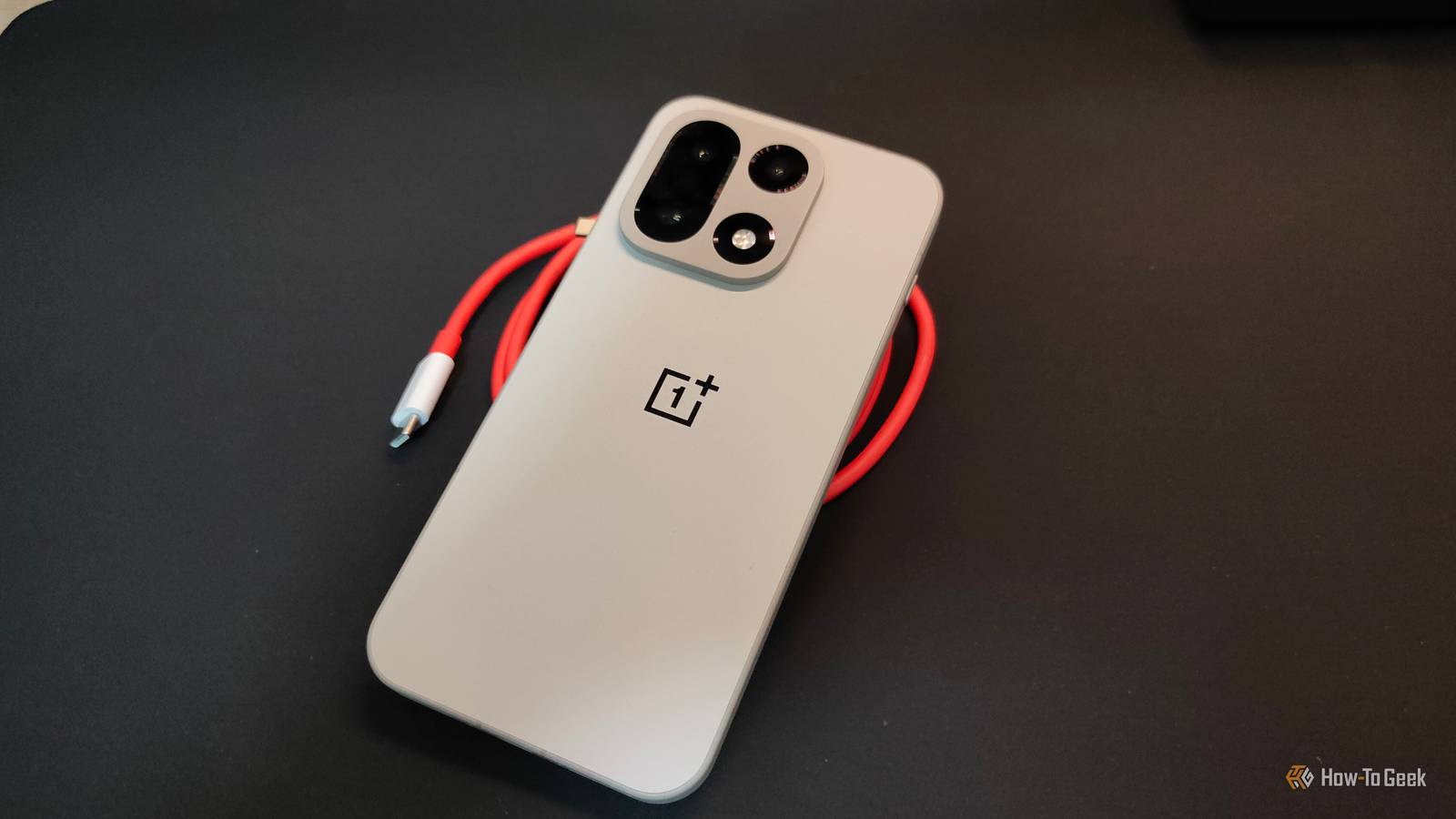
Samsung and Google make some of the best, most polished Android phones you can buy.But after using the OnePlus 15 for the past few months, I'd honestly dread switching back to a Samsung Galaxy S or Google Pixel.They're just hard to settle for; I wish the mainstream options didn't leave out so many of the things I love about this phone, because I'd love to be able to wholeheartedly recommend them to other people.
I don't want a flagship with a tiny battery I barely think about battery life anymore Close There are many things the OnePlus 15 does well hardware-wise, but the biggest upgrade for me has been its massive 7,300mAh silicon-carbon battery.This means 46% more battery than the Samsung Galaxy S26 Ultra and 42% more than what the Google Pixel 11 Pro XL offers.This massive capacity increase translates directly into several additional hours of use before it needs to charge.
The battery has been so impressive that I just don't have to think about charging it, other than plugging it in during the evening when it reaches around 20% or so — and I only charge it to 85%.It gives me the confidence to leave the house with 30% battery left, and I can even use it to top off my wife's Samsung Galaxy S23+ because she's always struggling to keep it full.This is possible because the battery contains a small percentage of silicon embedded into a carbon matrix in the anode (15% in the case of this phone).
Silicon has 10 times the theoretical capacity to hold a charge, allowing the phone to achieve a substantially higher capacity without increasing its thickness.Admittedly, Samsung has started using a small percentage of silicon in its new Fold 8 lineup, but it's still not present in the S Series.120W fast charging turns the chore into an afterthought Charging becomes something I barely think about Even a huge 7,300mAh silicon-carbon battery needs to be charged sometimes.
In fact, it needs faster-than-average charging if you want to top it up in a reasonable amount of time.Thankfully, the proprietary 120W (80W in the US and other regions with 110–120V outlets) SuperVOOC charger makes short work of that.OnePlus claims a 50% charge in just 15 minutes and a 100% charge in 40 minutes.
I haven't measured my charging speed, but that sounds about right in practice.There have been times when I've plugged the phone in at 10% for five minutes while getting ready to leave, only to come back home with more charge than I had before.The best part is that the phone doesn't get all that hot because the charging brick handles much of the voltage conversion instead of doing it inside the phone.
Samsung and Google rely on USB-PD, which places some limitations on how quickly their phones can charge.USB-PD PPS helps considerably, but there's still a ceiling compared with proprietary systems like SuperVOOC.The Google Pixel 11 Pro XL still peaks at 45W, while Samsung has upgraded the Galaxy S26 Ultra to 60W, which can get it to 75% in 30 minutes.
But considering how much smaller its battery is, OnePlus still edges it out.165Hz is the kind of display upgrade I actually want Flagships have gotten a little too comfortable with 120Hz Apart from the battery and fast charging, another massive upgrade comes in display technology.For some reason, Samsung and Google stopped chasing refresh rates above 120Hz years ago.
This is unfortunate, as I love ultra-smooth displays and have a 240Hz gaming monitor at my desk.OnePlus and a few other brands like Motorola and Xiaomi are bringing 165Hz OLED into the mainstream, which feels considerably smoother.It's a 37.5% increase in the refresh rate, and many people should perceive it as noticeably smoother than 120Hz.
It's a big upgrade for scrolling through apps and gaming — but only if the app actually supports it.The biggest barrier right now is that many apps and even games still only top out at 120 FPS or less.If big brands like Google and Samsung started pushing 165Hz, developers would have more incentive to add support, which would mean smoother displays that everyone could benefit from.
The software mostly gets out of my way I don't need another app for everything It feels weird to say this, but the Pixel's biggest enemy is Google.The Nexus line used to have some of the smoothest, least intrusive software, but Google has added so much bloat and AI to its phones that they no longer feel as clean to me.Samsung has always offered a ton of its own apps and features, so it's hardly surprising that One UI doesn't feel completely stock (though it isn't bad software by any measure).
In contrast, OxygenOS on the OnePlus 15 feels much less intrusive to me.There are a handful of AI features, mostly relegated to the gallery, but I rarely notice them.Overall, the software feels clean and unobtrusive, and I don't feel like I'm constantly dealing with extra apps and services such as Samsung Members, Samsung Health, and the numerous other Samsung apps.
The value proposition is hard to ignore This much hardware shouldn't cost this little One of the biggest benefits of going with a brand like OnePlus is that you get substantially better hardware for less money.The Samsung Galaxy S26, Google Pixel 11, and OnePlus 15 (while it was still available in the US) all start at around $900 for the 256GB storage model, but the difference is that the OnePlus 15 is actually competing against the Galaxy S26 Ultra ($1,300) and Pixel 11 Pro XL ($1,299).Software support length and camera quality are perhaps the only relatively minor objective downgrades, while OnePlus wins in almost every other area against these flagships that cost $400 more.
It's powered by the same flagship Snapdragon 8 Elite Gen 5 chip and has ultra-fast RAM and internal storage, Wi-Fi 7, Bluetooth 6.0, and all the other latest bells and whistles you'd expect from a high-end flagship.OnePlus has made my next upgrade harder to choose Ironically, owning a OnePlus 15 has made my next phone decision considerably harder.This phone has made me appreciate everything mainstream flagships leave on the table, but with OnePlus pulling out of the US and EU markets, Samsung and Google might end up on my shortlist in a few years anyway.
I just hope the brands adopt all these things I've talked about here, perhaps accompanied by a price drop.Perhaps I'll go with a foldable Motorola, as the brand seems to follow the same “more for less” philosophy that made me love OnePlus.Related Motorola's newest phones dethroned Samsung, and these 6 features prove it In this galaxy, Motorola is making better phones.
Posts 6 By Bertel King
Read More