
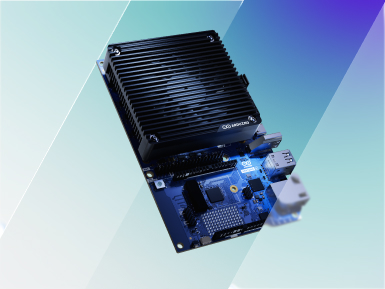
Can a $399 single-board computer index millions of technical documents, search video frames and audio logs in milliseconds, and run an 8B-class local LLM, all while managing a deterministic real-time control loop offline? To answer this, Moorcheh profiled an end-to-end, multimodal agentic memory pipeline directly on the Arduino VENTUNO Q board.Unlike cloud servers or 64 GB industrial workstations, edge hardware for physical AI demands strict memory discipline.Every gigabyte consumed by vector databases, graph pointers, and write-ahead logs is memory stripped away from local Vision-Language Models (VLMs), KV caches, speech engines, and real-time vision buffers.
Here is how we bypassed the edge memory bottleneck to bring scalable multimodal retrieval to the VENTUNO Q.The hardware: Dual-brain compute The VENTUNO Q features a dual-brain architecture built specifically for physical AI: Linux and AI compute: Powered by the Qualcomm Dragonwing IQ-8275 processor (featuring an 8-core Qualcomm Kryo CPU, Qualcomm Adreno GPU, and a Qualcomm Hexagon NPU designed to provide up to 40 dense TOPS) with 16 GB LPDDR5 system RAM.Real-time control: Powered by an STM32H5 microcontroller for sub-millisecond motor and sensor control loops.
While 16 GB of RAM is substantial for an edge board, standard vector retrieval engines quickly hit a memory wall at scale.The challenge: The multimodal memory wall In robotics and smart edge devices, vectors come from diverse data streams: text documentation, PDF schematics, camera keyframes, short video clips, and audio logs.When storing high-dimensional embeddings (e.g., 1,536-dimension float32 vectors) using conventional Approximate Nearest Neighbor (ANN) approaches like HNSW: Uncompressed float32 vectors alone require 6.14 KB per entry.
Graph adjacency lists, auxiliary pointer structures, and uncompacted write-ahead logs quickly explode.At 1,000,000 vectors, HNSW consumes 7.4 GB of RAM and 13.2 GiB on disk.Ingesting new vectors requires continuous, compute-heavy graph construction that can lock the board for hours.
On a board with 15.2 GB of total usable RAM, allocating 7.4 GB to the vector database triggers Out-Of-Memory (OOM) crashes the moment you load a quantized language model alongside vision and speech processing.The solution: Moorcheh information binarization + Memanto Moorcheh is a search engine that compresses high-dimensional vectors to one bit per dimension (reducing a 1,536-dimension embedding to just 192 bytes).Retrieval is executed as an exact bit scan directly on the Kryo CPU with built-in shortlist reranking.
This design leaves the Hexagon NPU, offering 40 dense TOPS, and roughly 14.5 GB of system RAM completely untouched for neural inference.Directly above the search layer, Memanto serves as Moorcheh’s open-source agentic memory engine.Memanto supersedes outdated information, prunes stale observations, and compiles structured context briefings before prompts reach the local LLM.
Hardware measurements on the VENTUNO Q Rather than relying on workstation simulations, Moorcheh was benchmarked against standard HNSW indexes on physical VENTUNO Q hardware across 10,000, 100,000, and 1,000,000-vector workloads: Zero index-build latency: Moorcheh requires 0 seconds of graph construction after upload.HNSW required 2 hours and 58 minutes of continuous computation to build its graph for 1M vectors on the board.Sub-gigabyte footprint: At 1,000,000 items, Moorcheh’s retrieval process sits flat at 737 MB of RAM and 294 MiB on disk (compared to 7.4 GB RAM and 13.2 GiB disk for HNSW).
Predictable laatency: Moorcheh delivered a 14.84 ms median query latency at 1M items, with candidate reranking already completed inside that window.Read the full empirical benchmark on Moorcheh.ai: For complete latency distributions (min, median, p95), cold-start reload timings, and side-by-side memory traces, read our technical deep-dive: What Retrieval Costs on the Board: VENTUNO Q Benchmarks.What fits beside 1,000,000 multimodal records? Because Moorcheh’s retrieval process leaves over 14.5 GB of RAM available, developers can run an entire multi-modal AI stack simultaneously on a single VENTUNO Q: Retrieval engine: Moorcheh (737 MB RAM / 294 MiB disk) Embedding model: BGE-small (~676 MB resident) Local language model: Qwen 2.5 3B or 7B Q4 (~2.1 GB to ~4.7 GB via Qualcomm GenieX) Speech-to-text: Whisper small (~750 MB resident) Text-to-speech: Piper (~470 MB resident) Object detection: YOLOv8n 1080p stream (~300 MB) This complete concurrent stack consumes between 5.0 GB and 7.6 GB, leaving substantial headroom for KV-cache expansion, operating system buffers, and ROS 2 communication nodes.
Real-world case studies for the VENTUNO Q 1.Air-gapped retail voice and vision kiosks Running directly on the Arduino VENTUNO Q, retail kiosks operate completely offline without cloud APIs or store Wi-Fi dependencies.When a shopper walks up to the kiosk and asks: , Whisper transcribes the voice query, while Moorcheh searches across 1,000,000 multimodal catalog entries, PDF schematics, and instructional video timestamps in ~15 ms.
The local LLM on the VENTUNO Q generates grounded step-by-step guidance, and Piper speaks the answer while the screen displays the exact diagram retrieved by Moorcheh.2.Autonomous mobile robots (AMRs) and spatial video memory Mobile robots navigating dynamic warehouses, hospital corridors, and retail floors use the VENTUNO Q as an integrated compute brain.
Rather than offloading millions of video feeds to a cloud server, the robot’s vision pipeline embeds live keyframes, depth maps, and obstacle logs directly into Moorcheh.Moorcheh acts as the robot’s resident episodic memory engine on the VENTUNO Q.When a pallet is missing or a corridor is obstructed, the robot queries Moorcheh to recall exactly when, where, and in which video frame the asset was last seen visually without leaving the edge.
3.Hands-free field assist across millions of schematics and video Field technicians servicing aerospace hardware, industrial turbines, or off-grid telecom towers carry rugged inspection kits powered by the VENTUNO Q.The board hosts a complete on-device technical library of over one million engineering schematics, wiring diagrams, diagnostic guides, and maintenance video clips indexed entirely within Moorcheh.
When a technician points a live camera at a broken component and asks a spoken diagnostic question, the VENTUNO Q captures both video frames and audio simultaneously.Moorcheh performs a cross-modal vector search across the entire library in under 15 ms, pulling up the matching wiring diagram and video snippet for the local LLM to narrate through the technician’s headset.References and further reading Moorcheh What Retrieval Costs on the Board: Ventuno Q Benchmarks arXiv paper 1: – MIB and ITS technical paper.
arXiv paper 2: – memory management and stateful-agent architecture Open-Source Agentic Memory, Memanto, GitHub Moorcheh Edge Documentation Qualcomm Qualcomm Dragonwing IQ8 / VENTUNO Q platform documentation Qualcomm GenieX Qualcomm AI Hub: Qwen3-4B-Instruct-2507 Qualcomm Dragonwing IQ10 Series / IQ10 Robotics Reference Design Qualcomm GenieX on GitHub Arduino Arduino VENTUNO Q documentation Build a voice based kiosk for retail store using Moorcheh-edge and Arduino UNO Q
Read More