What started with a hypercar is now taking Divergent Technologies into aerospace and defense manufacturing.By combining software, metal 3D printing and robotic assembly, the California-based manufacturer is working to make complex parts and structures with fewer production steps.But making parts for aircraft and defense equipment comes with another challenge: proving they work as expected, every time.
That’s where America Makes comes in.Through its work with the organization and other industry partners, Divergent is helping find ways to test and qualify these new manufacturing methods so they can be used more widely.Kyle Bass (center) joins U.S.
Secretary of Defense Pete Hegseth (left) as Divergent CEO Lukas Czinger (right) discusses the company’s digital manufacturing technology.Image courtesy of Divergent.From a Digital Design to a Finished Structure At the center of Divergent’s approach is the Divergent Adaptive Production System, or DAPS.
Instead of treating design, printing, and assembly as separate operations, the platform connects them into one process.It starts with software that designs parts based on how strong, light, or compact they need to be.The parts are then 3D printed in metal and assembled using robots.
Brian Erhartic, Divergent’s Chief Technology Officer, explained the process: “The process begins with design software and automated design, followed by AM and fixtureless automated assembly.” That last step is especially important.Traditional manufacturing often requires special tools to hold parts in place while they are assembled.These tools can be expensive to make and may need to be replaced whenever a design changes.
Divergent’s approach reduces the need for these tools, making it easier to produce different parts using the same manufacturing system.For customers, this could mean fewer production steps and less time spent preparing for a new design.It also changes the role of 3D printing.
Rather than being one operation in a longer manufacturing chain, it becomes part of a connected production process.What Started with Hypercars Is Moving into Defense One example of Divergent’s approach comes from the automotive industry.For the Czinger 21C hypercar, the company combined several parts that would normally be made separately into more integrated structures, including suspension and chassis components.
This helped reduce the number of separate parts and allowed engineers to make lighter designs without giving up the strength needed for a high-performance car.The same approach is now being used in aerospace.In December 2025, Divergent and Saab announced that they had produced a 15-foot-long fuselage for an autonomous aircraft concept.
The structure was made from 26 different 3D printed parts, which were joined using robotic assembly without the need for custom tools.Divergent delivered the initial fuselages for integration and flight testing.The Saab project is one example of Divergent’s growing work in aerospace and defense, where manufacturers face growing pressure to produce complex components faster and in greater volumes.
These industries also demand strict quality controls, particularly when parts are used in aircraft, military vehicles and other critical equipment.Saab teams with Divergent to move towards adaptive design and production.Image courtesy of Saab.
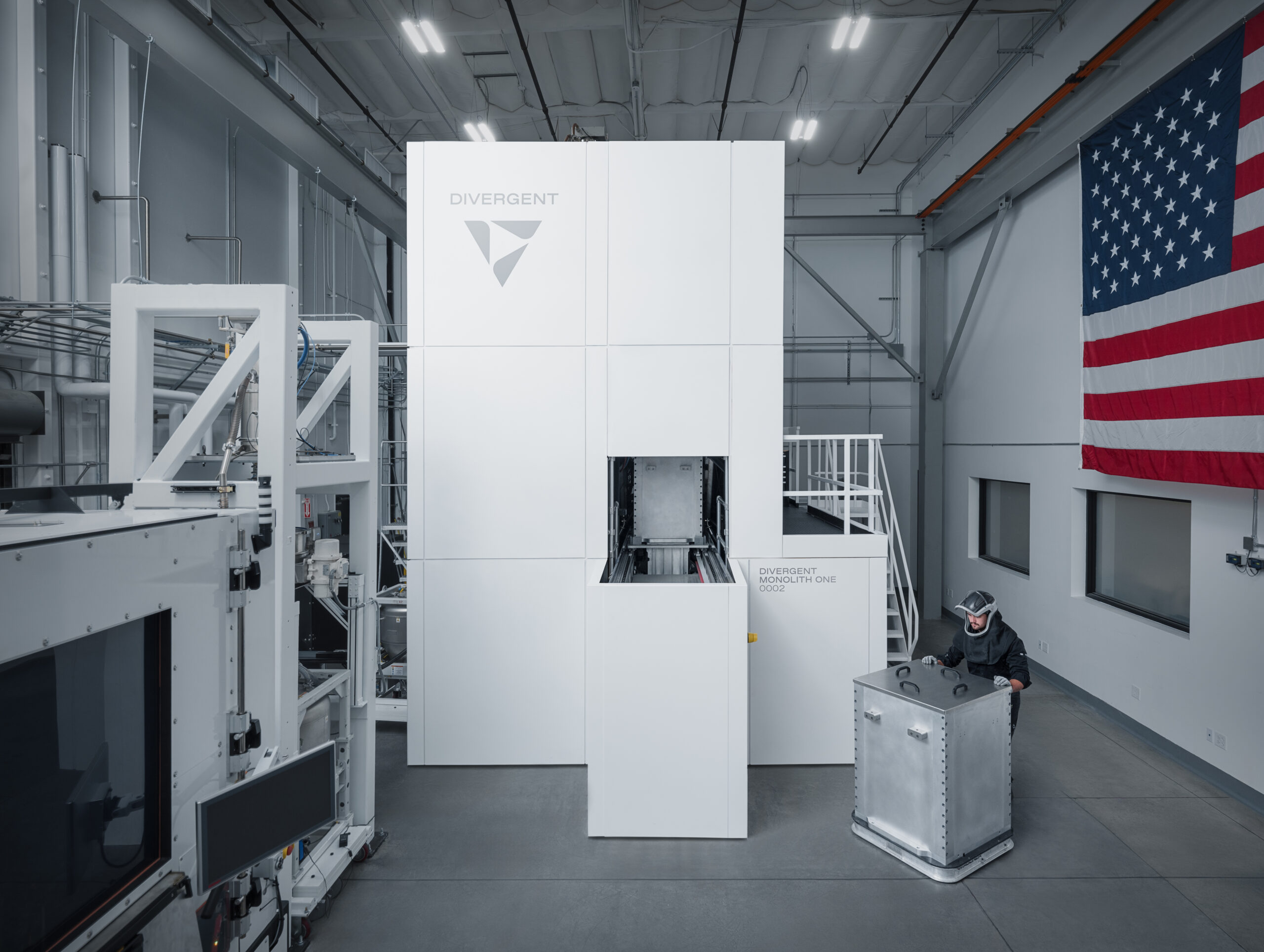
In June 2026, Divergent announced its Monolith One metal 3D printer and plans for a 430,000-square-foot manufacturing facility in Long Beach, California.The company said the new facility would eventually house 64 Monolith One systems, allowing it to produce parts on a much larger scale.The expansion shows that Divergent is moving beyond making individual parts and preparing to produce them in much larger numbers.
But making more parts is only part of the challenge.The company also needs to make sure they meet the strict requirements of the industries they’re made for.Making Sure the Parts Meet Industry Standards This is where America Makes comes in.
The organization brings together manufacturers, researchers, government agencies and other industry partners to solve problems that companies may struggle to tackle on their own.One of those challenges is qualification.This is especially important for Divergent because its manufacturing system combines several processes, including metal 3D printing and robotic assembly.
Traditional manufacturing methods have often been tested and used for decades, so companies know what to expect.With newer methods like Divergent’s, less testing data is available, so manufacturers must show they can consistently produce parts that meet the same standards.Through its participation in America Makes initiatives, including the DAPS Airworthiness Guided Supplement (DAWGS) program, Divergent has worked with defense stakeholders and industry partners on approaches to qualifying these integrated structures.
“We need to come up with intelligent ways of qualifying these integrated structures,” Erhartic said.The effort includes input from the Department of Defense, major defense contractors and NASA, with the goal of making it easier to qualify and use 3D printed parts in aerospace and defense.For America Makes, this type of collaboration is key to its mission.
Helping companies develop new technology is important, but so is making sure the wider manufacturing industry has the knowledge and methods needed to use it.Divergent’s print rooms host proprietary 3D printers.Image courtesy of Divergent.
Making Manufacturing More Flexible Another important part of Divergent’s strategy is how quickly it can improve its technology.For example, Erhartic explained that the company made more than 546 design changes to its powder bed fusion printer in just 20 months, bringing it to its fourth generation.That focus on improving its technology can also be seen in the company’s newer Monolith One printer.
Developed in-house, the machine uses 12 lasers and is designed for continuous industrial production.It forms part of the larger DAPS platform rather than being sold as a standalone printer.For Divergent, the printer is just one part of the process.
The company is also working to make design, assembly and quality checks faster and easier.And as it prepares to produce more parts, its work with America Makes becomes even more important.Customers need to know that those parts will meet the same standards every time, no matter how many are made.
The next step isn’t just building faster printers or producing more complex designs; it’s making sure the entire process works reliably at a larger scale.Subscribe to Our Email Newsletter Stay up-to-date on all the latest news from the 3D printing industry and receive information and offers from third party vendors.Print Services Upload your 3D Models and get them printed quickly and efficiently.
Powered by FacFox Powered by 3D Systems Powered by Craftcloud Powered by First Mold Powered by Xometry 3DPrinting Business Directory 3DPrinting Business Directory
Read More