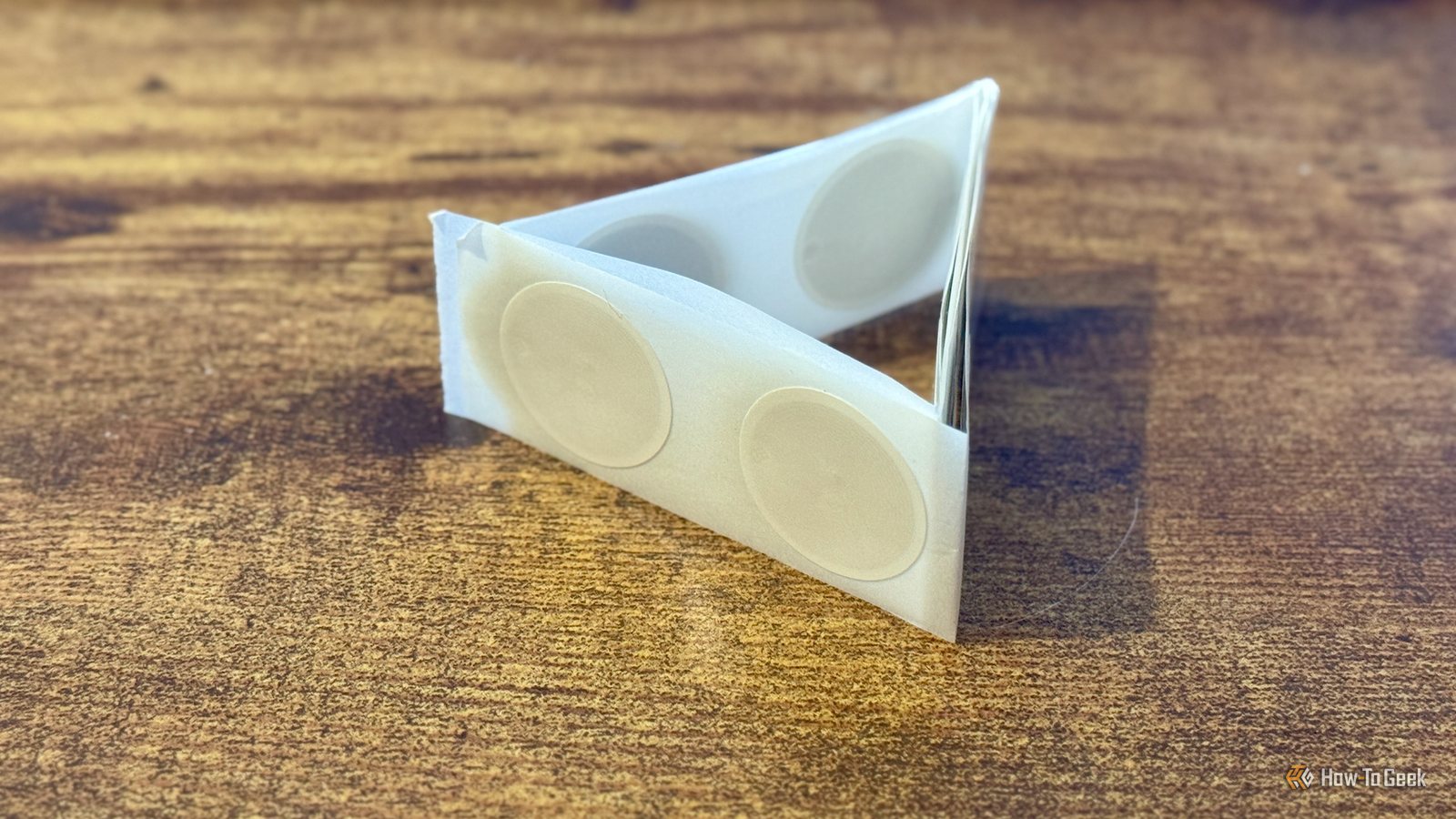
NFC tags can be incredibly useful smart home tools.They're cheap to buy, and you can use them to trigger automations just by scanning them with a phone.Not all NFC tags are created equal, and it's all too easy to buy the wrong NFC tags for the job.
Standard NFC tags may not work on metal Sticking tags to appliances can cause issues This was something I discovered when I first stuck an NFC tag to the side of a washing machine.I wanted to scan the tag to start an automation that would alert me when the washing cycle was finished, but I was struggling to get the tag to scan.I went through a few NFC stickers, assuming that I had a faulty batch.
It turned out that it wasn't the fault of the NFC tags at all.The problem was that I was sticking them to the metal casing of the washing machine.NFC tags communicate using a magnetic field, and attaching the tag to conductive metal can interfere with that field.
It means that the effective distance that you can scan the tag from is significantly reduced, making it much harder to scan the tag than normal.There are two solutions to this problem.The first is to stick the tag to a non-metallic part of the device.
This isn't always possible if you want to attach tags to something that's predominantly made of conductive metal.In these cases, you can opt to use anti-metal NFC tags.These tags have a layer of shielding material behind the tag so that the antenna isn't stuck directly to the metal surface.
An anti-metal tag should work far better on a metal surface than a standard NFC tag.Related 7 Places You're Not Using Smart Tech (But Should Be) Smart devices can improve almost any area of your home.Posts By Adam Davidson Smaller tags come with a trade-off They're easier to hide but harder to use Close When you buy NFC tags, it's tempting to go for the smallest size you can find.
One of the benefits of NFC tags is that they're easy to hide away, unlike bulkier smart buttons.I have NFC tags under plant pots, stuck to the side of my bed, and on the dashboard of my car.The problem with opting for smaller NFC tags is that while the chip itself can be tiny, it needs an antenna surrounding it for the tag to work.
The smaller the NFC tag, the less space there is for the antenna.This means that a larger NFC tag can usually be more forgiving than a smaller one.If you opt for a tiny tag, you may need to be quite accurate about where you place your phone to scan the tag.
With a larger tag that has a bigger antenna, the effective scanning distance can be greater, making it easier to scan the tag without having to be so precise.This is particularly useful if you've placed an NFC tag in a location that's awkward to reach, such as under a table.A larger tag can make it easier to scan the tag without having to hit the same exact location every time.
Don't pay for storage that you don't need You're probably not going to need more than 144 bytes If you're buying NFC tags, you may see identifiers such as NTAG213, NTAG215, and NTAG216 in the product names.These identifiers refer to different NFC chip models that offer different amounts of available user memory.NTAG213 gives 144 bytes of user memory, NTAG215 has 504 bytes, and NTAG216 provides 888 bytes.
It's easy to assume that getting NTAG216 tags makes the most sense, since it gives you the most user memory to play with.The reality is that for most smart home applications, even 888 bytes is overkill.The NFC tag is often used solely as a trigger for automations, with any necessary data for those automations coming from other sources.
The NFC tag only needs to store a small amount of information, such as the short URL that Home Assistant uses to identify the tag.The 144 bytes offered by NTAG213 tags are more than enough to contain the information necessary for an NFC tag to work as a Home Assistant trigger, for example.You can buy an NTAG216 tag, but all that extra user memory will simply be going to waste.
Even if you want to use a tag to store information, such as Wi-Fi credentials, an NTAG213 tag is usually enough, provided that the credentials aren't excessively long.Higher capacity NFC tags can often cost more than NTAG213 tags, so in the vast majority of cases, you'll just be wasting money.Stickers aren't the only option Different formats can work better for some uses Stickers are one of the most popular forms of NFC tags because they're incredibly easy to use.
You can slap a sticker on most surfaces, making it easy to hide away discreetly.Stickers aren't the only option, however.NFC chips and antennas are sold inside cards, key fobs, wristbands, plastic tokens, and more.
You can even use household objects.For some uses, these different formats can be more useful than stickers.For example, you could use an NFC key fob to trigger an automation that shares your location when you're driving somewhere.
NFC cards are a popular choice for making NFC movie libraries that play different movies depending on which tags are scanned.The more solid options, such as discs or cards, are much better when you want to move the tags around rather than fix them in a single location.Sticking NFC stickers to things such as cards or other objects can work, but stickers can be more vulnerable to damage from bending or repeated handling, so other formats may still be a better option.
NFC tags are useful as long as you choose wisely For many use cases, standard NFC stickers will do the job just fine.There are lots of situations where these aren't always the best choice, so you should think about what you want them to do before pulling the trigger on that pack of 200 stickers.
Read More