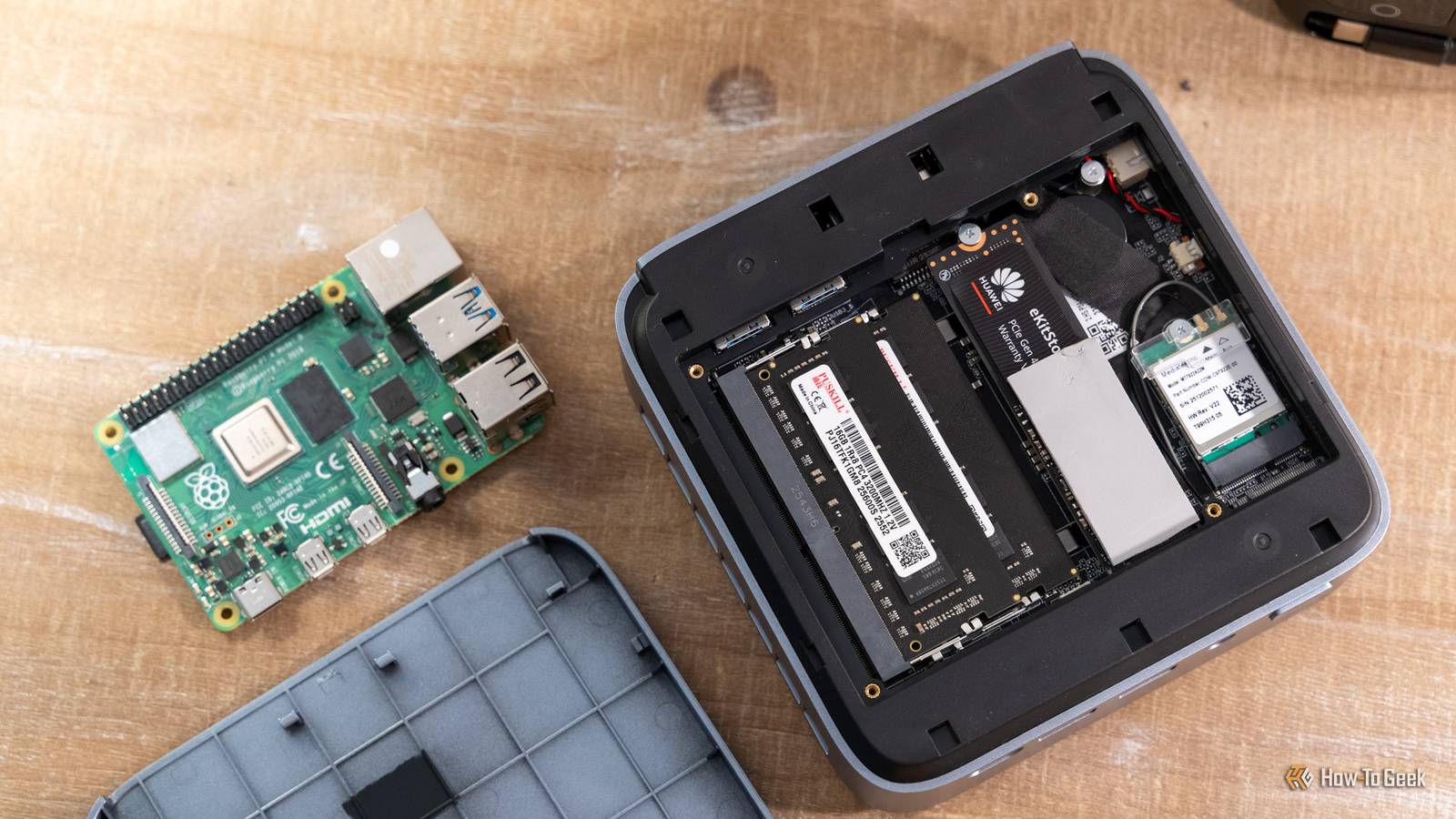
Raspberry Pis are becoming more expensive than mini PCs if you want real compute power.But, Raspberry Pis still do something better than any mini PC can—GPIO (general purpose input/output).With GPIO headers, a Raspberry Pi can interact with real-world objects like garage door openers, sensors, and more, and it doesn’t need 16GB of RAM to do it.
Add How-To Geek on Google Add as Preferred Source Follow on Google Discover Flip real switches with a relay board Garage doors, sprinklers, and anything with a dry contact Close A Raspberry Pi is actually a great way to flip switches or toggle power using things like relays.If you didn’t know, the button that you press inside of your garage to open the door basically just shorts two low-voltage wires together to complete the circuit and that’s what triggers the door opener to run.You can do the same thing using a relay board on a Raspberry Pi.
Simply hook the two wires of the garage door up to the relay and then program the Pi to connect them whenever you want to open the garage.This can be easily done in Home Assistant with Remote GPIO and it takes up very little room and power in the garage.In fact, all you need is USB power at your garage door opener and a Raspberry Pi and you can make almost any opener smart.
Read the room with I2C sensors Temperature, humidity, air quality, all on four wires A mini PC just isn’t the right tool for every job—and sensors are one of those jobs that it’s not the right choice for.A Raspberry Pi can take I2C sensor input, like CO2, temperature, humidity, and more with just four wires.These sensors are often cheap and easy to find on Amazon and can really let you build all sorts of fun projects.
For instance, you could combine temperature, humidity, air quality, and barometric pressure to build a full weather station that can go outside.Or, you could just use air quality sensors and have the Pi sit in your office to tell you when it’s time to open the windows because it’s too stuffy inside.No matter what route you go, a mini PC simply can’t hook up to I2C sensors in any reasonable way, while the Pi is made to handle that type of job.
Keep perfect time with GPS A stratum 1 NTP server for your whole network Every internet-connected device in your house sets its time clock from something called an NTP (network time protocol) server.These servers are hosted all around the world and allow you to have accuracy within tens of milliseconds for what time it is.However, if you don’t want to rely on those services to keep time in your homelab (or you want sub-millisecond accuracy), then you can actually run your own NTP server.
All it takes is a GPS module and your Raspberry Pi can tell time.This type of setup requires a PPS (pulse per second) signal and mini PCs can’t take that type of input without a special card.Once you have the GPS module you can set up your Pi to monitor the GPS module over UART and the pulse per second through the GPIO so that way it can (through software) decode what time it is and serve that to the other systems on your network.
Drive LED strips and status lights Addressable LEDs need precise timing, and the Pi 5 finally has it Did you know that a Raspberry Pi can actually drive LED strips and other lights? Well, it can.Basically every Raspberry Pi supports the timing needed to handle addressable LEDs.All it takes is the Pi, an addressable LED strip from Amazon, Adafruit, or elsewhere, and a bit of tinkering.
You’ll probably end up using the Adafruit Pi 5 NeoPixel library to get the project running, but this is a great way to add custom shelf/desk lighting to the office or status-based lighting for your homelab.Add real buttons and small screens Physical controls beat opening an app on your phone The GPIO pins of a Raspberry Pi can be used to drive many, many things.For instance, I’ve hooked up an e-ink display to my Pi through a HAT (hardware attached on top) that connects to the Pi’s GPIO.
These HATs make wiring super simple because they just plug onto the header and handles everything else from there—no soldering required.Another thing that the GPIO pins can do is handle buttons and automations.For example, you could hook up an e-ink display to the Pi, and then hook up some buttons to the GPIO pins as well.
The display could show the current status of your homelab, calendar, a funny quote, and a to-do list, while a button press cycles through the screens.The mini PC still runs the server, the Pi just does the hands-on work The best part about a Raspberry Pi is all the real-world stuff it can interact with that a mini PC simply can’t.Sure, there are workaround for many of these things on a mini PC, but a Pi does them .
If you need a computer to run as your homelab server: get a mini PC.If you need a computer that runs services that your homelab server: get a Raspberry Pi.
Read More