
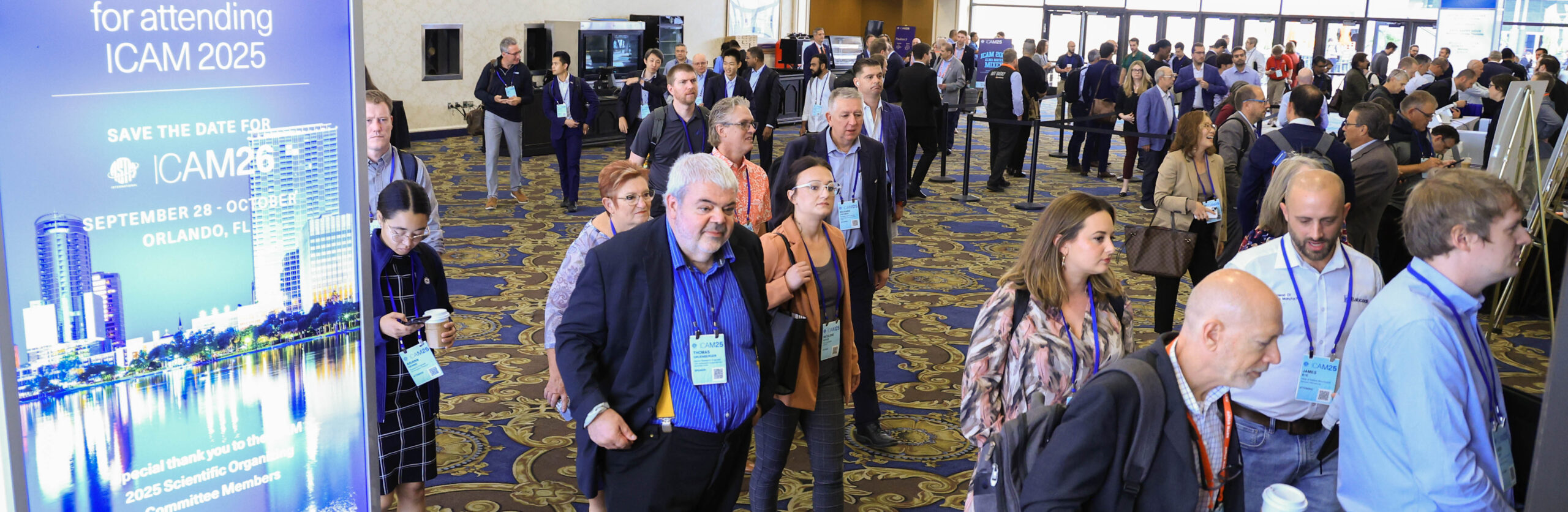
This year’s ASTM International Conference on Advanced Manufacturing (ICAM 2025) was special not only because it was the 10th anniversary of the event, but also because it was the first featuring coverage by veteran manufacturing journalist Peter Zelinski.Zelinski captured a unique trend throughout the week in Las Vegas: that additive manufacturing (AM) and artificial intelligence (AI) are no longer parallel conversations.They are converging into a single narrative about how the future of production will think, learn, and build.
Discussing the topic, Zelinski has published a white paper, “How AI Is Realizing the Promise of Additive Manufacturing,” which draws on dozens of ICAM presentations to outline a profound shift.AM will certainly benefit from AI, but it is also the manufacturing process most ready for it, and perhaps the one that needs it most.Design Freedoms, Not Just “Design Freedom” For years, AM’s great selling point was geometric freedom, the ability to produce shapes impossible to produce by traditional means.
But Zelinski argues that what’s emerging is a multitude of design freedoms, each unique to its domain.ICAM 2025 Defense session.In defense, the German Armed Forces presented evidence that AI helps rapidly redesign drones near the field, tailoring airframes to specific missions or threats.
In healthcare, researchers at North Carolina State University demonstrated how AI interprets CT scans to generate patient-specific bone implants, matching internal porosity to individual physiology.Both examples hinge on AI translating data into manufacturable geometry faster than human designers could iterate.Despite fears to the contrary, AI doesn’t replace design expertise.
Instead, it multiplies that knowledge, extending AM’s creative reach across sectors that once had little in common.Process Control: Seeing More, Knowing More Zelinski also highlights how AI is transforming process control, the step between design intent and material reality.Presentations from Lawrence Livermore National Laboratory and the University of Dayton Research Institute demonstrated how deep neural networks are mapping variables that were once too complex to model, such as dwell time and melt-pool dynamics in laser powder bed fusion.
With more sensors and smarter algorithms, AM systems can now identify the subtle patterns that precede defects or distortion.The result is real-time prediction and correction during the build itself.Automation After the Print Automation was another frontier.
Flexxbotics showcased robotics software that connects machining, cleaning, and inspection stations into a single data-driven loop.While no 3D printer was visible, Zelinski noted how this “AI-capable post-processing” is essential for true AM scalability.In that way, the intelligence continues after the part leaves the build plate, through finishing, inspection, and qualification.
Similarly, Ursa Major and Dyndrite showed how AI-assisted slicing can identify thin-wall features across multiple platforms, thereby reducing supports and streamlining post-processing.These are small algorithmic gains that add up to large reductions in cost and time.From Craft to Code Perhaps Zelinski’s boldest observation is that the “craft” phase of AM, when success depended on tribal knowledge and intuition, may prove to be transitional.
At ICAM, InfinitForm and Ansys demonstrated AI tools that can automatically design parts, generate support structures, and optimize thermal flux without manual trial-and-error.As he writes, “Design rules of AM are as defined and predictable, and (through AI) every bit as automatable as the more established processes.” Toward the AI-Enabled Factory Across five days and 725 presentations, ICAM 2025 revealed a manufacturing ecosystem in motion.Standards are catching up.
Qualification is accelerating.And AI is quietly becoming the connective tissue—linking design, simulation, production, and inspection into a continuous digital thread.Zelinski’s conclusion is less prediction than inevitability: AM will become the AI-enabled process.
It is the most digital, the most data-rich, and the most dependent on nuanced control of geometry, heat, and material.To realize its full promise, AM requires intelligence equal to its complexity, and AI is providing exactly that.As we look toward ICAM 2026 in Orlando, we will continue to observe that the story of AM has extended from the idea of machines that can print anything to encompass systems that can learn everything.
Images courtesy of ICAM/ASTM
Subscribe to Our Email Newsletter
Stay up-to-date on all the latest news from the 3D printing industry and receive information and offers from third party vendors.Print Services
Upload your 3D Models and get them printed quickly and efficiently.Powered by FacFox
Powered by 3D Systems
Powered by Craftcloud
Powered by Endeavor 3D
Powered by Xometry
3DPrinting Business Directory
3DPrinting Business Directory

