Spring is hard for teachers.By this point in the school year, routines that worked beautifully in the fall can start to fall apart.Students are tired.
Teachers are tired.Testing season is here.And somehow the same class that knew exactly what to do in January now needs three reminders to line up, log in, clean up, or stay focused.
If that sounds familiar, you are not doing anything wrong.You do not need a brand-new classroom management plan right now.You need a reset plan.
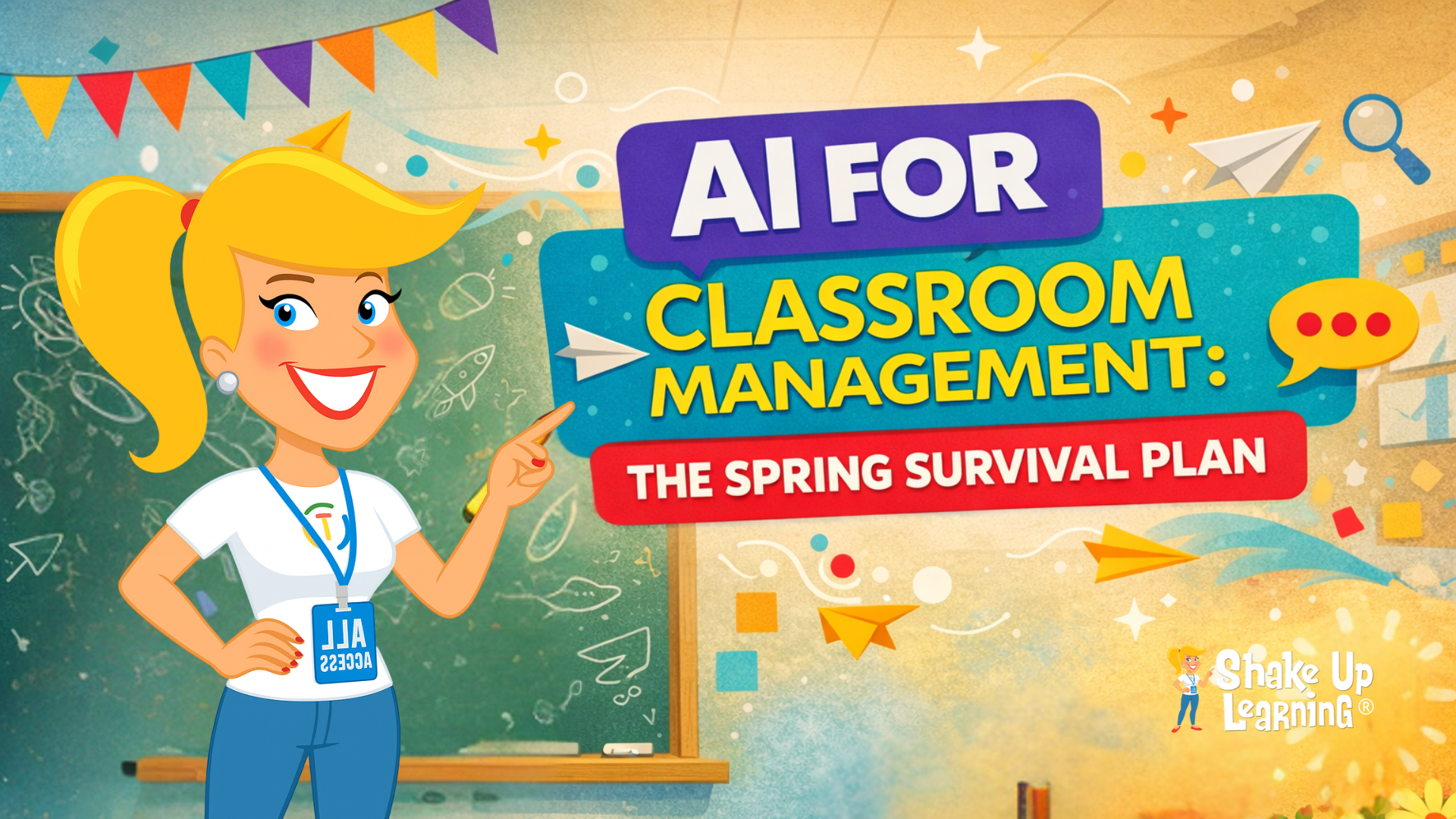
That was the heart of this week’s podcast episode, and it is exactly where AI can help.Instead of reinventing the wheel, you can use AI to simplify routines, pre-write responses, support students, and lighten your workload so you can finish the year strong.Listen to this podcast episode: AI for Classroom Management: The Spring Survival Plan In this post, I’m breaking down a practical spring survival plan for classroom management using AI, along with examples you can use right away.
Why Late Spring Feels So Hard There is something about this stretch of the school year that makes everything feel heavier.After spring break, students often test boundaries again.During testing season, schedules get weird, energy dips, and attention spans shrink.
Small issues can start to pile up fast: blurting, off-task talking, slow transitions, refusal to start, messy device use, and end-of-day chaos.In this episode, I talk about how teachers don’t need more guilt or a stricter personality overnight.What they need are a few smart systems, a few better responses, and tools that lighten the load.
That is one reason AI can be so helpful this time of year.As I share in the AI for Classroom Management book, generative AI can create drafts, routines, scripts, and support ideas based on your prompts, helping teachers spend less time starting from scratch and more time focusing on students.The Spring Survival Plan: 4 Ways to Use AI for Classroom Management The easiest way to think about this is in four parts: Reset expectations Support students who need more than reminders Simplify communication Protect your energy That is your spring survival plan.
*Related: 25+ AI Tips for Teachers 1.Reset Expectations Without Repeating Yourself All Day When routines start slipping, most of us do the same thing: we repeat ourselves over and over, usually with a little more frustration every time.But more reminders do not always help.
What helps is making expectations clearer, shorter, and easier to repeat.That was a major strategy in the episode: choose one routine that is falling apart and ask AI to simplify it into a short, repeatable script students can actually follow.Try this prompt: “Create a simple three-step transition routine for a noisy 7th-grade class moving from independent work to group work.
Keep the language short, clear, and easy to say out loud.“ That kind of prompt works much better than something vague like “help me with classroom management.” In the book, I make the same point: the more specific your prompt, the more useful and customized the response will be.Weak prompts produce generic answers.Strong prompts produce classroom-ready drafts.
Real examples by grade level Elementary school:If your third graders are struggling with the morning routine, you might ask AI to generate a structured morning checklist.In the episode, I gave this example: “Enter quietly, turn in work, start your warm-up.” Then you can turn it into a visual checklist or call-and-response for your classroom.Middle school:If your seventh graders lose control during transitions, ask AI for refocusing strategies after transitions.
Then build a simple routine like: finish your sentence, put materials away, laptops closed, 10 seconds to reset, eyes up for the next direction.It is not glamorous, but it works.High school:For older students, the issue is often tone.
A prompt like “Rewrite this classroom expectation in age-appropriate language for a 10th-grade class: Stay on task and complete your work quietly” can help you find wording that sounds respectful instead of cheesy.In the episode, that became something like: “Use this time to make progress.Keep side conversations off for now, stay focused, and let’s finish strong.” The AI Prompt Cheat Sheet for Classroom Management supports this with plug-and-play prompts for positive classroom rules, smooth morning routines, call-and-response cues, non-verbal behavior cues, and refocusing after transitions.
2.Pre-Write Calm Teacher Responses for Repeated Behaviors Some classroom management issues are not dramatic discipline problems.They are the same low-level behaviors repeated all day long: blurting, off-task talking, refusal to start, wandering, and distracting others.
What makes those behaviors so exhausting is that they require constant teacher response.In the episode, I recommended using AI to pre-write one calm, consistent teacher response for the behavior you are seeing most often.Try prompts like: Write a calm teacher response for a 9th-grade student who refuses to begin independent work.
Keep it respectful, firm, and de-escalating.Draft a short redirect for a 5th-grade student who keeps blurting out during whole-group instruction.Give me three teacher response options for a 7th-grade student who is off-task and distracting others during independent work.
What this might look like For blurting in 5th grade:“I want to hear what you have to say.Raise your hand, and I’ll come right back to you.” For off-task talking in 7th grade:“Right now, it’s independent work time.Show me the first step, and we’ll go from there.” For refusal in 9th grade:“You do not have to like this assignment, but you do need to begin.
Start with question one, and I’ll check back with you in two minutes.” These scripts work because they are short, calm, and consistent.They help you respond intentionally instead of emotionally.In the book, I share an example of using AI to generate a de-escalating response for a 9th-grade student who refuses to follow directions, then refining it by age or situation.
The takeaway is that AI can help teachers stay calm and consistent, but the teacher still personalizes the tone and delivery.This cheat sheet includes prompt starters for redirecting off-task behavior, responding to defiance, and de-escalation strategies, which makes it easy to build your own script bank.*Related: 5 Google Classroom AI Secrets That Save Teachers HOURS Every Week! (FREE Workshop) 3.
Build Better Support Plans for Students Who Need More Than a Quick Redirect Sometimes a student does not need another reminder.They need more structure, more support, and a plan that helps them be successful.That might be the student who is constantly distracted, shuts down when frustrated, struggles to complete work, escalates quickly, or needs support with self-regulation.
In the episode, I talked about using AI to help you think through a support plan faster, not as a replacement for teacher judgment, but as a starting point when you are mentally overloaded.Try prompts like: Create a simple behavior support plan for a 5th-grade student who struggles to stay focused and complete assignments.Include classroom supports, check-ins, and ways to build independence.
Give me classroom support ideas for a 7th-grade student with ADHD who is blurting out and struggling during independent work.Help me create a non-punitive reset plan for a high school student who shuts down when frustrated.In the AI for Classroom Management book, I include an example of a behavior intervention plan for a 5th-grade student who gets distracted and struggles to complete assignments.
The AI-generated draft includes ideas like seat placement near positive role models, chunking work into smaller parts, movement breaks, a visual timer, and teacher check-ins.It also suggests refining the prompt further for a 7th-grade student with ADHD.Support Ideas by Grade Span Upper elementary:One-step directions, visual timers, five-minute work chunks, movement breaks, and quick check-ins.
Middle school:Shorter work intervals, a nonverbal cue between teacher and student, reduced distractions in seating, and an end-of-class reflection question.High school:A reduced first step, a quiet reset cue, a short break-and-return plan, or a prompt like “What part feels hardest right now?” The goal here is not perfection.It is faster brainstorming, better starting points, and less decision fatigue.
*Related: AI for Classroom Management (presentation by Kasey Bell) 4.Shift From Constant Correction to Student Reflection By spring, constant correction can wear everybody out.You correct.
They nod.Ten minutes later, you are having the exact same conversation again.A smarter strategy is to use AI to create quick reflection tools that help students take some ownership.
In the episode, I suggested using AI for behavior reflection forms, weekly self-checks, morning check-ins, and reset sheets.Try prompts like: Create a simple student reflection form for a 6th-grade student who keeps getting off task during class.Keep it brief, supportive, and focused on accountability.
Write four reflection questions for a high school student who is struggling with focus and participation.Create age-appropriate reflection questions for a 2nd-grade student after disruptive behavior.Reflection examples by grade level Elementary:What happened? How were you feeling? What can you do differently next time? How can I help? Middle school:What were you supposed to be doing? What distracted you? How did your choices affect your group? What is one goal for tomorrow? High school:What pattern are you noticing in your focus or behavior? What got in the way? What support do you need? What is one action you will take next time? The cheat sheet includes prompts for student reflection sheets, morning check-ins, and weekly self-reflection, all designed to support accountability without turning every behavior conversation into a punishment.
*Related: How to Create AI-Generated Audio Lessons in Google Classroom 5.Simplify Parent Communication With Reusable AI Templates When behavior slips, parent communication usually increases, too.And writing those emails when you are tired can feel like A LOT.
This is a perfect use for AI because tone matters.You want to sound calm, clear, supportive, and collaborative.In the episode, I challenged teachers to draft three reusable templates: a positive behavior email, a mild concern email, and a collaborative support email.
Save them once and stop staring at a blank screen every time.Try prompts like: Write a supportive email to the parent of a 5th-grade student who is talking during lessons and distracting others.Keep it positive, clear, and collaborative.
Draft a positive parent email for a 6th-grade student who has improved in staying on task.Help me write a conference summary email about behavior concerns that sounds supportive and professional.This also builds on the strategy from episode 223 about pre-writing parent emails and saving them in a place that’s easy to reuse like Google Docs.
The cheat sheet includes prompts for supportive parent behavior letters, positive parent emails, difficult behavior conversations, parent-teacher conference tips, and home communication journals.*Related: Underpaid and Overworked? A Teacher’s Guide to Higher-Paying Roles 6.Don’t Forget Tech Use and End-of-Day Chaos Two more trouble spots this time of year: student device use and the last few minutes of class.
The classroom management cheat sheet includes prompts for managing student device use, classroom technology policies, preventing end-of-day chaos, and creating a 5-minute end-of-day reset routine.These are ideal spring reset areas because they often don’t involve major discipline issues.There are structural issues.
Try prompts like: What are strategies for managing student device usage in a 7th-grade classroom? Create a 5-minute end-of-day routine to help 3rd-grade students reset the classroom.Generate strategies to help 6th-grade students stay focused and follow expectations during the last few minutes of the school day.When AI helps you tighten a few of these routines, you reduce friction for everyone.
7.Protect Your Energy, Too This part matters.Spring classroom management is not just about student behavior.
It is also about teacher capacity.When you are tired, everything feels harder: redirecting, planning, documenting, emailing, staying patient, staying consistent.In both the episode and the book, I talk about using AI not just for students but also to reduce your own overload.
The book includes a sample AI-generated weekly self-care plan for teachers, with small steps such as setting a hard stop time for grading, taking a short movement break, using AI to delegate a nonessential task, and reflecting on what worked that week.AI can also reduce paperwork, automate routine documentation, and help draft behavior reports and parent communication.The point is not to let AI replace your judgment.
The point is to stop making yourself rebuild every single support system from scratch in April.The Best Way to Prompt AI for Classroom Management One of the most important reminders from the episode and the book is this: don’t be vague.Instead of asking: Help me with classroom management.
Try: Generate a behavior intervention plan for a 4th-grade student who struggles with staying on task.Or: Write a calm teacher response for a 9th-grade student who refuses to begin independent work.Keep it respectful, firm, and de-escalating.
The book explains this clearly: the more specific and detailed your prompt, the better the output will be.It also reminds teachers not to include confidential student information in prompts and to always review and fact-check AI-generated content carefully.The Best Way to Use the Book and Cheat Sheet Together Here’s the simplest way to think about it: Use the AI Prompt Cheat Sheet for Classroom Management when: You need a quick idea You want a prompt fast You are ready to copy, paste, and get moving Use the AI for Classroom Management book when: You want examples You want the why behind the prompt You need help refining a response You want support across routines, behavior, communication, tech use, and teacher workload That exact “fast start + deeper playbook” framework came straight from the episode, and it is the strongest way to position these resources together.
Your Challenge This Week Do not try to fix everything.Pick one spring reset area: expectations student support communication teacher capacity Then ask AI for help with one specific pain point.Start small.
Refine it.Make it your own.That “start small, personalize, and review carefully” message is consistent across the episode, the book, and the cheat sheet.
Because spring is hard.But you do not have to white-knuckle your way through the rest of the year.You need a few smart systems, a few better responses, and a few tools to lighten the load.
Let AI help with the draft, and let your experience shape the final version.Grab the Resources If you want to put these ideas into action faster, grab: AI for Classroom Management AI Prompt Cheat Sheet for Classroom Management The cheat sheet gives you ready-to-use prompts.The book helps you go deeper with examples, strategies, and support to refine what AI gives you.
Shake Up Learning 2025.Unauthorized use and/or duplication of this material without express and written permission from this blog’s author and/or owner is strictly prohibited.Excerpts and links may be used, provided that full and clear credit is given to Kasey Bell and Shake Up Learning with appropriate and specific direction to the original content on ShakeUpLearning.com.
See: Copyright Policy.
Read More