For over three months, I have been running 12 speed tests per day every single day.It's added up to over 1,200 tests spanning over 100 days, using nearly 2.5TB of data.What did I learn from this endeavor? Actually, way more than I imagined I would.
My average internet speed hid a recurring problem It was fast most of the time, but not all of the time Close I started running Speedtest-Tracker a while ago because I was writing about it and I thought it sounded like something cool to have in my homelab.I didn't expect to find a smoking gun.I didn't expect to find at all.
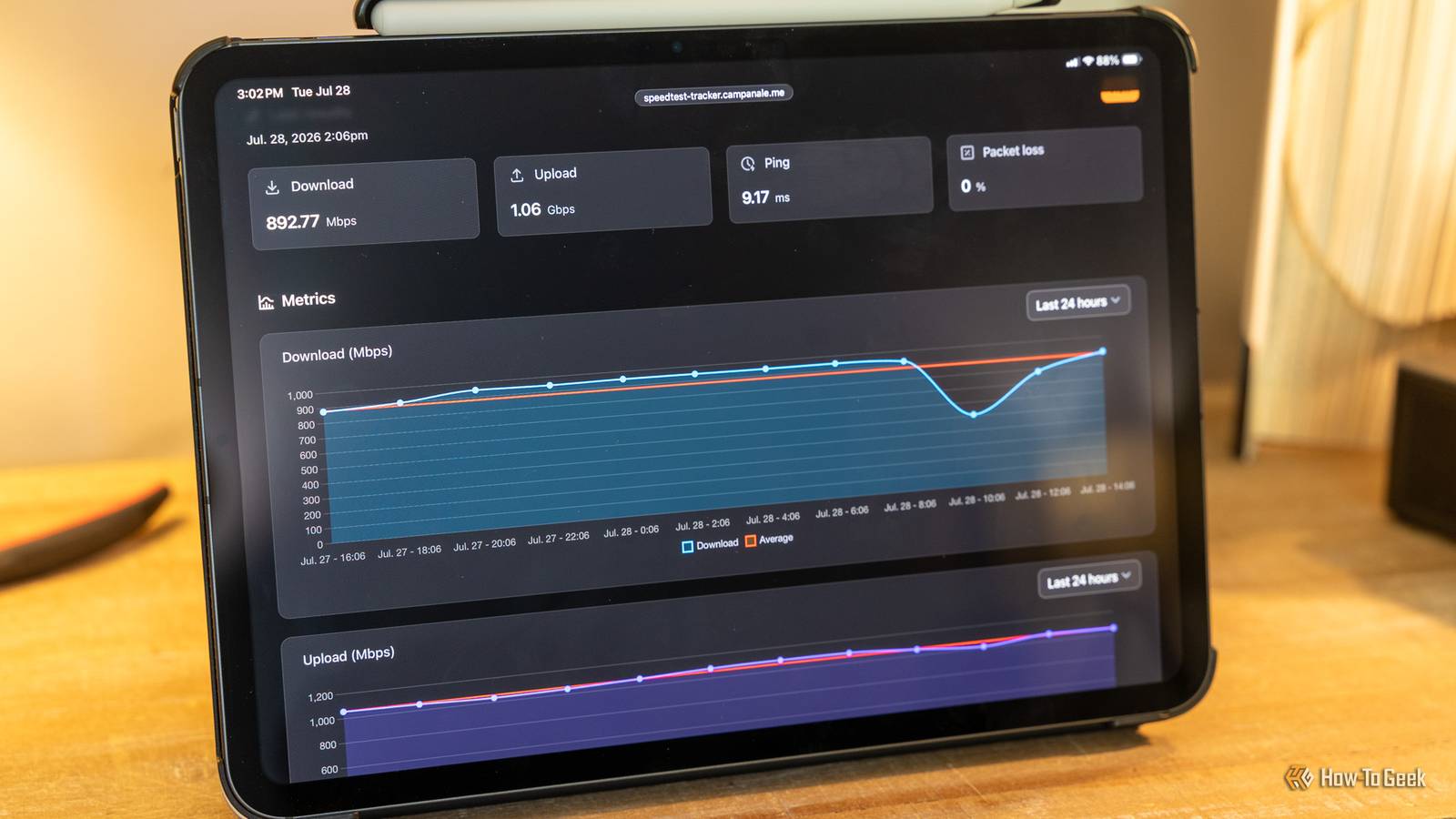
However, there was a pattern that emerged over time.My internet sat right at 930.8Mb/s download, 885.16Mb/s upload, with a 9.86ms ping basically constantly.There were a few blips up and down, but, on average, it was 940/940, which is exactly what I pay for.
That's great, right? Well, it is, except that's not the whole story.The tests show that, starting on April 30th, at 4AM, my network speed would slow down significantly.In fact, on average it slowed down to 152Mb/s download and 455Mb/s upload, which is somewhat surprising given the reason for the slowdown.
You see, at the end of April, I had a major data loss event in my homelab and I started backing everything up to the cloud after that.This backup took months to complete because of how much data there was to move, and it was only doing it in small chunks from 3 to 6AM.I stopped the large-scale backups in mid-June, and that meant my speed tests returned to normal.
In fact, sometimes better than normal, as I'm now seeing upload speeds of up to 1.11Gb/s.Tracking my network over time showed me exactly when things were slowing down, and when they were speeding up, and this is invaluable information to have as a homelabber.Quiz 8 Questions · Test Your KnowledgeHome networking & Wi-FiThink you know your routers from your repeaters — put your home networking know-how to the ultimate test.Wi-FiRoutersSecurityHardwareProtocolsBegin 01 / 8Wi-FiWhat does the '5 GHz' band in Wi-Fi offer compared to the '2.4 GHz' band?ALonger range but slower speedsBFaster speeds but shorter rangeCBetter wall penetration and faster speedsDLower interference but identical speedsThat's right! The 5 GHz band delivers faster data rates but loses signal strength more quickly over distance and through walls.
It's ideal for devices close to the router that need maximum throughput, like streaming 4K video.Not quite — the 5 GHz band actually offers faster speeds at the cost of range.The 2.4 GHz band travels farther and penetrates obstacles better, which is why smart home devices and older gadgets often prefer it.Continue 02 / 8ProtocolsWhich Wi-Fi standard, introduced in 2021, is also known as Wi-Fi 6E and extends into a new frequency band?A802.11acB802.11axC802.11beD802.11nCorrect! 802.11ax is the technical name for Wi-Fi 6 and Wi-Fi 6E.The 'E' variant extends the standard into the 6 GHz band, offering a massive swath of new, less-congested spectrum for faster and more reliable connections.The answer is 802.11ax — that's Wi-Fi 6 and Wi-Fi 6E.
Wi-Fi 6E adds support for the 6 GHz band, giving it far less congestion than the crowded 2.4 GHz and 5 GHz bands.802.11be is actually the upcoming Wi-Fi 7 standard.Continue 03 / 8RoutersWhat is the default IP address most commonly used to access a home router's admin interface?A192.168.0.1 or 192.168.1.1B10.0.0.1 or 172.16.0.1C255.255.255.0 or 255.0.0.0D127.0.0.1 or localhostSpot on! The vast majority of consumer routers use either 192.168.0.1 or 192.168.1.1 as the default gateway address.Typing either into your browser's address bar will bring up the router's login page — just make sure you've changed the default password!The correct answer is 192.168.0.1 or 192.168.1.1.
These are the most common default gateway addresses for home routers.The 255.x.x.x addresses are subnet masks, and 127.0.0.1 is your own machine's loopback address, not a router.Continue 04 / 8SecurityWhich Wi-Fi security protocol is considered most secure for home networks as of 2024?AWEP (Wired Equivalent Privacy)BWPA (Wi-Fi Protected Access)CWPA2 with TKIPDWPA3 (Wi-Fi Protected Access 3)Excellent! WPA3 is the latest and most robust Wi-Fi security protocol, introduced in 2018.It uses Simultaneous Authentication of Equals (SAE) to replace the older Pre-Shared Key handshake, making it far more resistant to brute-force attacks.The answer is WPA3.
WEP is completely broken and should never be used, WPA is outdated, and WPA2 with TKIP has known vulnerabilities.WPA3 offers the strongest protection, and if your router supports it, you should enable it right away.Continue 05 / 8HardwareWhat is the primary difference between a mesh Wi-Fi system and a traditional Wi-Fi range extender?AMesh systems only work with fiber internet connectionsBRange extenders create a seamless single network while mesh systems create separate SSIDsCMesh nodes communicate with each other to form one seamless network, while extenders create a separate networkDMesh systems are always wired, while extenders are always wirelessExactly right! Mesh systems use multiple nodes that talk to each other intelligently, handing off your device seamlessly as you move around your home under one SSID.Traditional range extenders typically broadcast a separate network and can cut bandwidth in half as they relay the signal.The correct answer is that mesh nodes form one intelligent, seamless network.
Range extenders are actually the ones that often create separate SSIDs (like 'MyNetwork_EXT') and can significantly reduce speeds.Mesh systems are far superior for large homes with many devices.Continue 06 / 8ProtocolsWhat does DHCP stand for, and what is its main function on a home network?ADynamic Host Configuration Protocol — it automatically assigns IP addresses to devicesBDirect Hardware Control Protocol — it manages router firmware updatesCDistributed Hosting and Caching Protocol — it speeds up web browsingDDynamic Hypertext Communication Protocol — it secures data transmissionsPerfect! DHCP (Dynamic Host Configuration Protocol) is the unsung hero of home networking.Every time a device joins your network, your router's DHCP server automatically hands it a unique IP address, subnet mask, and gateway info so it can communicate without manual configuration.DHCP stands for Dynamic Host Configuration Protocol, and its job is to automatically assign IP addresses to devices on your network.
Without it, you'd have to manually configure a unique IP address on every single phone, laptop, and smart device — a tedious nightmare!Continue 07 / 8RoutersWhat is 'QoS' (Quality of Service) used for in a home router?AEncrypting all traffic leaving the routerBPrioritizing certain types of network traffic over othersCAutomatically switching between 2.4 GHz and 5 GHz bandsDBlocking malicious websites using a DNS filterThat's correct! QoS lets you tell your router which traffic gets priority.For example, you can prioritize video calls or gaming over a family member's file download, ensuring your Zoom meeting doesn't freeze just because someone is downloading a large update.QoS — Quality of Service — is actually about traffic prioritization.By tagging certain data types (like VoIP calls or gaming packets) as high priority, your router ensures latency-sensitive applications get bandwidth first, even when the network is congested.Continue 08 / 8HardwareWhat does the 'WAN' port on a home router connect to?AOther computers in your home network via EthernetBA wireless access point for extending Wi-Fi coverageCYour modem or ISP-provided gateway to the internetDA network-attached storage (NAS) deviceCorrect! WAN stands for Wide Area Network, and the WAN port is where your router connects to the outside world — typically to your cable modem, DSL modem, or ISP gateway.
The LAN ports on the other side connect to devices inside your home network.The WAN (Wide Area Network) port connects your router to your ISP's modem or gateway — essentially your entry point to the internet.The LAN (Local Area Network) ports are for connecting devices inside your home.Mixing them up can cause your network to not function at all!See My Score Challenge CompleteYour Score/ 8Thanks for playing!Try Again More frequent testing isn’t necessarily better Testing every two hours already used nearly 2.5TB in just over three months Some might test once every hour, or even once every 30 minutes.
That's really not necessary, and it would increase the data usage of your system significantly.Of the 1,236 tests that have run over the past 104 days, I have used approximately 2.42TB of data.Each test takes just under 2GB to run, so you can extrapolate that over a month to know how much data will be used in that timeframe.
With my setup running once every two hours, I'm using approximately 24GB of data per day, or 720GB of data per month.That's a lot of data to use just to log speed test results, but I have unlimited data so I'm not worried about it.However, if you only have 1TB of data usage per month, then running a speed test every two hours would utilize nearly 75% of your data allotment for the month.
Doubling that rate would push it to nearly 1.5TB per month if you ran it every hour.So, testing more frequently isn't necessarily better.Sure, you would get more data points from it, but you'd also be burning through way more data than necessary.
As seen here, just 12 tests per day was enough to show me when my network was suffering, and when it stopped lagging.Historical data can tell me exactly when something changes Since I'm tracking the data, I know when (and if) things change Thankfully, my network slowdowns were my own doing, and they were expected.However, the benefit of having a system like this running is to catch when things operating as they should.
For instance, if your ISP is throttling your network speeds every day at 5PM, even though they're not supposed to, this type of system would catch it.Or, if you notice that you pay for 1Gb/s network speeds, but only achieve that in the overnight hours, then that shows you're not really getting what you pay for.There are a number of things that a system like this could catch, and it only takes a few minutes to set up.
I'd definitely recommend spinning up a Speedtest-Tracker server and having it run periodically on your network.Even three or four times a day would be a good place to start if you're worried about the data usage.KAMRUI Hyper H2 Mini PC Brand KAMURI CPU i5-14450HX Memory 16GB DDR4 Storage 512GB NVMe The KAMRUI Hyper H2 Mini PC features an Intel Core i5-14450HX 10-core 16-thread processor and 16GB of DDR4 RAM.
The included 512GB NVMe SSD comes with Windows 11 pre-installed so the system is ready to go out of the box.$479 at Amazon Expand Collapse Sometimes tracking shows nothing is happening, and other times it's the very thing you need In my case, tracking my internet speed over the past 100 days really hasn't shown much in the way of negative performance.Yeah, I had slowdowns around 4AM, but that was expected as that's when large-scale backups were running.
However, sometimes tracking your network speed can be just the thing you need to get your ISP to fix an issue they're denying.
Read More