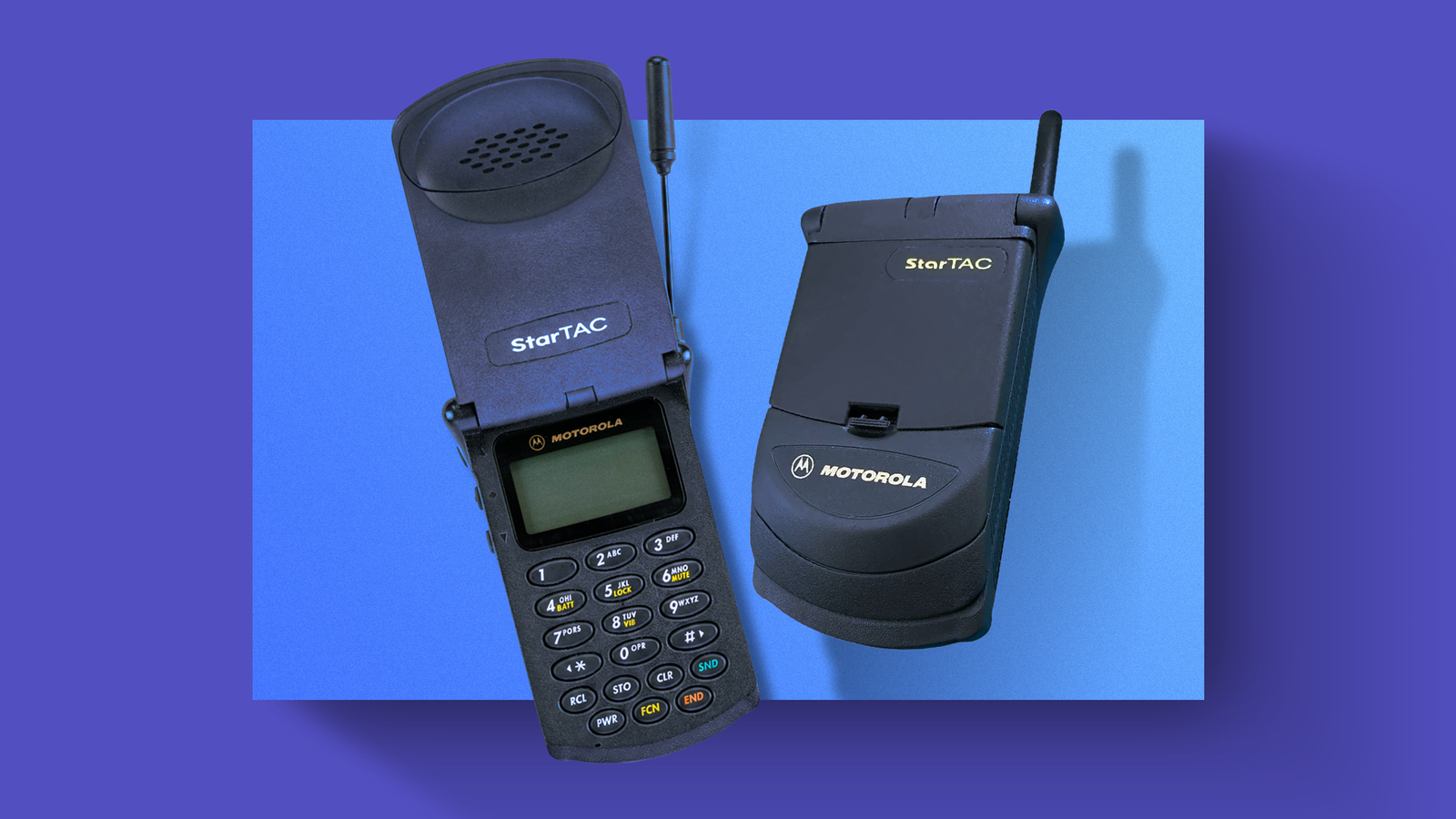
In 1996, mobile phones were not very interesting.My dad had one provided by his employer, and it was this big walkie-talkie thing that charged upright in a chunky charging base.So you could understand that flipping open a magazine and seeing a photo of the Motorola StarTAC felt like someone selling a communicator from to the public.
The StarTAC advanced mobile phones in plenty of ways, but what most people remember today is the form factor.One that went away with the advent of our slab phones, but has been coming back thanks to foldable screens.The StarTAC wasn’t just first—it defined the flip phone The StarTAC is the phone that set the template for what we would later call the "flip phone." At the time, Motorola itself marketed its phone as a "wearable", which is very telling.
The selling point is that this was a mobile phone you could actually wear on your body.You could put it in your pocket, or clip it to your belt.My hand-me-down Nokia phone from high-school in the early 2000s certainly couldn't be used this way.
I had to carry it in my backpack! Of course, such a revolutionary phone wasn't cheap.The StarTAC launched with a cool $1000 price tag.In today's money, that's around $2000, which makes some of the complaints about $1000 flagship super-phones sound a little silly now.
Suffice it to say, it would be many years before I even saw a StarTAC in person.Its design was ruthlessly simple, and that was the point It's not an exaggeration to call the StarTAC the first "fashion phone." It wasn't created by engineers who were only concerned with functionality.The StarTAC was a lifestyle item as much as it was a gadget.
However, part of how Motorola achieved this form factor came down to ruthless efficiency.The StarTAC was advanced compared to other phone of the day, but it was also highly-focused.It had a simple monochrome screen that could show you a few lines of text.
The early models could receive messages, but not send them.While most phones used frankly terrible NiMH batteries, the StarTAC was one of the first phones to offer a lithium-ion battery option.Speaking of things we take for granted today, it was one of the first phones to have a vibration function in addition to a ringer.
Looking at the size, shape, and functionality of the StarTAC, it's now obvious that what Motorola were actually trying to do is create a pager with the capability of making phone calls, but in the process the company created something more than the sum of those parts.Modern foldables solved a different problem—and maybe the wrong one The funny thing is that the hinged folding design of the StarTAC solved a completely different set of problems than folding phones do today.Phones needed to be desperately smaller back then, but no one has any issue putting an iPhone in their pocket.
The StarTAC's hinged design protected the screen, keypad and fragile inner parts of the phone.Modern foldables make phones fragile than if they were just a normal slab.The StarTAC was meant to be a phone that you could keep on you and not baby or worry about until you needed it.
I just can't have that level of peace with modern foldables personally.While people say that foldables offer extra utility, I think the truth is that we have foldables like the Samsung Z-Flip and even the Motorola razr+ as fashion items first and foremost, whereas the StarTAC became a fashion phone as a result of its usability engineering goals.Why the StarTAC still matters As basic as StarTAC was, I think if we're going to bring back the flip phone form factor with any degree of seriousness, there are important lessons to be learned from the StarTAC series.
Subscribe for deeper insights on flip-phone design Explore deeper design lessons by subscribing to the newsletter.Receive focused explorations of StarTAC's legacy, why modern foldables miss the point, and practical takeaways for thinking about pocketable devices and product design.Subscribe By subscribing, you agree to receive newsletter and marketing emails, and accept our Terms of Use and Privacy Policy.
You can unsubscribe anytime.First, the whole point of a flip phone is to offer you more utility.Right now, the only real "benefit" of a folding flip phone is that you halve the length of the phone by doubling the thickness.
Then, you have to add an external screen to allow for access to common, basic actions quickly, because you've caused extra friction by making the phone have a folding sequence in the first place.This is why I think modern flip phones with folding screens are only superficially like the StarTAC and the flood of flip phones that followed, including my own beloved Samsung V200.Despite the high initial price, Motorola sold roughly 60 million units in the series, and it's undoubtedly one of the most iconic, and historically important phones, nay, ever made.
Which is why I can't help but feel that modern folding screen flip phones are missing the point.The StarTAC was (even if by accident) a major turning point in personal communications tech, and the next StarTAC will be a device that achieves a similar level of revolution, not one that tries to bring back something that's had its time in the sun.
Read More