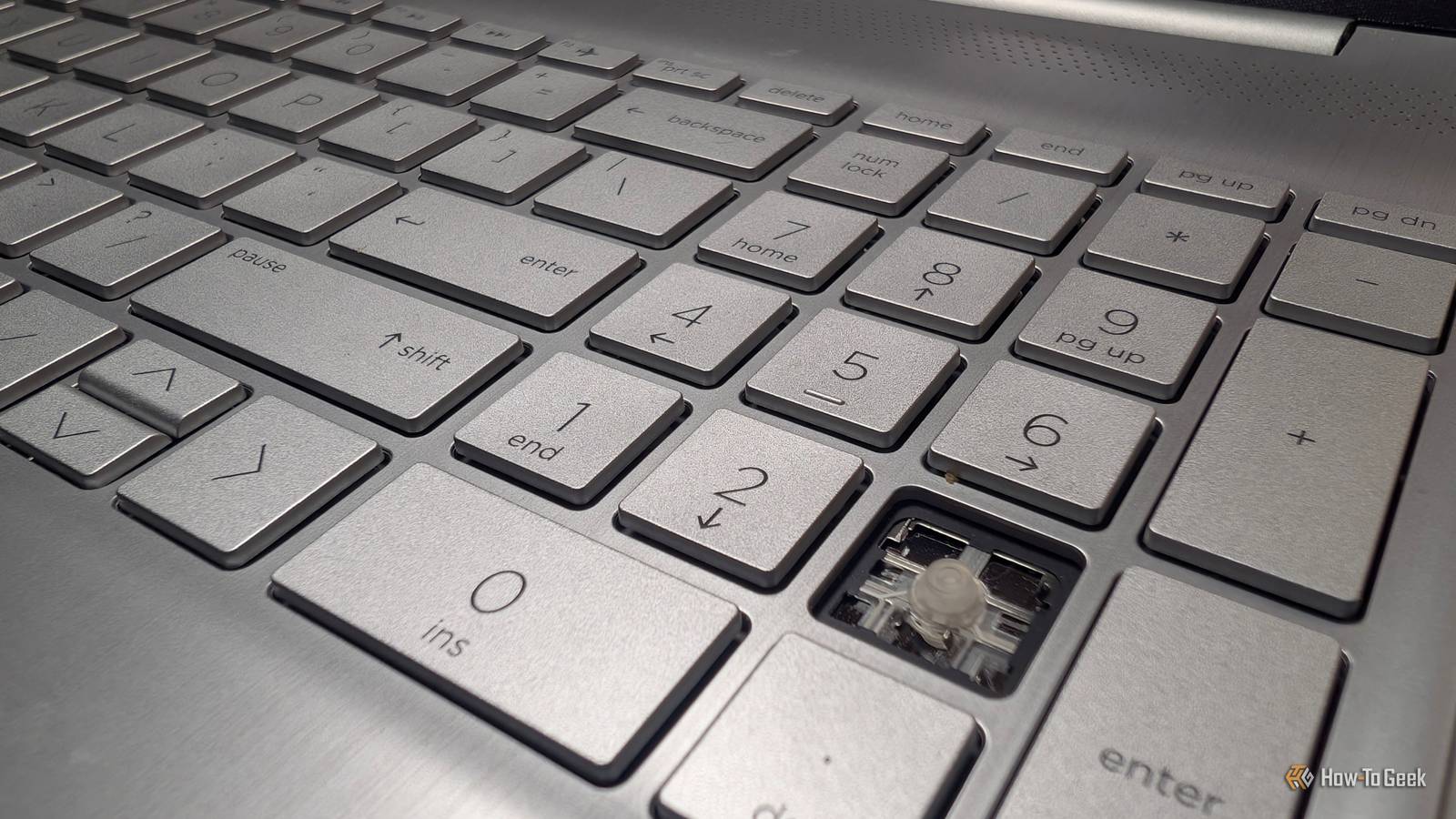
I recently picked up an old laptop off Facebook Marketplace for $150.It has no discrete GPU, a low-power CPU, 16GB of RAM, and a meager 512GB SSD.It isn't exactly the kind of device you look at and think, "Yeah, this will be great for AI," but that is exactly how I've used it.
In April, Google released Gemma 4, one of their open-weight models.Critically, it comes in several variants, two of which are for low-power, small devices like this marketplace rescue.Now, the laptop sits on my home network as an always-on AI box.
I've only just begun to tinker with it, but it was obvious from the beginning that it has real potential, especially given current hardware costs.Gemma 4 has a model for any hardware From an RTX 5090 to a Raspberry Pi Close The Gemma 4 family comes in five sizes, ranging from a 31B dense model (which requires at least 20GB to run) to much smaller variants like the E2B (roughly 2.3B effective parameters) and E4B (roughly 4.5B effective).If you don't have a GPU, the E2B and E4B models are the only ones that are viable.
They were designed specifically for phones and "edge" devices.Despite their size, every version supports native image input, input on the smaller variants, and over 140 languages with up to a 128K context window.That is a remarkable set of features for such small models.
Why the small variants work on old hardware The "E" in E2B and E4B stands for effective parameters.In practical terms, an E4B model runs in roughly 5GB of RAM at 4-bit quantization (usually written Q4), while the E2B fits into even less.Because these models were trained specifically for lower bit depths (4 as opposed to 8), their quality holds up far better than that of other models after heavy quantization.
On a modern multicore CPU, you can expect 5–10 tokens per second for E2B and 2-5 for E4B.It isn't fast, but it is perfectly usable, especially if you don't need results in real time.My laptop acts as another resource on my network A cobbled-together AI homelab Like many things in homelabbing, repurposing a laptop for AI works better if you give up the idea of actually sitting in front of it to use it.
The laptop now runs a headless version of Linux and Ollama, which allows other devices on my network to connect to it over the LAN.So far, I've tested it in a handful of situations with solid results.It is capable of summarizing long documents without hallucinating, extracting structured data from inputs, or classifying files.
I've also used the models' native vision capabilities to try automated image description for image captioning.I tested it head-to-head against qwen2.5vl:7b (the model that currently powers my auto captioning) and found it is comparably good.It is slightly worse at identifying ambiguous software and will sometimes misidentify an app running on Linux as an app running on Windows unless there are strong visual cues that tip it off.
However, for real-world imagery, it is pretty much spot-on.Related Gemma 4 and Qwen 3.6 aren't competing—they're solving completely different problems Your choice between Gemma 4 and Qwen 3.6 depends entirely on where your code runs.Posts 4 By Jorge A.
Aguilar With those few caveats, I've actually found it to be great in that capacity.Batch image captioning doesn't really need to be real time.I can take screenshots or feed it images for whatever I'm working on while I research or test things out and by the time I'm ready to get writing, it has finished processing the images.
Setting up your own AI laptop Ollama is your best friend If you want to try this yourself, I'd recommend installing a very lightweight Linux distro to start.Debian is a good choice; Alpine Linux is lighter, but there are significant compatibility issues that aren't worth the trouble in this specific setup.After that, just install Ollama.
It handles model management and has an API that'll save you the headache of getting everything running manually.Once it is installed, pull whichever Gemma 4 variant matches your RAM.If you have 8GB, use E4B to start; if you have less, use E2B.
Use Google's QAT checkpoints rather than default quantizations to get the maximum quality per gigabyte of RAM.You'll need to manually pull those using Ollama.One critical step is to keep an eye on your context window.
These models technically support 128K, and you may be tempted to move it to the maximum, but don't.It doesn't work well.A more practical cap is around 8K.
After that, enable the setting in Ollama that exposes the API to your network and point your devices at the IP address.AI is getting more efficient For a long time, it felt like the only way to get better AI was to spend extraordinary sums on newer, faster hardware with as much VRAM as possible.However, that isn't really the case.
More development emphasis has been placed on improving the efficiency of AI models so they're more performant on less capable hardware, and it really shows with the Gemma 4 models in particular.An old laptop makes a pretty poor AI workstation, but these days, it is actually a fairly capable AI service on your network as long as you're careful about the jobs you give it and the models that you use.
Read More