
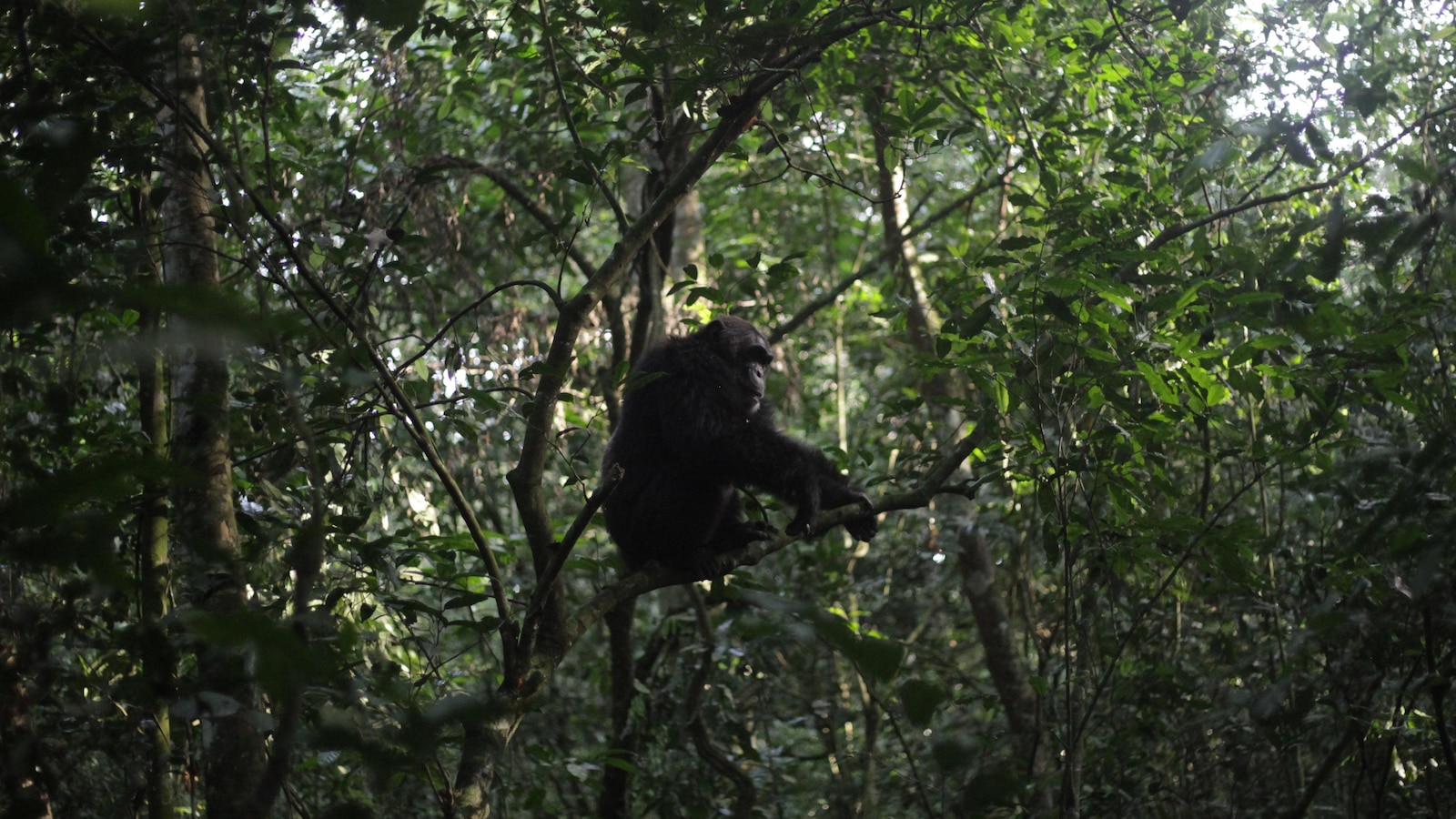
KIBALE NATIONAL PARK, Uganda -- The man tracking chimpanzee movements in a rainforest is required to follow the primates wherever they go — except up in the trees.Onesmas Ainebyona stalks the chimps with such spirtual determination that he's been able to win the trust of a chimp leader named Jean, who came down a tree one recent morning as Ainebyona lingered nearby.“The job requires patience,” Ainebyona said.“Passion also.You have to care." Ainebyona doesn't leave the forest even when it rains.
“You accept," he said."The rain must beat you, but you can’t desert the chimp.” The rainforest in western Uganda is part of Kibale National Park, a protected area described by some as the world's primate capital.Species range from colobus monkeys to chimpanzees, a major tourist attraction.But tourists can't be taken to track wild chimpanzees, which flee deeper into dense patches of montane forest and are known to be violent during clashes over territory.
Instead, rangers lead tourists to one of three groups of habituated chimps, with numbers ranging from dozens to more than 100 in a group.Chimps in Kibale now number at least 1,000, many of them wild.“Jean is my friend,” Ainebyona declared one recent morning as some tourists gathered nearby.The strong and flamboyant chimp in his 20s lay on his back and put his feet up.
The connection between Ainebyona and Jean was sealed in July when the chimp showed up one day with a wire snare pressing his hand, an injury that risked severing a finger.Ainebyona was among those who removed the wire, which Jean picked up when he strayed outside the forest to steal sugarcane.Ainebyona is among four men working in shifts as chimp habituators with Jean's group.When the chimps rest, the men crouch in mud nearby.
When the primates go hiking, they trek alongside them, sometimes even grunting like them.Ainebyona carries binoculars and takes note of what he sees.The goal is to increase the chimp numbers and extract more tourism revenue.At Kibale, a permit to track chimps costs a foreign visitor $250.Tourist guide Alex Turyatunga told The Associated Press that the habituation process is enlightening.
He and his colleagues have been trying to fully habituate the Kisongi group for more than a decade, he said.“We try to learn about these chimpanzees, but they also try to learn about us,” Turyatunga said.Popular ReadsTrump backtracks on releasing boat strike video, distances himself from controversyDec 9, 5:03 PMCharges upgraded to murder in hospital stabbing of San Francisco social workerDec 9, 9:23 PMTrump admin live updates: Trump pardons former entertainment exec indicted by own DOJDec 4, 6:23 AMHabituators like Ainebyona must show a willingness to interact closely with chimps, said Ankunda Viola Ariho, Kibale's tourism warden.“We look at the attitude.That’s very important,” she said, speaking of habituators.
“You are not going to work doing this job, if you don’t like what you’re doing.”Kibale National Park received enhanced protected status in 1993 after the forest had been encroached upon by hundreds of people who built homes there and felled trees for firewood.The park is now thriving, thanks in part to the habituation efforts that make it possible for tourists to contribute directly to chimp conservation.Chimp habituation can open up research opportunities that wouldn’t otherwise be possible, and Kibale is home to one of the longest-running field stations in the tropics, said David Morgan, who co-directs the Goualougo Triangle Ape Project in the Republic of Congo.“If chimps don’t want to be seen, they’re incredibly good at disappearing,” said Morgan, who also is a chimpanzee and gorilla expert at the Lincoln Park Zoo in Chicago.
Chimp habituation and related tourism can improve how the public interacts with the apes, he said.Turyatunga takes a walkie-talkie when he ventures into the forest, now and then asking habituators if they have close and clear views of chimps.That’s because chimps, even when habituated, are more likely to be seen up in the trees.“You listen for early morning calls when they are getting out of the nests.Then present yourself to the chimps — they see you are there, that’s all,” he said.
“Keep with them.If they move, follow them."___Holly Meyer contributed to this report from Nashville, Tennessee.___Associated Press religion coverage receives support through the AP’s collaboration with The Conversation US, with funding from Lilly Endowment Inc.
The AP is solely responsible for this content.


