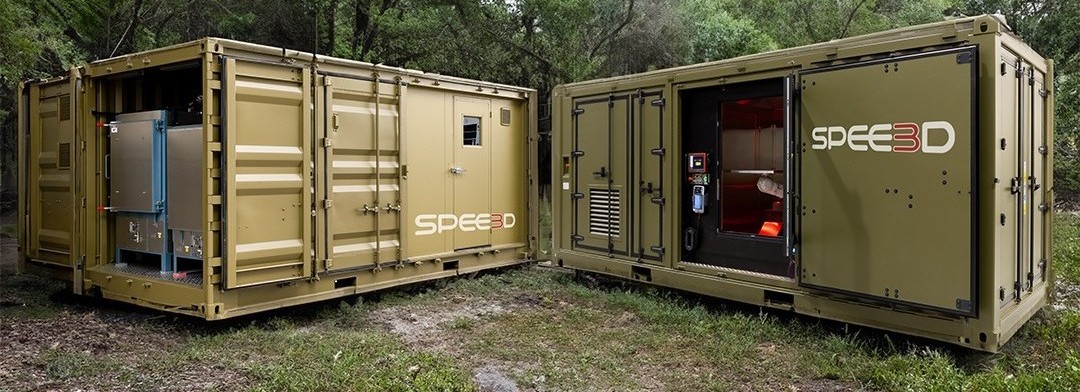
A couple of years ago, in the title of an interview I did with the CEO of SPEE3D, Byron Kennedy, I referred to SPEE3D as “the most American 3D printing company.” I partially did this to be provocative to companies that are actually based in America — SPEE3D was founded in Australia — but I also think the company is the epitome of the way that the US defense sector has been changing in recent years, a shift that has been deeply integrated with rising metal AM adoption.Additionally, at the time, the company had just opened its first physical US presence, a combined applications testing site and assembly operation in New Hampshire.Now, SPEE3D is doubling down on its focus on the American market by naming Bryan O’Connor the company’s global CEO, with Kennedy (also one of the company’s co-founders) moving to the US to support its continued American expansion.
It’s not clear yet what Kennedy’s exact role will be in the US, and while it’s impressive how much traction the company has made in the country thus far with basically just a skeleton crew on the ground, SPEE3D will certainly benefit from a more robust American footprint.Meanwhile, O’Connor comes to the company with many years of experience at Moog, most recently as the company’s General Manager in the Asia-Pacific region for Space and Defense.Thus, O’Connor is familiar with managing the Indo-Pacific side of things for a company embedded in the US defense supply chain, making him a perfect fit for SPEE3D’s objectives.
The cold spray OEM recently executed its first mobile expeditionary manufacturing demonstration at RIMPAC 2026, a pivotal milestone for an AM ecosystem that has been working towards precisely that goal all through the 2020s.SPEE3D’s new global CEO, Bryan O’Connor The leadership restructuring happens against the backdrop of uncertainty related to AUKUS, the trilateral defense pact between Australia and the two other countries whose names appear in the acronym.A 12-week public inquiry that was, curiously enough, crowdfunded, because the government itself refused to investigate the deal, centered upon nuclear submarines but also involved a whole bunch of other deep tech collaboration.
All that aside, SPEE3D seems to be relatively insulated from any of the AUKUS chaos.The company has close ties to both the US Army and the US Navy, not to mention other key US military allies.Western militaries and their partners appear very intent on making SPEE3D’s technology work, and the company has repaid that confidence with a tireless dedication that’s well exemplified by Kennedy’s move to the US.
One detail in this announcement that could prove to be important is O’Connor’s background with industrial automation, as general feedback from US military customers indicates that this is a growing need amidst increased adoption of AM and other advanced manufacturing technologies.Even more importantly, O’Connor oversaw Moog’s Asia-Pacific operations at a time when the company was massively expanding its Australian presence, illustrating that he knows how to navigate growth cycles while simultaneously working with multiple different national governments on the most strictly regulated industrial projects.The most underappreciated aspect of reshoring is that it may require even more cooperation between nations than the system that it is replacing, in order for it to be effective.
In no small part, SPEE3D’s success is tied to its intimate understanding of this dynamic.Images courtesy of SPEE3D Subscribe to Our Email Newsletter Stay up-to-date on all the latest news from the 3D printing industry and receive information and offers from third party vendors.Print Services Upload your 3D Models and get them printed quickly and efficiently.
Powered by FacFox Powered by 3D Systems Powered by Craftcloud Powered by First Mold Powered by Xometry 3DPrinting Business Directory 3DPrinting Business Directory
Read More