You might think that storage is expensive and scarce today, but kids these days have no idea what it is like to scrounge every kilobyte you can.Which is why a floppy disk hack from the early '90s promising twice your data seemed too good to be true.In a lot of cases, it was.
When 720KB was the bottleneck 720KB should be enough for anyone By the early '90s, 1.44MB floppy disks (so-called were already a few years old, having come to the market in 1987.However, the standard 720KB "double density" disks were still the most common, partly because they were cheaper, and partly because not everyone had upgraded to HD floppy drives yet.Incidentally, IBM had a 2.88 MB floppy variant, and there was even a 13MB triple-density floppy (as covered by Adafruit) but at the time I thought 1.44MB was as good as it could get.
720KB certainly felt too tight by 1992.Consider that one of the pictures of floppy disks above wouldn't even fit on a 720KB disk, and that gives you an idea of how tight it is by modern standards, but back then apps and media files were growing.In particular, large applications like operating systems, games, and office apps came on multiple disks.
Doubling the size from 720KB to 1.44MB is the difference between a dozen disks and 24 of them! The tiny square hole that controlled everything The '90s were basically controlled by tabs Look at the two floppy disks below.The blue one is a double-density disk, and the yellow one is high-density.Notice a difference? Close The blue disk only has one square hole at the bottom, and the yellow disk has two.
One on each side.This is the density-detection hole.If the hole is there, the drive switches to HD mode and treats the disk like any 1.44MB floppy.
This means the formatting parameters are different, and it will write the bits packed more tightly.Now this is a good time to cover what the actual differences between these disks are.On an HD disk, the magnetic coating is made from a different material.
Usually cobalt-doped iron oxide.This is what allows the disk to have its bits packed more tightly.However, this isn't strictly necessary, it's just that the coating on the HD disks made them reliable for this purpose, and ensured that any HD drive could read the data.
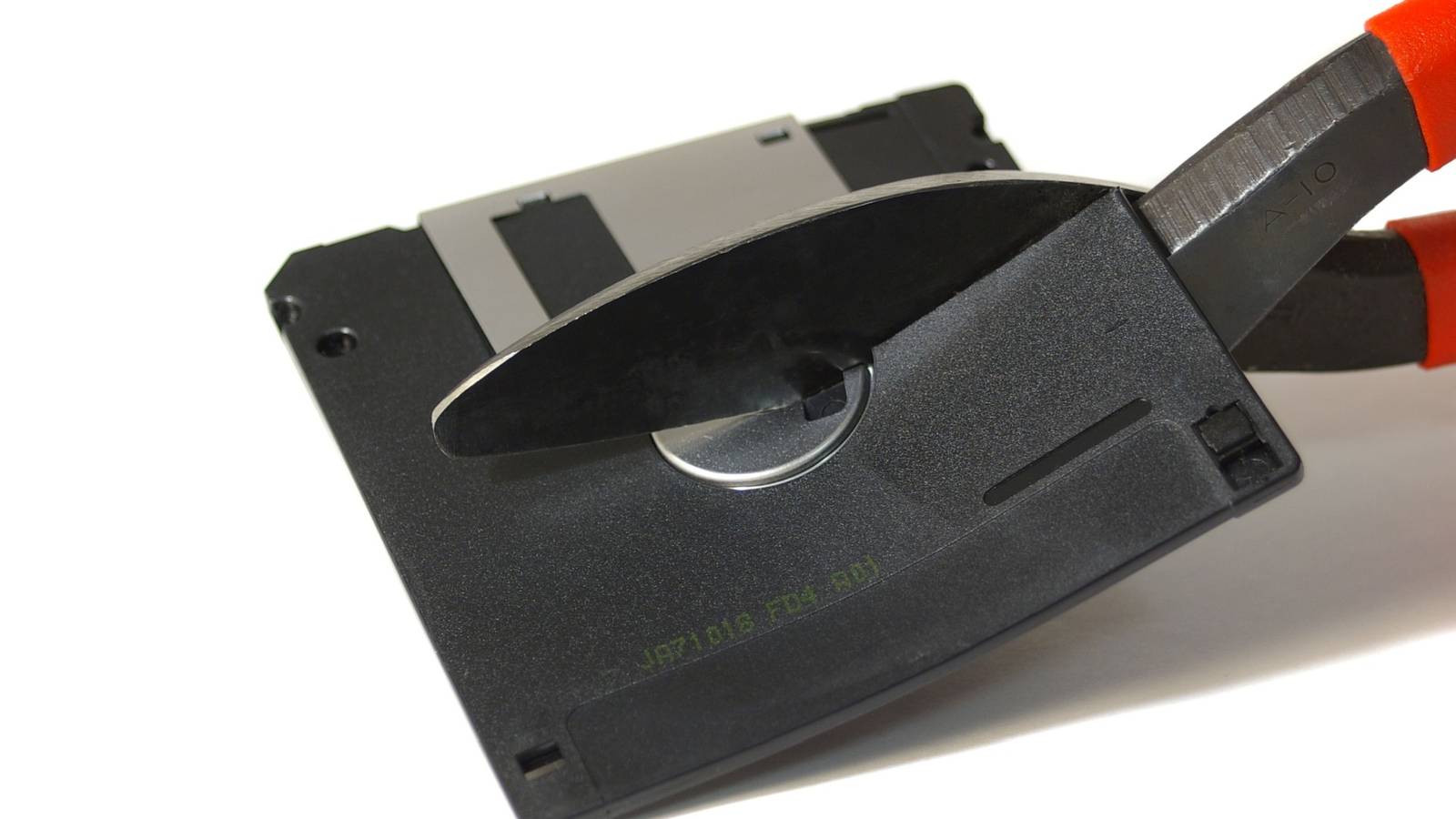
The scissors hack that “created” 1.44MB disks The real double disk However, if you were lucky, your DD disk handled the extra density just fine, and as long as you didn't store crucial data there with no backups, reliability could be managed.All you had to do was carefully cut or punch a square hole in the same spot it would be on an HD disk.That's it, from there just insert the disk into the drive and treat it like any HD disk.
As you can see from the image below, the hole is literally just a bit of removed plastic.The actual data surface isn't anywhere near it, so it's not something that you could easily get wrong.Why it sometimes worked — and why it shouldn’t have Man was not meant to wield such power If you had luck on your side and did everything right, you'd double your data capacity on that floppy, but as time goes by the risk of data loss increases.
The coating on the DD disk might not preserve the data and it can become corrupted.Subscribe to the newsletter for vintage tech stories Hungry for more hands-on vintage tech coverage? Subscribe to the newsletter for deep dives into hardware hacks, restoration tips, and the engineering stories behind classic devices — plus broader tech history and curiosities.Get Updates By subscribing, you agree to receive newsletter and marketing emails, and accept our Terms of Use and Privacy Policy.
You can unsubscribe anytime.However, as anyone who lived through the era of floppies will tell you, these things were super-fragile at the best of times anyway.I still remember the day I finally said goodbye to floppy disks for my computer science homework, because I was sick of losing that homework for no apparent reason.
I blew a whole month's pocket money on a 64MB flash drive and never lost my homework again.The older hole-punch trick that really did unlock hidden storage This has happened before, and it will happen again The scissor trick for 3.5-inch floppies isn't the first time people have literally hacked more space from their disks.The older, larger, and much floppier 5.25-inch disks also had a trick you could do with a punch or scissors.
In the 1980s, some floppy disks were sold as single-sided, but they had magnetic coatings on both sides.The only thing that prevented you from using the other side was a notch, or rather the lack of one.In this excellent video by the 8-Bit Guy you can see how adding a notch lets you flip over the disk and write to the other side.
There were even dedicated tools sold to make this easy and reliable to do, but again, if you were careful, you could get the same result just using a plain old pair of scissors.Take that Big Floppy!
Read More