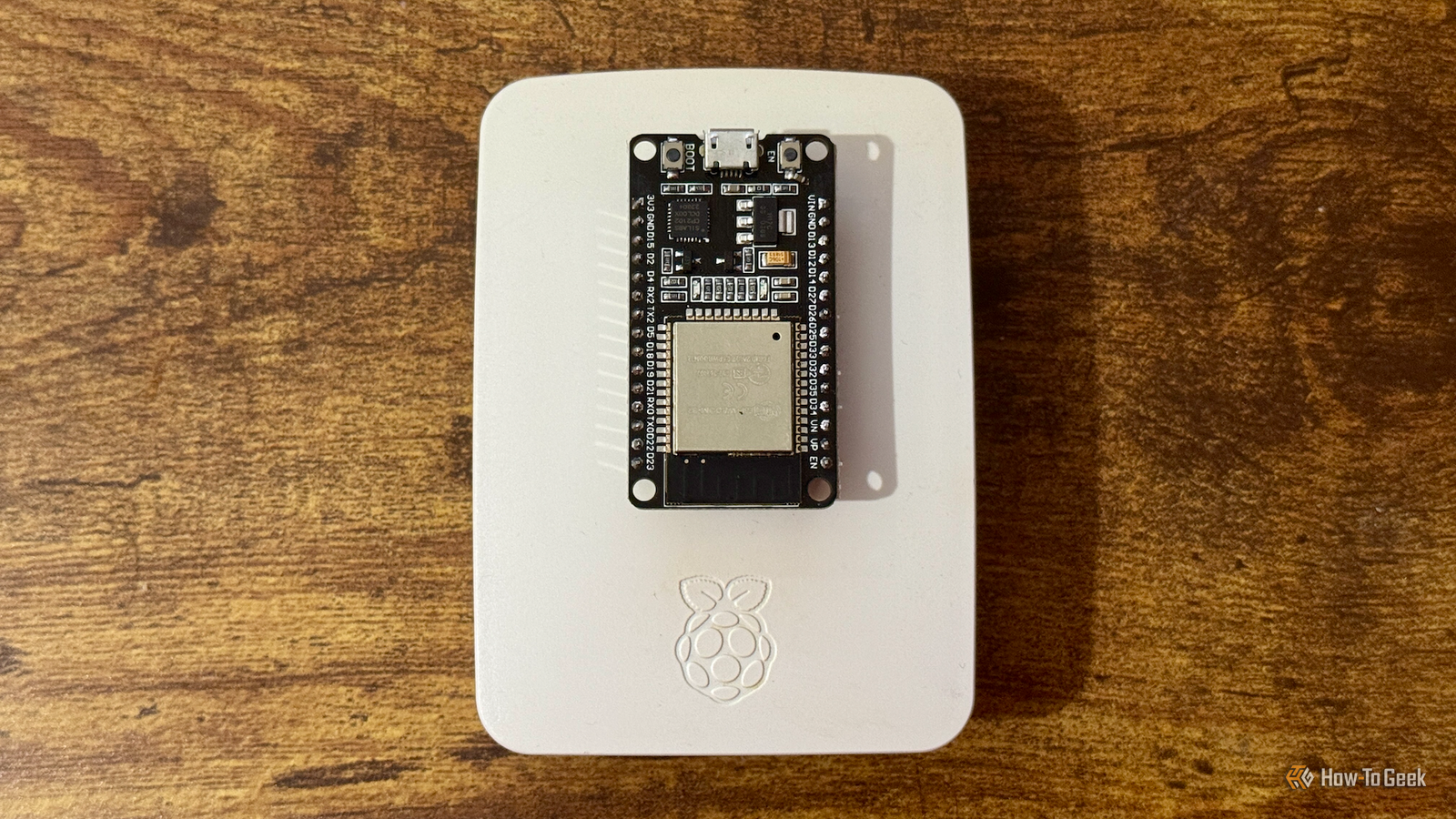
Raspberry Pis have been popular devices for DIY projects for years.They're ideal for many tech projects, but they're not always the perfect choice.There are many projects where a cheap ESP32 board is a better option, and the benefits go beyond the much lower price.
Building battery-powered door or window sensors A Pi can't match the deep sleep of an ESP32 ESP32 boards are great for building your own sensors.You can often create working smart home sensors for a fraction of the price of buying a ready-made sensor.You can build sensors using Raspberry Pi models too, but there's one area where the ESP32 is the clear winner.
Some sensors aren't ideal for connecting to power.Window and door sensors, for example, need to be placed on the windows or doors, and it's not always practical to use power cables in these locations.Using batteries is often a more sensible solution.
These sensors spend most of their time doing nothing.It's only when a door or window is opened or closed that they need to report home.An ESP32 can enter deep sleep when nothing is happening, significantly reducing how much power it uses.
When the reed switch changes state, the GPIO event can wake the ESP32 so that it can report the change and then go back to sleep.In comparison, a sensor built using a Raspberry Pi can be configured to halt and wake through GPIO, but it's not the same as the ESP32's deep sleep.When the Pi wakes up, it has to go through the boot process, load the operating system, reconnect to the network, and start the appropriate software.
This results in a significant delay before the event is reported.You can keep Linux running to reduce this delay, but this requires the Pi to maintain continuous power.Even a Raspberry Pi Zero will draw a reasonable amount of power when idling, making battery power far less practical.
Related 5 ways to use a Raspberry Pi with Home Assistant (aside from running your server) It's time to repurpose your old Home Assistant server.Posts 2 By Adam Davidson Extending Bluetooth coverage ESPHome makes an ESP32 an ideal Bluetooth proxy Close One of the simplest ways to use an ESP32 is as a Bluetooth proxy.Placing a Bluetooth proxy within range allows your smart home to communicate with Bluetooth devices that are too far away from the main smart home hub to talk directly.
Instead, the signals are passed back and forth over Wi-Fi to the Bluetooth proxy, which then communicates with the Bluetooth device over a shorter distance.You don't need any additional hardware to use an ESP32 as a Bluetooth proxy, since many ESP32 boards come with built-in Bluetooth and Wi-Fi.Setting one up is also easy to do; ESPHome has ready-made Bluetooth proxy firmware that you can flash to your ESP32 without having to write a single line of YAML.
You can use a Raspberry Pi as a Bluetooth proxy, but it's likely to be overkill if that's all the device is doing.In addition, there are some potential issues with using Bluetooth on Linux that ESP32 boards don't have.Home Assistant's documentation mentions that Linux kernel updates have previously broken Bluetooth functionality, and that Linux Bluetooth driver support can often lag behind other operating systems for newer hardware.
The documentation states that in many cases, a better approach is to use an ESP32.There is a list of ESP32 devices that work well as Bluetooth proxies.Controlling addressable LED strips using WLED Linux makes control more complicated Addressable LED strips are a common choice for smart-home lighting projects.
These strips contain multiple LEDs which can be controlled independently to produce impressive lighting effects.The strips don't work on their own; you need something to control them.Running WLED on an ESP32 turns the cheap board into a network-accessible LED controller that can display different lighting scenes and effects and is controllable via Home Assistant or a web interface.
You can control addressable LED strips using Raspberry Pi models, but there are several issues that you don't get with an ESP32.These LED strips require precisely timed control signals, which a Raspberry Pi running ordinary software on Linux can't do all that well.It often requires the use of specialized libraries or hardware-assisted methods to ensure that Linux doesn’t get in the way of accurate timing.
There are often secondary issues.For example, some methods of controlling LEDs via a Pi can interfere with the Pi's onboard audio.An ESP32 is much better at handling precisely timed hardware tasks in a predictable way.
Making capacitive-touch smart buttons Touch is built into many ESP32 chips Automation is great, but sometimes you need a way to control smart home devices manually.Smart buttons make an excellent choice, and you can build a physical smart button using an ESP32 or a Raspberry Pi.One thing a Raspberry Pi can't do is let you easily make a capacitive-touch-controlled smart button.
Some ESP32 chips have capacitive-touch sensing built in.All you need to do is connect a conductive surface such as copper tape to a touch-capable pin on the ESP32, and the board can detect the change in capacitance when your finger touches or nears the surface.You don't even need to physically touch the surface.
Capacitive touch sensing can work through thin non-conductive materials such as glass, plastic, or wood.You can hide the smart button under a surface and control your smart home just by placing your finger in the right location.Raspberry Pis don't have the same capacitive-touch sensing hardware.
If you want to achieve the same goal with a Pi, you need to add additional components to detect the touch and pass the information to the Raspberry Pi.The benefits of an ESP32 aren't just the price An ESP32 board can cost just a few dollars, while many Raspberry Pi models have become increasingly expensive in recent months.The benefits of using an ESP32 aren't simply the price; there are plenty of situations where it's the better hardware for the task.
Read More