Every weekday morning I wake up to a daily brief prepared for me by Claude with what that day will hold.Tasks, calendar appointments, upcoming todos, even what emails need my attention, all waiting at my desk before I ever step into the office.This has changed how I work and improved my productivity, and here's exactly how you can steal it.
Add How-To Geek on Google Add as Preferred Source Follow on Google Discover Every weekday, Claude reads my Todoist before I do It was told to be calm and opinionated, not thorough I have used Todoist for well over a decade now, but my one struggle is remembering to check the app after I put something on my list.I'll add tasks to various projects, even assign dates, and then just completely forget to open it again to see what I've done or what's still left to do—I just do it all by memory.This also means my list often goes stale.
I'll finish a lot of what's on the list, and then the "due" number grows bigger and bigger and I just get overwhelmed with it (thanks ADHD), so I check the app .This isn't a Todoist problem—it's a me problem.I juggle a lot of projects, between my writing here at , my small business, the multiple social media channels I run, managing the IT at my church, and many other tasks that I can't even think of right now.
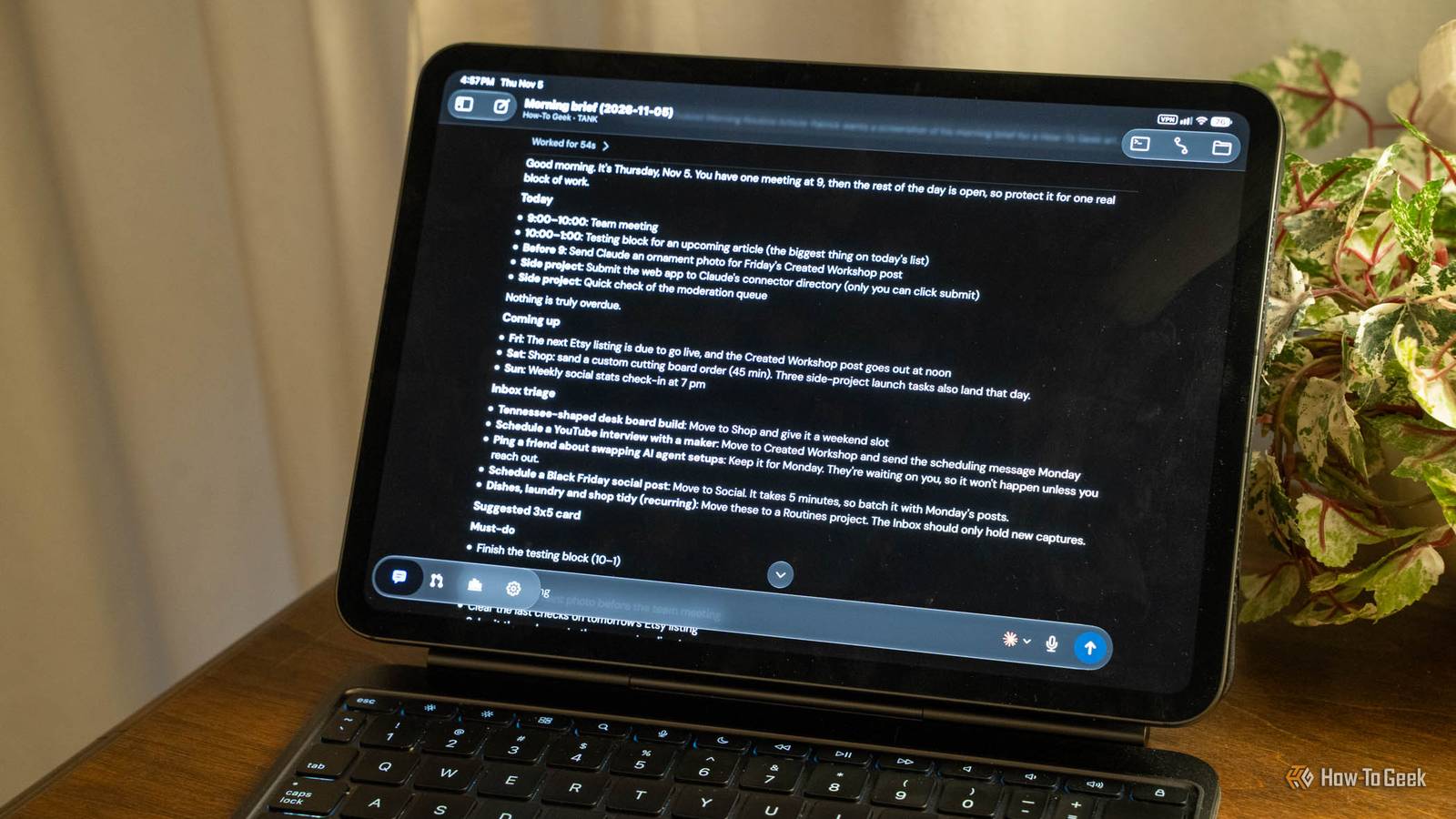
Often, someone with this much on their plate will hire a VA (virtual assistant), but I can't afford one of those, so I decided to do the next best thing—make my own with Claude.Every weekday morning, I wake up to a message from Claude in a new thread that goes over a few things that I have coming up that day.It starts with telling me what's overdue as well as what's due that day.
Then, it gives me a quick overview of what I have coming up over the next three days.I really love the next part of what I've built: it looks at my entire list to see if there is anything I need to watch out for that could creep up on me or that might not have had a date assigned to it.This makes sure that I don't ever miss something that I have put a date on.
If something is already done, Claude can clean it up for me It's like a real-world assistant Claude doesn't just look at what's currently on my Todoist.It can also check what should be marked as completed already.I do all of my writing in Obsidian, which stores files locally on my computer.
Claude has read access to those folders and can see when something is inside of my "In Progress" folder or my "Published" folder.It also has read-only access to my email accounts (I still don't trust AI enough to give it write access to email).With these capabilities added to Claude, it can actually take a look at my Todoist list and see if I've already done some stuff that was on it.
If I have a due article that's marked as published, then it can likely be checked off.Email tasks that I've already taken care of? Those can likely be checked off, too.While I could have Claude automatically check those things off for me (and I might do that in the future), right now it just flags them with things like, "It looks like you published this article/review and already followed up on this email, would you like me to complete those tasks for you?" This can also cause it to create follow-up tasks for me by suggesting them, and then I tell it to either create the task or ignore it.
For instance, if I'm working with a new partner for my maker YouTube channel, and we're talking about an upcoming video, Claude can see that I replied to them (which was a task in my Todoist) and then suggest a new task to follow up in a week if I haven't heard back yet.This level of assistance is exactly what I need.I need someone or something that can look at my list, look at what I've done, complete the stuff I have done when I tell it to, and suggest new things to do based on what I have coming up—and Claude does this perfectly.
It hands me my top priorities for the day to write on a 3x5 card My physical list always starts out as a digital list Close Years ago, I designed a desk accessory that I go on-again and off-again with frequently.It's a little wooden tray that holds 3x5 task cards (which I also designed) to give a more physical way to stay on top of tasks and things to do.So, when I'm on-again with the physical paper task system, I can have Claude give me a breakdown of what I should do that day.
My one must-do, two to four should-dos, and a few easy wins.I've designed Claude to triage my task list and it essentially knows how I think, so it does pretty well with organizing the list into the stuff that needs to go on my physical list for me.Sometimes I disagree with it, just like a normal assistant, but I can pretty easily work through that with Claude via a quick conversation and come out with what should go on my list for the day.
Want to copy my setup? Here's the prompt My setup has evolved a lot over the several months that I have been using it.I have actually used variations of this setup with Codex, OpenAI's dots, Hermes, xAI's Grok Bot, and others, so it's extremely portable so long as whatever you're using has the connectors you need.But, as it stands right now, here is exactly what you would need to copy my morning brief setup.
Every weekday morning, act as my personal assistant and prepare a short, calm, opinionated morning brief.This is a plan for my day, not a dump of my Todoist list.What you can access: - Todoist (read my tasks, projects, and Inbox) - [My calendar], read-only - [My email], read-only.
Never send, draft, archive, or delete email.- [My writing folder], read-only.Files in [In Progress] are unfinished; files in [Published] are done.
Don't change anything in Todoist on your own.Only complete, create, move, or reschedule tasks after I approve it in our conversation.Before you write the brief: 1.
Read my Todoist Inbox, overdue tasks, tasks due today, and tasks due in the next 3 days.2.Read today's calendar so you know my fixed appointments and open time.
3.Check for work I may have already finished.For each open task that looks like writing or an email: - If a matching file is in my [Published] folder, the task is probably done.
- If I've already sent the reply or follow-up the task describes, the task is probably done.Only flag a task as done when the evidence clearly matches it.If you're unsure, leave it alone.
4.Look for follow-ups I'll need.If I replied to someone about something still in progress (a partner, a client, a collaborator) and there's no follow-up task, suggest one about a week out, so I can check back if I haven't heard anything.
How to judge what matters: - Respect dates I've deliberately pushed out.A due date by itself isn't a reason to bring something up.- Don't list something just because it's high priority or undated.
- Do point out anything that could sneak up on me: a task with a real deadline but no date, a commitment with no next step, or something that's due soon but needs prep starting now.Write the brief in this order, and leave out any section that has nothing in it: 1.One line saying good morning, plus the shape of my day.
2.Overdue and due today: only what matters, each as "Task — Project".3.
Coming up: the next 3 days, only meaningful items.4.Watch-outs: things that could creep up on me or should have a date.
5.Looks done: tasks I seem to have already finished, with the evidence for each (the published file or the sent email).Ask whether I want you to complete them.
6.Suggested follow-ups: new tasks you'd add, each with a suggested date.Ask before you add any.
7.Inbox triage: a recommended project, date, or next step for every Inbox task.Don't move anything yourself.
8.Today's 3x5 card: 1 must-do, 2 to 4 should-dos, and a few easy wins, fit around my calendar.Keep the whole brief readable in under a minute.
If a source fails, say which one and keep going with the rest.
Read More