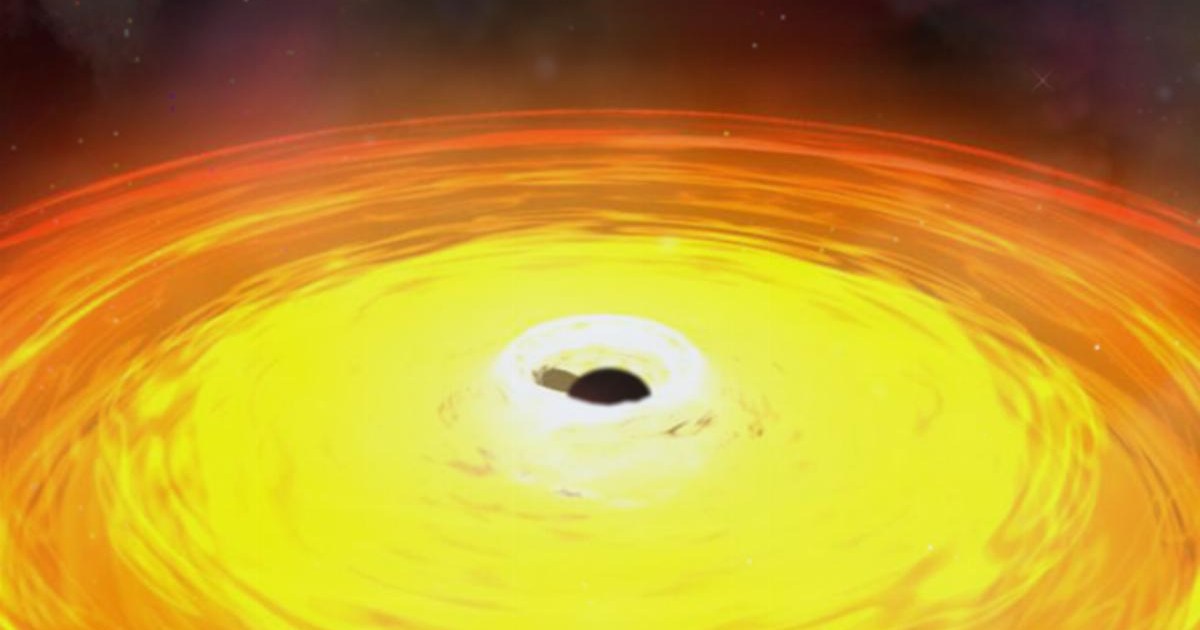
Astronomers have identified what appears to be two supermassive black holes that could collide within a century, sending out huge gravitational waves that will be felt on Earth.The bizarre event, which sees the two black holes engaged in a ‘death spiral’ that will eventually result in a spectacular merging, is located in the galaxy Markarian 501 around 500 million light-years from Earth.It had previously been classified as a blazar — a bright galactic core typically powered by a single black hole.
However, a new analysis of decades of radio telescope data suggests a more complex picture.Researchers found evidence of not one but two powerful jets of particles emerging from the galaxy’s core.Each jet is believed to be driven by a separate black hole, with masses estimated at between 100 million and one billion times that of the Sun.
The findings, published in the journal Monthly Notices of the Royal Astronomical Society, indicate that the two black holes orbit each other roughly every 121 days.They are separated by a distance of just 250 to 540 times that between the Earth and the Sun — extremely close given their immense size.Trending Now Trump stopped from ‘accessing nuclear codes' in furious row US 22 hours ago By Sarah Hooper First 24-hour Tube strike ends but Londoners warned of major disruption Mum asks for prayers for influencer still fighting for life after being run over in Soho Veteran 'who served his country' beaten to death in Hull city centre 'assault' Further support for the binary black hole theory came from observations in June 2022, when the alignment of the system caused light from one jet to be bent by the gravity of the foreground black hole, forming what is known as an Einstein ring.
This effect strengthened the case that two supermassive black holes are present.Scientists say that when the pair eventually merge, the event will generate powerful gravitational waves detectable from Earth— far stronger than those previously detected from smaller black hole collisions.Such a merger would offer a rare opportunity to study extreme physics on a cosmic scale, although any direct effects would remain far beyond Earth, so we are safe for now.
MORE: How to see the Lyrid meteor shower in the UK as it peaks today MORE: Artemis II astronaut films Earth setting behind the moon with just his iPhone MORE: World’s oldest iceberg is no more: A23a melts into puddle of water after 40 years Comments Add as preferred source News Updates Stay on top of the headlines with daily email updates.This site is protected by reCAPTCHA and the Google Privacy Policy and Terms of Service apply.Your information will be used in line with our Privacy Policy HomeNewsTech Related topics NasaSpaceSun How to see the Lyrid meteor shower in the UK as it peaks today Tech 19 hours ago By Sarah Hooper Nasa unveils plans for permanent £15,000,000,000 base on the Moon Tech April 14, 2026 By Liz Hazleton
Read More