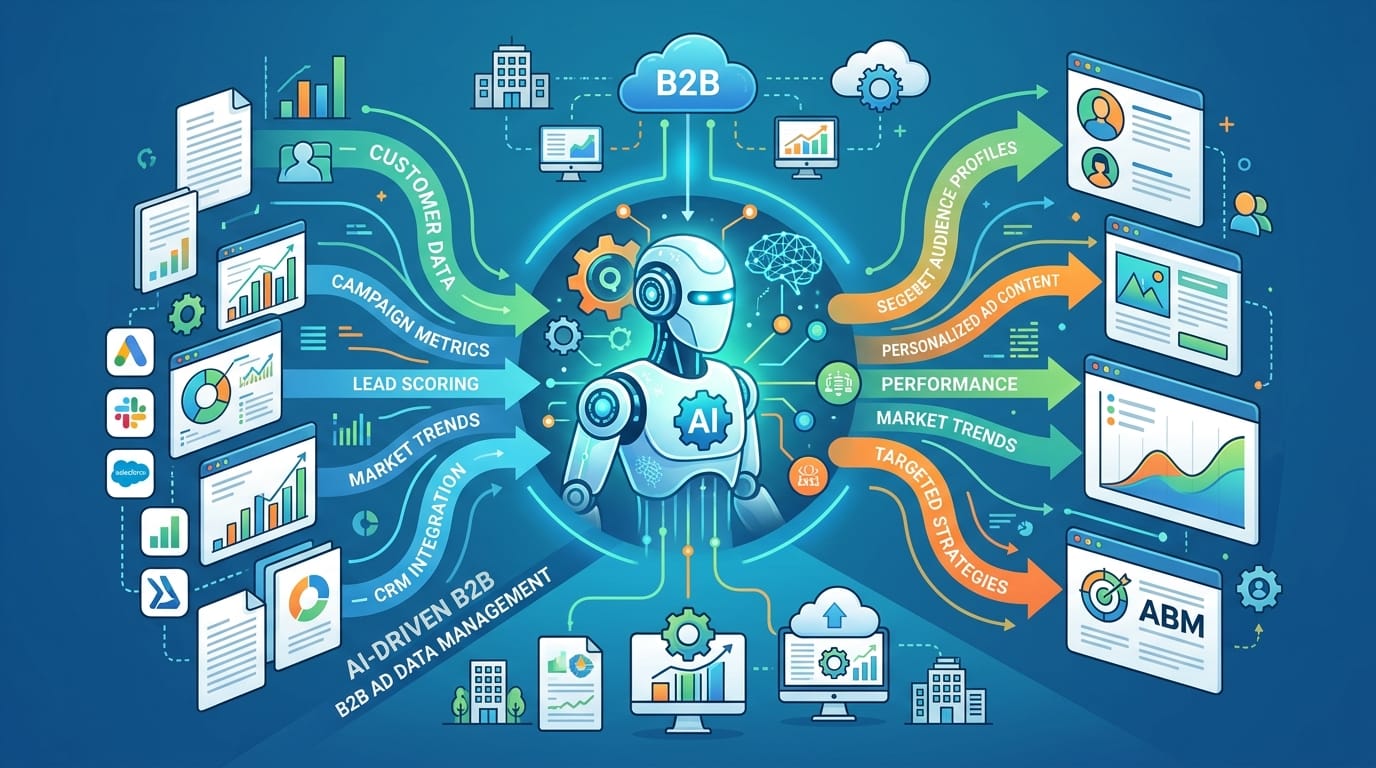
AI agents in marketing are taking over the least visible, most time-consuming part of B2B advertising: managing the data itself.Instead of analysts exporting, cleaning, and stitching together campaign reports from a dozen disconnected platforms, autonomous agents now handle those workflows inside the marketing stack — and act on what they find.The adoption curve is already steep: McKinsey’s 2024 State of AI survey found 65% of organizations using generative AI regularly, nearly double the share from ten months earlier.ContentsAI Agents in Marketing: The Shift From Passive Analytics to Autonomous ExecutionUnifying Fragmented B2B Data StreamsAutomated Data Cleaning and NormalizationAI in B2B Marketing: Sharper Targeting Through Intent DataReal-Time Intent MatchingLead Scores That Update ThemselvesStandardizing Integrations With Open ProtocolsWhat the Model Context Protocol (MCP) Actually DoesEliminating Custom Pipeline MaintenanceTurning Marketing Data Management Into Campaign ROIClosed-Loop AttributionProactive Budget ReallocationAutomated Creative Testing and Variant AnalysisFrequently Asked QuestionsWhat are AI agents in marketing?How is agentic AI different from traditional marketing automation?What is an MCP server in advertising?Will AI agents replace marketing operations teams?What to Watch NextAI Agents in Marketing: The Shift From Passive Analytics to Autonomous ExecutionTraditional marketing tools assume a human does the data work.
Someone exports reports from each ad platform, cleans the rows, reconciles the naming mismatches, and only then interprets what happened — by which point the optimization window has often closed.Autonomous agents flip that sequence: they sit inside the marketing technology stack, do the data management themselves, and adjust campaigns while the data is still current.This is no longer a fringe experiment.Salesforce launched Agentforce in 2024 to run autonomous agents inside its sales and marketing clouds, and HubSpot shipped its Breeze agents for the same go-to-market workloads.
The pattern matches what we’ve seen across AI agent trends shaping data-driven businesses: agents take hold first where data volume is high and the rules are clear — which describes B2B advertising data almost perfectly.Unifying Fragmented B2B Data StreamsB2B marketers track the same prospect across ad networks, customer relationship management (CRM) platforms, and web analytics tools — and each system records that journey differently.Connecting them used to mean brittle custom integrations; an agent instead plugs into each platform directly and merges the performance metrics itself.
Tools such as a LinkedIn Ads MCP server for AI-driven marketing show how this works in practice: the Model Context Protocol (MCP), an open standard for connecting agents to business tools, lets the agent pull live spend, click, and conversion data from LinkedIn Campaign Manager as if it were querying a built-in database.No CSV exports, no manual reconciliation, no debates over whose numbers are right.Your team gets one current view of performance across every touchpoint.More Read Finance Can Get a Big Advantage from Big Data Stop Using Search Engines Foundation of Social Business: Defining Social and Enterprise Text Analytics R Successor Language ‘Tea’ announced Docker Tools Accelerate Advances in AI Technology in 2021 Automated Data Cleaning and NormalizationDirty B2B data compounds quickly: the same account shows up as “IBM,” “I.B.M.,” and “International Business Machines,” and one mistagged campaign source quietly poisons every downstream report.
An agent attacks this continuously instead of in a quarterly cleanup project.In practice, that means:Matching and merging duplicate account and lead records as they arriveStandardizing fields such as company name, industry, and country into one shared taxonomyFlagging missing or malformed UTM parameters before they corrupt attributionThe payoff is simple: every dashboard starts from clean data, so your analysts spend their time on insight rather than spreadsheet triage.AI in B2B Marketing: Sharper Targeting Through Intent DataB2B sales cycles run for months and involve whole buying committees, not single decision-makers.Effective targeting therefore depends on continuously reading buying signals and account engagement — a monitoring job that overwhelms human teams but suits an agent perfectly.
Real-Time Intent MatchingIntent data providers such as 6sense and Bombora track which companies are researching which topics across the web.An agent wired into those third-party signals watches target accounts around the clock, and when an account surges on relevant topics, it shifts ad delivery the same day rather than at the next weekly review.Budget stops flowing to accounts that have gone cold, and impressions concentrate where buying interest is actually rising.Lead Scores That Update ThemselvesMost marketing operations teams still refresh lead scores on a fixed schedule — weekly, if they are disciplined.
Lead scoring, though, is applied predictive analytics: the model estimates which accounts are most likely to convert, and its inputs change every time someone clicks an ad, downloads a report, or visits a pricing page.An agent rescores continuously against those live interactions and alerts sales the moment an account crosses the engagement threshold that signals a real opportunity — while the buying window is still open.Standardizing Integrations With Open ProtocolsHooking up multiple advertising tools has historically meant custom API work for every pair of systems — and every time one vendor changes its API, something breaks.Modern agent architectures replace that tangle of point-to-point connectors with standardized communication layers.What the Model Context Protocol (MCP) Actually DoesThe Model Context Protocol is an open standard, introduced by Anthropic in November 2024 and since adopted by OpenAI and Google DeepMind, that defines how AI agents connect to external tools and data.
An MCP server exposes a platform’s data and permitted actions in one structured, predictable format, so any agent that speaks MCP can discover the available data schemas and execute commands safely — no bespoke database connector required.For B2B data management, that turns “can we get this ad platform’s data into our stack?” from a weeks-long engineering ticket into a configuration step.Eliminating Custom Pipeline MaintenanceAnyone who has owned a data pipeline knows the drill: a vendor renames a field on Tuesday, and by Wednesday the dashboards are wrong.Agents built on open protocols absorb those changes themselves — when a schema shifts, the agent reads the new structure and adjusts its queries, so data keeps flowing while your engineers work on something more valuable than connector repair.
Maintenance costs fall, and “the report is broken again” stops being a standing agenda item.Turning Marketing Data Management Into Campaign ROINone of this plumbing matters unless it changes business outcomes.The real test of marketing data management is whether it makes campaigns cheaper to run and easier to prove to the CFO — and this is where agents earn their keep, translating incoming data into proactive adjustments.Closed-Loop AttributionAttributing revenue to specific B2B ad impressions is notoriously difficult: the path from first click to signed contract runs for months, crosses channels, and involves a buying committee whose members rarely all click anything.
An agent can still stitch that journey together by joining impressions and clicks to CRM stages and closed deals, then scoring multitouch attribution models against real pipeline.When the analysis shows one campaign sourcing revenue while another only generates clicks, budget follows the revenue.Proactive Budget ReallocationUnderperforming campaigns used to burn through budget until someone noticed in a weekly report.An agent watching performance daily catches the slide early — rising cost per qualified lead, falling conversion rates — and moves spend toward higher-yielding audiences before the waste compounds.
Return on ad spend no longer depends on how quickly a human happens to open the dashboard.Automated Creative Testing and Variant AnalysisCreative testing is where agentic AI compounds quietly.Instead of running one A/B test at a time, an agent rotates messaging and creative variants across target account segments continuously, tracks engagement signals, pauses the losers, and promotes the winners — all without a media buyer babysitting the test plan.Weeks of manual variant analysis compress into days.Frequently Asked QuestionsWhat are AI agents in marketing?AI agents in marketing are autonomous software systems that work toward a goal — such as keeping campaign data clean or maximizing return on ad spend — by choosing their own steps and tools rather than following a fixed script.
In B2B advertising, they typically connect to ad platforms, CRM systems, and analytics tools, then manage data and execute optimizations with minimal human supervision.How is agentic AI different from traditional marketing automation?Marketing automation executes predefined rules: if a lead submits a form, send an email.Agentic AI pursues an outcome instead — it plans its own steps, queries the tools it has access to, and adapts when conditions change, which lets it handle messy work like reconciling mismatched campaign data that rule-based workflows cannot.What is an MCP server in advertising?An MCP server is a connector built on the Model Context Protocol that exposes an ad platform’s data — campaigns, spend, impressions, conversions — in a standard format any compatible AI agent can read and act on.
It replaces a custom API integration with a plug-in layer, which is why open protocols matter so much for B2B data management.Will AI agents replace marketing operations teams?No, but they will change the job.Agents absorb repetitive work such as exports, deduplication, and budget pacing, while people keep the parts that require judgment: setting goals and guardrails, shaping messaging, and deciding which decisions an agent is allowed to make on its own.What to Watch NextThe trajectory is not subtle: Gartner expects agentic AI to make at least 15% of day-to-day work decisions autonomously by 2028, up from essentially zero in 2024, and advertising data work — high-volume, rules-rich, instantly measurable — sits near the front of that queue.For leaders evaluating AI agents in marketing, the practical next step is deliberately unglamorous: find the workflows where your team still moves data by hand, fix the underlying data quality, and pilot one agent on one painful process, such as attribution joins or budget pacing.
The advantage will not go to the companies with the most agents.It will go to the ones whose data the agents can trust.Sources: 1.https://b2bmarketing.exchange/news/how-ai-agents-are-transforming-b2b-sales-and-marketing/987510705/ 2.
https://thesmarketers.com/blogs/ai-agents-b2b-marketing/ 3.https://www.mckinsey.com/capabilities/growth-marketing-and-sales/our-insights/the-future-of-b2b-sales-how-growth-champions-rewire-their-playbooks-with-ai 4.https://demandspring.com/blog/ai-agents-in-b2b-marketing/ 5.
https://metadata.io/resources/blog/agentic-gtm-2/
Read More