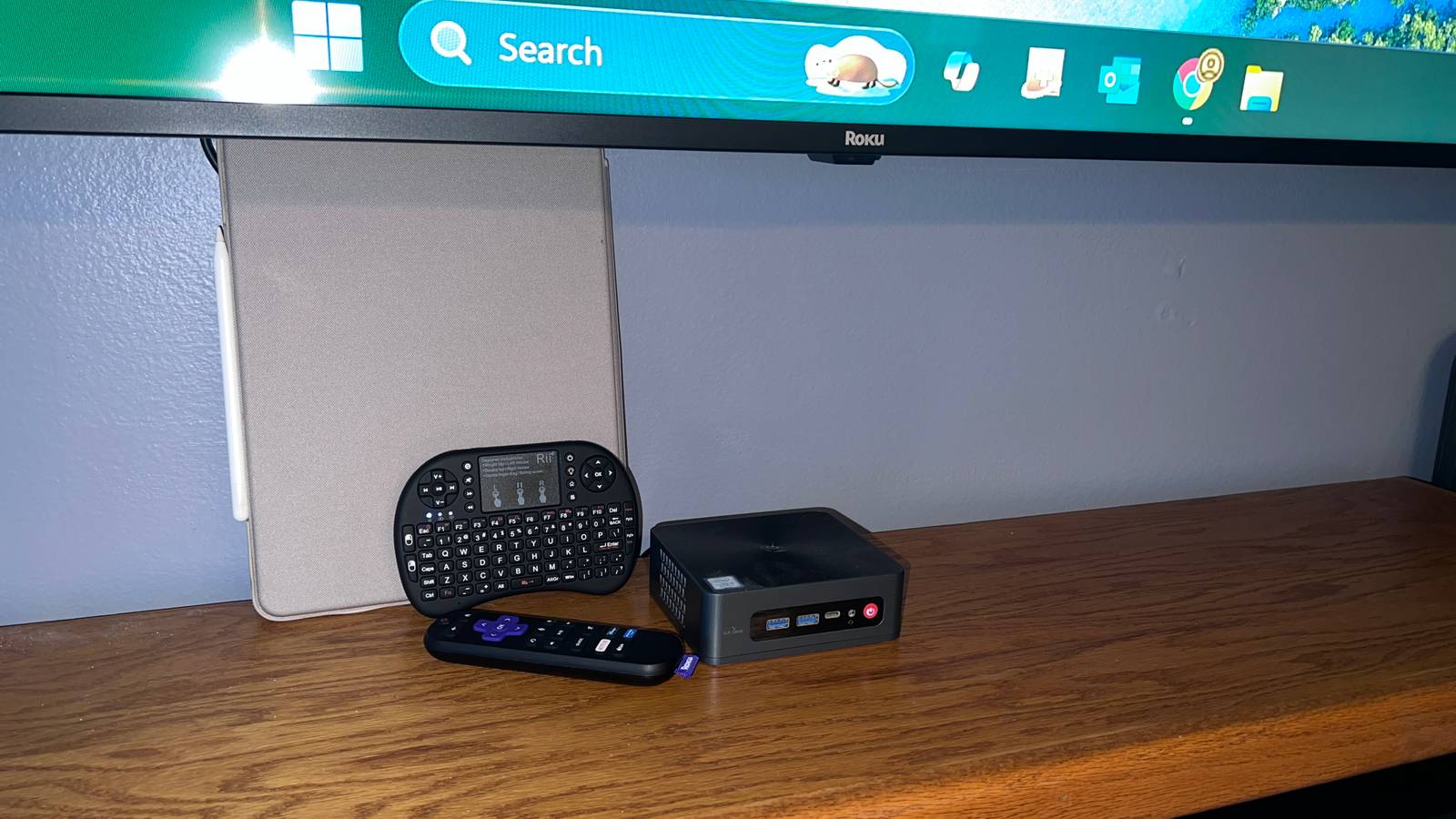
If you walk through my house, you’ll see plenty of Roku gear.I've got Roku TVs and a couple of streaming sticks, and for the most part, they do exactly what they're supposed to do.They're simple, they're familiar, and they're good enough for most people.
And honestly, if you just want something that works the same way every time you turn on the TV, that familiarity is hard to beat.But I'm also the kind of person who notices the limitations pretty quickly.An app isn’t available.
Playback is limited in ways that don’t make sense.And that's where Roku, and really every streaming platform, starts to feel a little restrictive.That's why I keep coming back to cheap mini PCs instead.
They take a bit more setup and a little more technical comfort, but in exchange, you get complete control over what you can watch and how you watch it.Once you get used to that flexibility, the trade-off starts to feel worth it.You're not locked into any streaming platform Every app, every service, and your own media in one place Close This is where a desktop PC completely changed the equation for me.
I'm not tied to Roku, Amazon, or Google TV, and I'm not stuck waiting for apps to show up or stick around.If a service exists, I can get to it, either through a browser or a native app.There's no gatekeeping, no weird gaps where one platform has something and another doesn't, like how Twitch still doesn't have an official app on Roku but works fine on Fire TV.
It also means everything I already run fits right in.I can stream whatever service I want, but I also use one of my mini PCs as a Plex media server, so my own movies, shows, and music are always available alongside everything else.It all lives in one place, and nothing feels like a workaround.
Beelink SER3 Mini PC CPU Ryzen 3 3200U Graphics Radeon Vega 3 Memory 16GB DDR4 Storage 500GB SSD The Beelink SER3 mini PC is the perfect entry-level Windows desktop for those on a budget.With a Ryzen 3 3200U processor, this desktop ships with Windows 11 Pro and 16GB of DDR4 RAM.A 500GB SSD is pre-installed (and user-upgradable), and you'll find dual HDMI ports, Ethernet, and four USB-A ports on this compact desktop.
$299 at Amazon Expand Collapse Performance is on a different level Faster navigation, smoother playback, and real multitasking without expensive hardware The difference was immediately obvious.Even an inexpensive mini PC feels faster than any streaming stick I've used.Menus load instantly, apps don't hang, and there's none of that slight delay you get bouncing around a Roku or Fire TV home screen.
It just responds the way a real computer should.It also handles things streaming devices struggle with.High-bitrate video plays smoothly, large local files don't choke, and I can have a browser, Plex Media Server, and a download running at the same time without it falling apart.
And the best part is you don't need a powerhouse system to get there.Even lower-cost mini PCs can deliver this kind of experience, especially for streaming and local playback.Local media actually works the way it should No codec issues, no transcoding, just play anything without the hassle This is another area where streaming devices start to show their limits.
Yes, Roku and Fire TV can play local media, usually through apps like Plex or their own media players.But it's rarely as simple or as reliable as it should be.You run into codec issues, high-bitrate files that struggle to play, or situations where you suddenly need a server to transcode something that should have worked automatically.
On a desktop PC, none of that really matters.It plays anything I throw at it without thinking about formats or compatibility.Using something like VLC, files just open and play, whether it's a large MKV, a high-quality rip, or a random format I downloaded years ago.
There's no workaround, no middle layer, and no guessing.It's how local media playback should work.The downsides are real, but manageable More setup, different controls, and a higher upfront cost with simple workarounds This isn't a perfect setup, and for many people, the downsides are real.
My wife still prefers Roku, and I get why.The interface is familiar, the remote is simple, and it works the same way every time.There's nothing to learn, nothing to tweak, and no friction between turning on the TV and watching something.
That kind of consistency matters more than flexibility for most people.A desktop PC also adds a bit of complexity.You're usually dealing with a mini keyboard and mouse instead of a simple remote, and it takes a little more effort to set up the way you want.
It can also cost more upfront, especially compared to a $30 streaming stick, unless you're repurposing an old PC.That said, there are some easy workarounds.I've even used an old Xbox controller as a media remote, and it works surprisingly well.
Between that, compact keyboards, or even phone-based controls, you can get pretty close to that "sit down and just watch" experience once everything is dialed in.You can make it feel like a real streaming device Auto-launch apps, saved logins, and a setup that removes the usual PC friction One thing I've learned pretty quickly is that reducing friction makes all the difference.I've removed the login password so it boots straight to the desktop, and I have Chrome launch automatically into Pluto TV, which is my go-to free streaming platform.
From there, all my regular services like Netflix, Amazon Prime Video, Spectrum, Tubi, and others are already bookmarked, so everything I need is one click away.It ends up feeling a lot closer to a streaming device than you'd expect.If resolution or playback quality is a concern, I'll usually check for a dedicated app in the Microsoft Store instead of relying on the browser.
Those apps tend to handle higher resolutions and DRM better, so you're not giving up quality just to get the flexibility.Related This open source TV box has zero tracking and everyone I show it to wants one It's time to rethink what's on your TV.Posts 2 By Bertel King A streaming stick is easier, but a desktop PC is more flexible A streaming stick is still the easier choice, and for many people, that's enough.
If you care about flexibility, performance, and not being boxed into someone else's platform decisions, a desktop PC is on a completely different level.It handles streaming, local media, and multitasking and gives you full control over your setup.It even opens the door to things like serving your personal media anywhere you are, not just in your living room.
It takes a little more effort to get there, but once you do, it's hard to go back to something that feels this limited.
Read More