Happy New Year! We’ve got an abbreviated 3D Printing News Briefs for you today, so we can all enjoy our holiday weekend but still keep up on the industry’s news.First, in business news, amsight has announced a new strategic investor.Moving on, a 3D printed replacement part helped put an F-15 back in the air way ahead of schedule.
Finally, since winter has fully arrived in the U.S., we’ll end with research out of Amsterdam about 3D printing ice trees and other structures.amsight Announces Butterfly & Elephant as New Strategic Investor Hamburg-based software startup amsight has gained a strong strategic partner in GS1 Germany’s investment company Butterfly & Elephant, which invested in amsight as part of a Pre-Seed II financing round.The startup specializes in data-driven quality management for industrial 3D printing, consolidating all relevant production data within a single software.
With its investment in amsight, Butterfly & Elephant is supporting the automation, digitalization, and standardization of AM, and joins amsight in its goal of advancing end-to-end traceability for 3D printed parts, in addition to digital product and process data based on GS1 standards.Together, the two will collaborate to develop solutions that allow companies to document and securely exchange important parameters across the production chain.amsight will use this infusion of capital to speed up product development, drive market entry in regulated industries, and expand its software, specifically in compliance and data standardization areas.
“We are very pleased to have gained Butterfly & Elephant as an investor who not only provides capital, but above all brings deep strategic expertise in standardization as well as part identification and labeling.Together, we will elevate the exchange of digital manufacturing data and traceability in industrial 3D printing to a new level,” said Dr.-Ing.Tim Wischeropp, CEO & Co-Founder of amsight GmbH.
NAVAIR Supports Navy & Marine Corps with 3D Printed F-15 Replacement Part To increase readiness in forward-deployed locations, the NAVAIR Additive Manufacturing team helps US Marine Corps and Navy maintainers with engineering support, AM training, and technical data.A recent example is a cross-service collaboration in which maintainers with Marine Aircraft Logistics Squadron 36 (MALS-36) and 18th Maintenance Group (18 MXG) used 3D printing to fix a right-hand cockpit cooling duct in a USAF F-15 Eagle fighter aircraft.During a post-flight inspection at Kadena Air Base in Okinawa, Japan, a crack was noticed in the part, and maintainers initially decided to repair it with traditional processes, which would have kept the F-15 grounded for 3-4 months.
But, after a consultation with a depot liaison engineer, they decided to use 3D printing to create a replacement instead.18 MXG maintainers printed two prototypes, but ran into technical difficulties before fabricating the final component.Because MALS-36 had the same printer, they reached out for help, and two prototypes were printed, delivered, and fit-checked in less than 12 hours—putting the F-15 back in the air months ahead of schedule.
Additionally, after analyzing the Air Force’s technical data package, the Marines came up with a better design for the part that reduced print time by two hours.“Here was a situation where a multi-million dollar aircraft was going to be sidelined for months due to the lack of a part in the supply system.The Air Force’s proactive, forward-leaning maintainers sought and obtained approval to repair the part using their on-site AM capability.
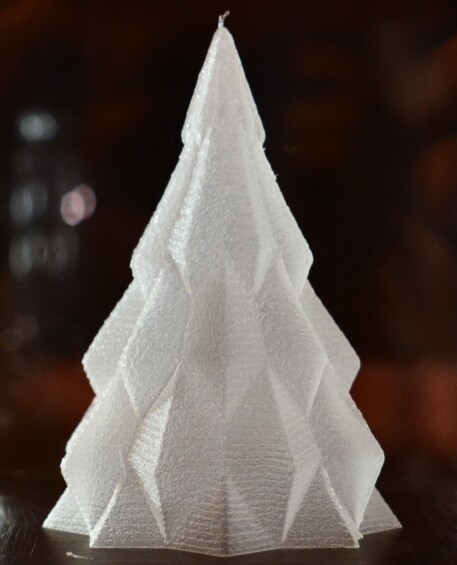
18 MXG was backstopped by MALS-36’s AM capability and they even got a better and quicker AM design out of the collaboration,” said Theodore Gronda, NAVAIR Additive Manufacturing Program Manager.“This was truly a glowing example of a ‘One Team, One Fight’ effort.” 3D Printing Ice Christmas Trees with Evaporative Cooling in Vacuum Figure 1: Photograph of a Christmas tree made entirely from 3D printed ice.The structure is fabricated using a 16 µm liquid jet mounted on a commercial 3D printer inside a vacuum chamber.
The tree has a height of approximately 8 cm and a base diameter of about 6 cm, with branches and fine features faithfully reproduced from the digital model without any supporting material or external cooling.The slight translucency and smooth surfaces demonstrate the optical quality of the ice and the stability of the evaporative-cooling printing process.A trio of researchers from the Institute of Physics (IOP) at the University of Amsterdam used evaporative cooling to 3D print freeform ice structures inside a vacuum chamber.
Research into ice 3D printing is still fairly limited, but if properly harnessed, it could be very useful for intricate tissue engineering scaffolds, microfluidic devices, casting templates, and even construction.Other approaches have used cryogenic refrigeration or substrate cooling to stabilize solid water, but this is expensive, and special infrastructure and equipment is needed.IOP researchers Menno Demmenie, Stefan Kooij, and Daniel Bonn went a different route, housing a ROOK MK1 commercial 3D printer inside a transparent acrylic vacuum chamber.
They replaced the thermoplastic extruder with a custom nozzle mount, driven by a High-Performance Liquid Chromatography (HPLC) pump to eject a jet of water that breaks into droplets which freeze, via evaporative cooling, onto the substrate to form a structure; only a tiny bit of water needs to evaporate to induce freezing.What’s very interesting is that the low ambient pressures on the moon and Mars are within the necessary range for the freezing mechanism.So in theory, water-based or particle-laden jets could directly print structures in these punishing environments without having to use additional cooling systems.
Plus, ice mixed with regolith or sand could make a strong composite material for building radiation shielding or protective structures off-planet.“A micrometer-sized water jet is used to 3D print inside a vacuum chamber.The reduced ambient pressure leads to rapid evaporation of the extruded water, extracting latent heat, and quickly cooling the water well below 0 °C.
Once deposited, the water freezes almost instantaneously into stable ice structures.We demonstrate high-fidelity printing of complex geometries (Christmas trees, cones, vertical pillars, and free-standing zigzag structures) without cryogenic infrastructure, supporting materials, or external refrigeration.This approach directly visualizes fundamental thermodynamic principles—latent heat, evaporative cooling, and pressure-dependent phase transitions—while offering a relatively simple and scalable platform for ice-templated microfluidics and tissue engineering, or even extraterrestrial 3D printing,” the team explained in the abstract of their paper.
Subscribe to Our Email Newsletter
Stay up-to-date on all the latest news from the 3D printing industry and receive information and offers from third party vendors.Print Services
Upload your 3D Models and get them printed quickly and efficiently.Powered by FacFox
Powered by 3D Systems
Powered by Craftcloud
Powered by Xometry
3DPrinting Business Directory
3DPrinting Business Directory