New cars have become so expensive that the gap between mainstream and luxury models barely feels real anymore.A fully-loaded family sedan now comes packed with the kind of comfort, tech, and refinement that used to be reserved for premium badges only.That shift has quietly created a strange problem for luxury brands.
When regular cars start feeling this good, spending thousands more for an entry-level luxury sedan suddenly gets a lot harder to justify.And that’s exactly why one Japanese sedan has become such an outlier.Most people still don’t realize it exists, but it delivers the kind of quietness, comfort, and upscale feel you’d normally expect from something wearing a much pricier badge.
In order to give you the most up-to-date and accurate information possible, the data used to compile this article was sourced from Lexus and Toyota, as well as other authoritative sources including CarEdge, Kelley Blue Book, and TopSpeed.Related This Toyota hybrid makes some luxury SUVs hard to justify Turns out you don’t need a luxury badge to feel spoiled—this Toyota SUV is refined and seriously comfortable.Posts 1 By Adam Gray Mainstream cars are creeping into luxury territory Modern flagship sedans now offer premium comfort without premium badges Brand positioning has always mattered in the car industry, especially when it comes to separating mainstream models from luxury ones.
But over the last decade, that gap has started shrinking fast.Mainstream automakers have been creeping further into luxury territory, not just with pricing, but with overall quality, comfort, and refinement too.Modern mainstream cars feel more luxurious than ever New cars have gotten expensive for a pretty simple reason: automakers sell fewer of them now, so each vehicle has to bring in more profit.
At the same time, buyers have become a lot more careful about where their money goes, especially once prices started creeping into luxury-car territory.Instead of just pushing people toward premium sub-brands like Acura or Lexus, mainstream automakers have started making their top trims dramatically nicer.The end result is that a lot of flagship mainstream models now feel just as refined as entry-level luxury cars, sometimes while costing thousands less.
Nameplates are making a comeback for a reason Nameplate revivals have become a common move for automakers over the past decade.Brands with long histories are increasingly pulling from their archives to give new models instant identity and recognition.More often than not, they’re bringing back names that carry nostalgia or once sat at the top of the lineup before the rise of luxury sub-brands pushed them out of the spotlight.
Bringing back a former flagship name isn’t just a nostalgia play—it’s a signal that the car is meant to stand apart from the usual lineup.The name itself carries weight, and with it comes higher expectations and a very specific audience.Automakers use these revivals to instantly shape perception, leaning on heritage to position a new product in the market without starting from scratch.
It’s less about memory, and more about using recognition to define what the car is supposed to represent from day one.Related 76% of drivers say luxury badges aren't worth it anymore—here's what they want instead Respondents prioritized financial security over a fancy new car.Posts By Carl Anthony Luxury benchmarks have quietly been pushed higher Features once reserved for premium cars are now showing up in mainstream models Like any competitive space, luxury standards don’t stay still—they keep moving up every year.
Features that were once reserved for six-figure sedans, like massage seats, are now showing up in mainstream models such as the 2026 Nissan Murano Platinum.That shift has forced traditional luxury brands to raise their game just to stay clearly ahead.What used to feel exclusive now has to be constantly redefined to stand out.
Hybrids have quietly changed what luxury feels like Hybrid powertrains have quietly become a favorite among luxury automakers over the past decade as more brands realize how much refinement electrification can bring.They were once brushed off as purely efficiency-focused tech, not something that fit the luxury mindset.In reality, hybrids deliver a strong mix of efficiency, performance, and smoothness that lines up perfectly with what luxury buyers actually want.
That sense of calm, composure, and sophistication behind the wheel is exactly where hybrid systems tend to shine.That’s exactly what helped the Lexus ES take over the luxury hybrid space.If you wanted something sporty, you went for a BMW 3 Series.
If you wanted something smooth, efficient, and easy to live with, the ES was the obvious pick.It nailed that formula of comfort, low running costs, and effortless driving in a way that made a lot of its rivals feel unnecessarily complicated.So when mainstream brands start using similar hybrid systems and pairing them with genuinely high-quality interiors, the gap between “mainstream” and “luxury” gets a lot harder to justify.
The gap in interior quality is disappearing If there’s one area where the industry has changed the most in the past decade, it’s interior quality.It used to be the clearest way to separate luxury cars from mainstream ones, especially when it came to materials and finish.Now, even mainstream models can offer things like Nappa leather, as seen in vehicles like the 2026 Subaru Outback Touring XT.
Most new cars also feature soft-touch materials and leather-trimmed surfaces, while the cheap-looking wood veneers that once defined older luxury cabins have largely been replaced by open-pore wood or proper metal accents, even outside premium brands.Acoustic engineering has also moved well beyond the luxury segment, with active noise cancellation, improved body sealing, and better glass lamination now showing up in mainstream models.The result is cabins that are quieter and more refined than anything we’ve seen in past generations, even outside premium brands.
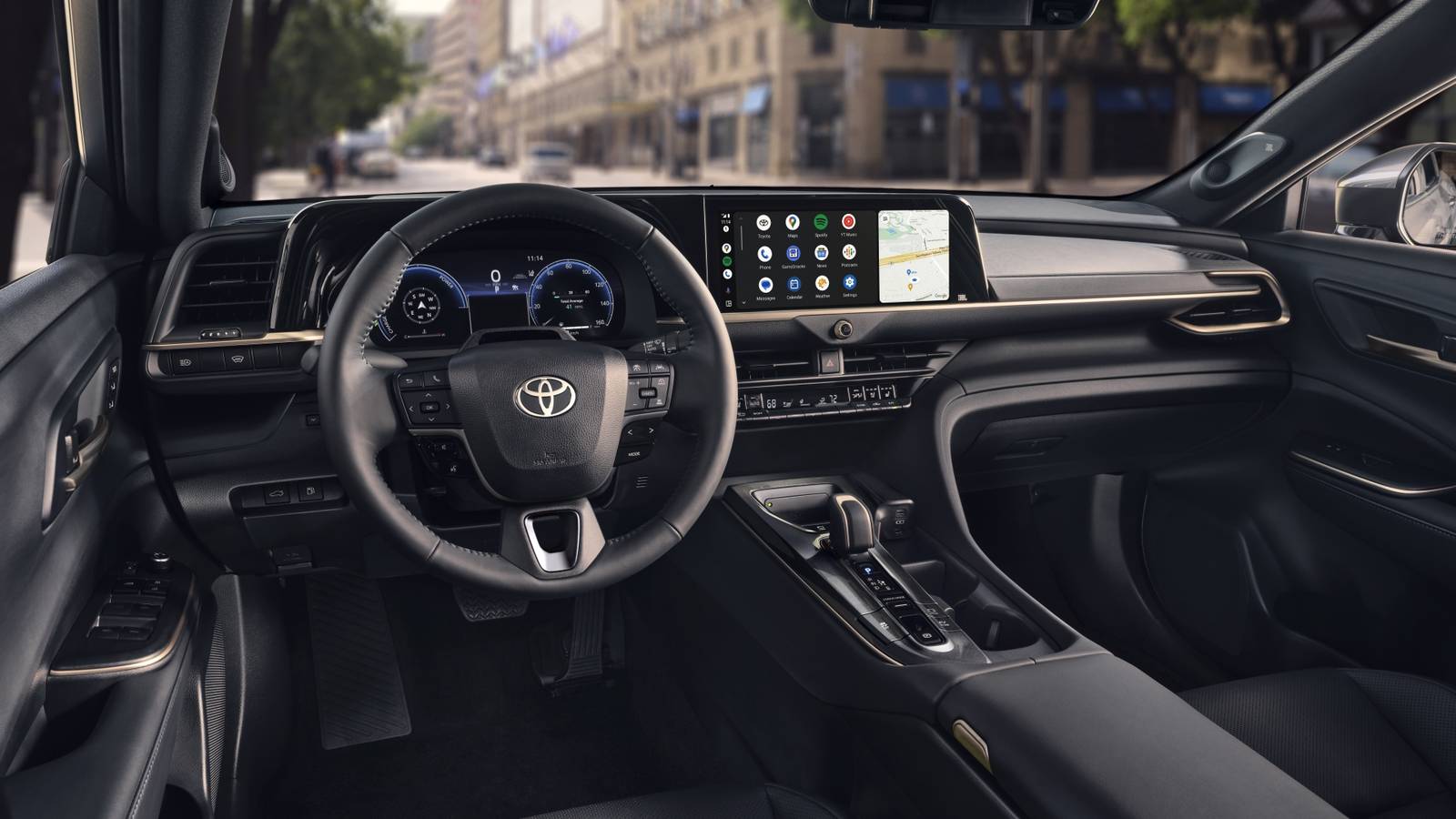
That overall jump in refinement is exactly what makes something like the Toyota Crown stand out.As a modern revival of one of Toyota’s most important flagship nameplates, it’s a clear example of how far mainstream comfort and quietness have come.Related How Cutting-Edge Tech Is Making Cheap Cars Feel Luxurious More tech equals better value for money.
Posts 1 By Tyler Dupont The Toyota Crown is quietly redefining mainstream luxury A flagship sedan that delivers premium comfort without the premium badge Toyota made a bold move bringing the Crown nameplate back for the 2023 model year after a 50-year gap in North America.It steps in as the spiritual successor to the discontinued Avalon, while also sitting below the more EV-focused 2026 Lexus ES.It essentially bridges the gap between mainstream comfort and entry-level luxury, offering buyers a more accessible alternative without stepping fully into Lexus territory.
Toyota Crown Like SUV 2026 Base: $41,440 Base Trim Engine 2.5L Dynamic Force I4 Hybrid Base Trim Transmission CVT Base Trim Drivetrain All-Wheel Drive Base Trim Horsepower 184 HP @6000 RPM Base Trim Torque 163 lb.-ft.@ 3600 RPM Base Trim Fuel Economy (city/highway/combined) 42/41/41 MPG Base Trim Battery Type Lead acid battery Make Toyota Model Crown Powered by Expand Collapse Sedan value isn’t dead—the Toyota Crown proves it The crossover SUV has become the default definition of luxury in today’s market, but the Toyota Crown pushes back against that idea.Toyota has clearly built it as a full luxury experience, just without the premium badge.
Cabin quietness is a major focus, with serious acoustic insulation that rivals what you’d expect from much more expensive brands.The suspension is tuned for comfort above all else, and the standard feature set makes it one of the most well-rounded sedans in its class.The base Crown XLE starts at $41,440, which is already where many Toyota models top out in terms of trim level.
Even at that price, you’re getting heated and ventilated leather-trimmed front seats, heated rear seats, wireless Apple CarPlay and Android Auto, and wireless charging as standard.To match that same equipment in a 2026 Lexus ES 350e Luxury, you’d be looking at at least $57,195, plus an additional $3,635 for the Executive Package.That’s roughly a $19,400 gap just to reach the same level of standard features already included on the base Crown.
The Crown Platinum redefines what luxury performance looks like The top-trim Crown Platinum comes in at $54,990, which is a lot of money for a Toyota sedan—and rightly so.This isn’t trying to be a budget option; it’s the best Toyota has to offer right now.Once you actually look at what you’re getting, though, the price starts to feel less like a stretch and more like strong value.
In context, it feels closer to a bargain than you’d expect from a flagship like this.The Crown Platinum is the only trim that gets the hybrid 2.4-liter turbocharged inline-four, producing 340 horsepower.That’s more power than any new Lexus ES or IS on sale today, despite coming from a Toyota badge.
You also get standard AWD, adaptive variable suspension, dynamic rear steering, a panoramic view monitor, a hands-free power trunk, and fully configurable drive modes.On paper and in practice, it doesn’t just undercut Lexus on value—it genuinely matches or exceeds many of its models for performance and tech.Related Thinking of a Toyota Crown? This top trim Honda offers similar luxury for less Similar refinement, smarter price — that’s the real appeal here.
Posts 1 By Tyler Dupont Entry-level luxury sedans can’t keep up with the Crown More performance, more tech, and more value for less money When you factor in ownership costs, the Crown starts to make a lot of sense for the right buyer.It’s especially compelling if you’re shopping in the $40,000 to $60,000 entry-level luxury sedan space.Once you zoom out and look at the long-term financial picture, the Crown becomes an easy alternative to a lot of more expensive badge-driven options.
The cost of owning a Crown According to , maintenance costs for the Crown over the first five years come out to about $1,662, which is only around three percent of total ownership costs.Over a 10-year span, that rises to $4,895, still comfortably below the segment average.Insurance averages about $2,474 per year, which is roughly $659 less than the national sedan average.
On top of that, the standard Crown returns 41 mpg combined, while the performance-focused Platinum still manages a solid 30 mpg combined.Resale value and availability in the market The Crown is still a relatively niche model, so supply of this flagship sedan remains fairly limited.In its debut year, it sold 19,063 units, followed by 19,648 units the next year, before dropping to 12,309 units in the most recent full-year report for 2025.
For context, the Toyota Camry moved 316,185 units in 2025 alone, showing just how small the Crown’s footprint still is in the broader sedan market.estimates the average private-party value of a 2024 Crown sits between $28,800 and $35,300 depending on trim, with Platinum models landing around $37,000 to $40,000.That puts it well below what you’d expect for a car offering this level of comfort and equipment.
If you’re open to stepping outside the usual luxury badges, there are some genuinely strong deals on lightly used examples right now.As it stands, the Crown looks like one of the more underrated used buys on the market given how much quality you get even in base form.
Read More