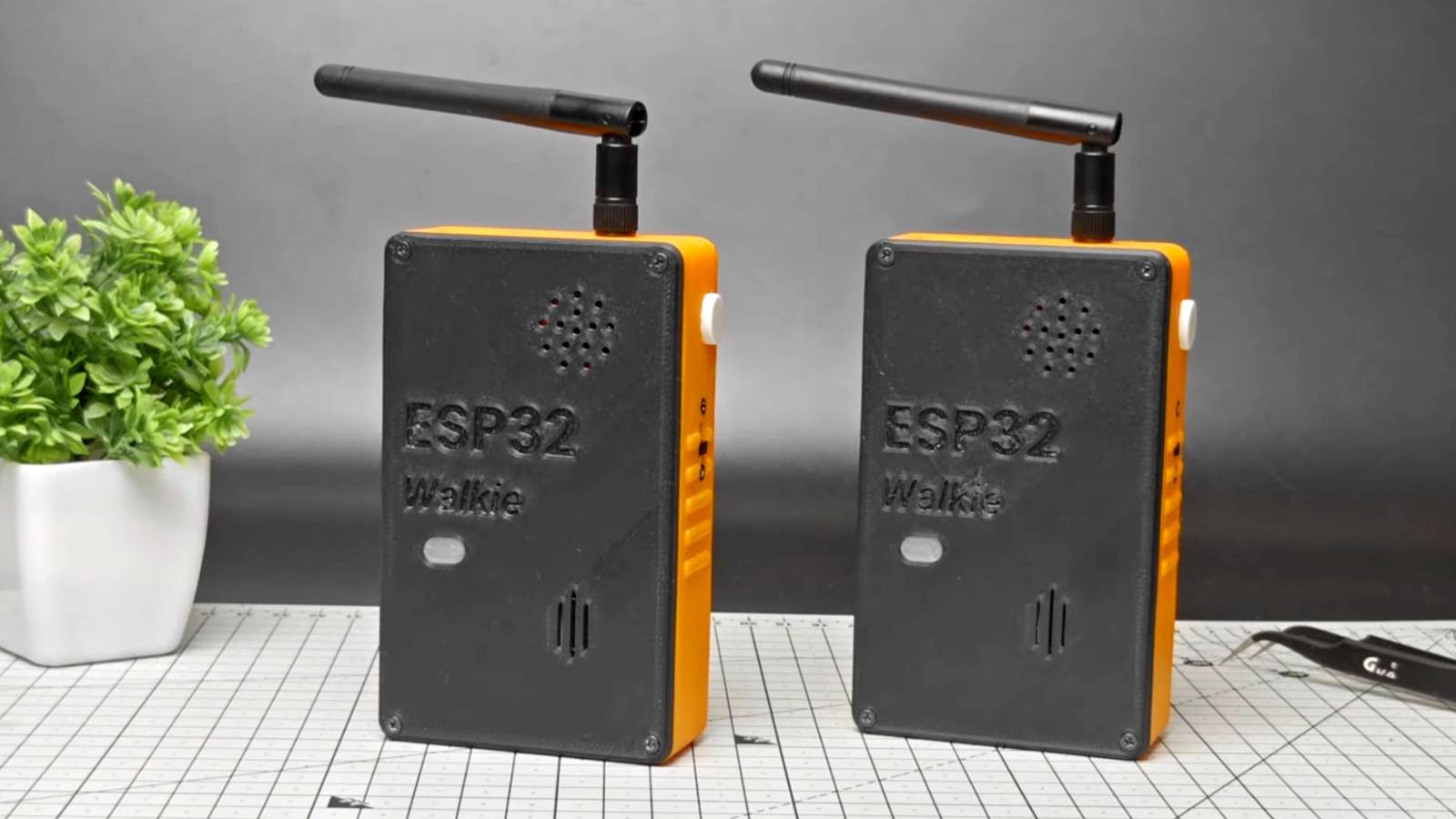
Completing any project comes with a sense of accomplishment, but there’s no denying that some are more impressive than others.Whether it’s functionality you never thought possible, the culmination of months of work, or a particularly inventive way of circumventing limitations—these ESP32 projects have it all.ESP32 push-to-talk walkie-talkies Complete with a 3D printed shell ESP-NOW is Espressif’s mesh-based communication protocol developed for ESP32 devices.
It uses the 2.4GHz band to enable peer-to-peer communication between two microcontrollers, with no need for a centralized access point or the internet.This technology has been used to create the ESP32-S3 ESP-NOW Walkie Talkie talkies that use ESP32-S3 boards from Seeed Studio.The XIAO ESP32-S3 Sense is a $14 microcontroller that includes a digital microphone, a vital component for a project like this.
Other components include a MAX98357A I2S amplifier to drive the speaker, a 23mm round speaker, a push button, slide switch, and a 2GHz antenna for 3dB of gain.Naturally, you’ll need two of everything in order to build a set of walkie-talkies.The project is built on the Arduino IDE, and requires flashing the same firmware to both boards, which will then detect their respective MAC addresses on boot and label themselves accordingly.
The whole thing is powered via an 18650 battery.The whole thing is held together with a 3D-printed chassis, plus supports for keeping everything in place.Seeed Studio XIAO ESP32-S3 Sense Seeed Studio XIAO ESP32-S3 leverages dual-core ESP32-S3 chip, supporting both Wi-Fi and BLE wireless connectivities, which allows battery charge.
It integrates built-in camera sensor, digital microphone.It offers 8MB PSRAM, 8MB FLASH, and external SD card slot.All of these make it suitable for embedded ML, like intelligent voice and vision AI.
$14 at Seeed Studio Expand Collapse HEARD group safety mesh for hikers Find out if a group member goes off track HEARD stands for Hiking Emergency Assistance and Rescue Device, and it works a lot like the previous walkie-talkie project.The aim is to enable long-range communication between a group of people without having to rely on cellular networks, which are often not present in off-grid locations.The HEARD project is the work of Lucio Baiocchi, a computer science student who used the project for their thesis.
It has since been open-sourced.The project encompasses three ESP32-powered units: HEARD Core, HEARD Node, and HEARD Pico.Core is the group leader’s device; it handles route creation and global monitoring.
Node is a device designed to be carried by other adult members of the group who are being tracked.Pico is a minimal device designed for emergency situations only, to be used by children.HEARD uses an ESP32 board, LoRa mesh radio, GPS unit, and a small 2.9-inch E-Ink display.
The leader’s device broadcasts a position request, which the nodes answer.When these nodes go out of range, the alert is sounded.The project has a breadboard schematic available.
Seeed Studio XIAO ESP32C3 Brand Seeed Studio The Seeed Studio XIAO ESP32-C3 is the perfect budget-friendly microcontroller for smart home projects.With Wi-Fi and Bluetooth built-in, it also features a super deep sleep mode for low power usage when it isn't doing anything.The compact size makes this ideal for building smart home projects, and ESPHome allows it to easily integrate into Home Assistant.
$5 at Seeed Studio $10 at Amazon Expand Collapse Seeed Studio XIAO ESP32-C6 Brand Seeed Studio The Seeed Studio XIAO ESP32C6 is the perfect microcontroller for your next smart home project.The built-in Zigbee and Thread radios compliments Matter support.Plus, with Wi-Fi 6, it'll easily connect to modern wireless networks. $5 at Seeed Studio $12 at Amazon Expand Collapse A simulated aquarium on a Cheap Yellow Display Who said impressive couldn’t be fun? The term Cheap Yellow Display, or CYD as it is often known, is used to describe a range of ESP32-embedded LCD touchscreens.
It’s basically a microcontroller and display in one, saving you the hassle of having to source the two parts separately and wire them together.The ESP32 CYD Aquarium is a simple aquarium project adapted from the Livegrid OpenMatrix.The author has used an ESP32-2432S028R to create a pixelated self-running desk aquarium.
The water moves, creatures interact, food drifts around, and the time is displayed on-screen at all times.It even uses Wi-Fi to sync the time with the internet and an on-board light sensor to dim the backlight.Watch the fish, stars, turtles, snakes, octopi, and more float around your aquarium, and tap the display to feed.
This isn’t a Tamagotchi experience, it’s a wholly passive affair, so there’s nothing to take care of if you don’t want to.Posting on Reddit, the project author revealed: “Getting it onto a plain ILI9341 TFT meant writing a dot-grid renderer and squashing the whole scene into an 80x106 logical frame, so it still reads like a tiny LED matrix rather than a normal screen.That dot look is honestly my favorite part.” That’s pretty impressive if you ask me.
Looking for more ESP32 projects? Give last week’s beginner projects a try!
Read More