We’re kicking off 3D Printing News Briefs with some news from last week’s Shot Show in Las Vegas, and then moving on to new 3D printing systems.We’ll end with news about university students 3D printing with recycled plastic.Read on for all of the details! AGF Defcom Chooses 6K Additive as Strategic Metal Powder Supplier 6K Additive’s UNIMELT Plasma Technology produces high-performance premium metal powders and alloy additions for additive manufacturing.
Last week at Shot Show in Las Vegas, 6K Additive announced that it was chosen as a preferred metal powder supplier for AGF Defcom, which will not only majorly reduce production costs and material waste, but also ensure a secure, domestic supply chain.A closed loop upcycling program is key to this strategic partnership, and 6K Additive will use its proprietary UniMelt microwave production system to turn AGF Defcom’s solid and powdered manufacturing scrap back into high-performance metal powder for 3D printing suppressors.Forecasting a significant amount of first-time buyers and record-breaking sales, industry analysts have dubbed 2026 the “Year of the Suppressor.” The high-volume suppressor industry has been growing fast, catalyzed mainly by the removal of the $200 NFA federal tax stamp, and advanced manufacturing methods, like 3D printing, are really helping to scale production.
AM Research Executive Vice President of Research Scott Dunham has been watching the additive suppressor market since 2017, and expects metal AM to penetrate it by over 70% within five years.“With the suppressor market growing at a staggering 265% in just five years, teaming up with AGF Defcom is a perfect strategic fit.They have a 25-year legacy of manufacturing excellence, and we are excited to support their high-growth trajectory.
Beyond the business expansion, AGF Defcom truly understands the importance of converting scrap into high-performance powder,” explained Frank Roberts, the CEO of 6K Additive.“The fact that we are both U.S.suppliers makes this collaboration even more significant for the defense sector and domestic manufacturing.” Elegoo Launches Multicolor Centauri Carbon 2 Combo 3D Printer ELEGOO’s Multicolor 3D Printer Centauri Carbon 2 Combo to Launch on January 26 At RAPID+TCT in 2024, Elegoo introduced its first CoreXY flagship 3D printer, the Centauri Carbon, great for beginners with features like smart AI camera capabilities.
Yesterday, the company launched the family-friendly Centauri Carbon 2, a combo model designed for everyday household use with an attached color system.While this new version resembles the previous model, it has a lot of new features, including a filament changer on the printer frame that supports up to four different materials or colors.There’s also a 350°C hardened steel nozzle for better wear and heat resistance, and it supports high-performance filaments.
There’s an advanced temperature controller that automatically adjusts airflow in the chamber, while four extra sensors and a new zone-leveling mode enable faster, more accurate calibration.The Centauri Carbon 2 Combo also has a 5″ touchscreen, supports 11 languages, operates at a quiet 45 decibels, and has easy color switching, automatic filament backup, and instant filament loading.Plus, its RFID auto-recognition feature suggests the correct setting after identifying the type of filament you’re using.
At less than $500, the Centauri Carbon 2 Combo seems like a great deal.James Bricknell, CNET managing editor and 3D printing expert, said, “Even if the Centauri 2 is just the first Centauri with a color system attached, it’ll likely be worth the price of admission.” Q5D Introduces Five-Axis Laser-Assisted Metallization System for 3D Electronics The Q10L robotic cell enables high-precision, high-speed creation of conductive tracks onto large, complex three-dimensional (3D) substrates.UK-based Q5D, which manufactures five-axis robotic cells for automating product electrification, has introduced its newest platform.
Called the CY10L, the platform offers a laser-assisted selective metallization process for high-speed, high-precision fabrication of conductive tracks onto large 3D substrates of materials like polymers, ceramics, and specialist aerospace dielectrics.A 100-watt, 1064nm laser-assisted ablation and sintering head, paired with multi-axis control, creates metal traces right onto these complex substrates, making it a good choice for applications like sensors, wireless antennas, and radio frequency (RF) selective shielding.It offers a cylindrical one meter build envelope and 150µm print resolution for copper and silver deposition, while metal layers are between 1µm and 15µm thick.
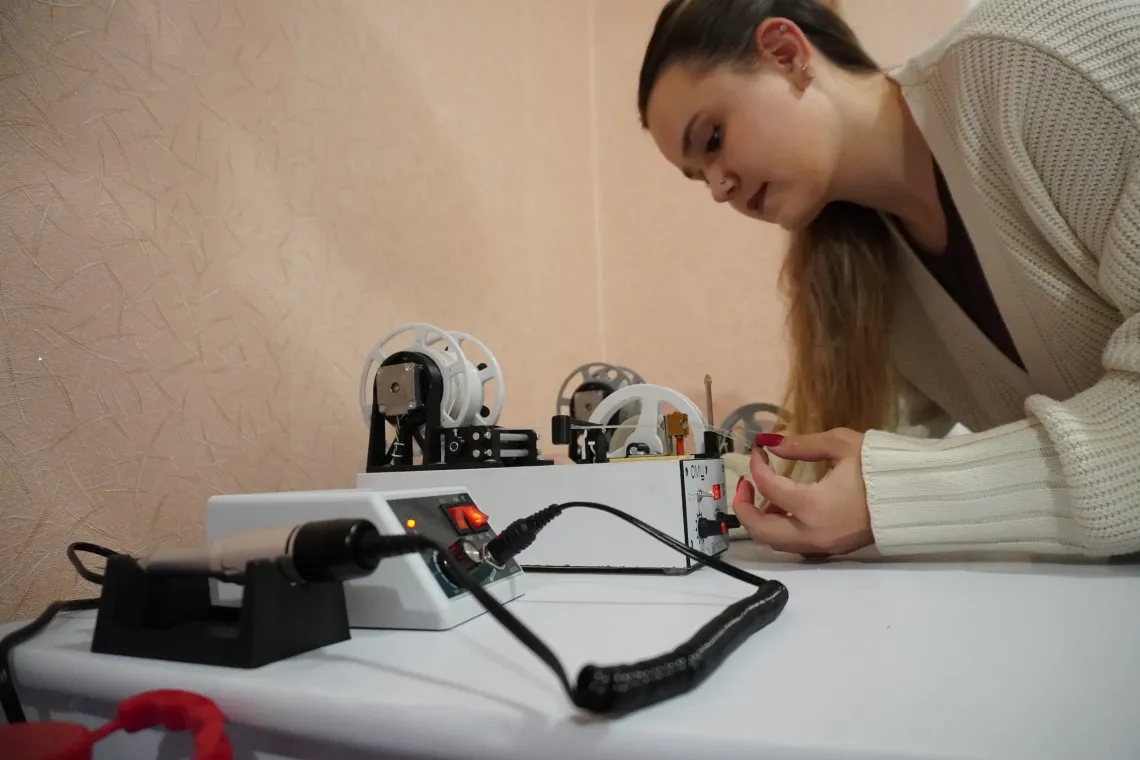
The platform is well-suited to working with large components, and can be used as a standalone machine, or be integrated right into existing manufacturing lines.“The CY10L not only delivers the usual automation benefits of greater speed, precision, and productivity, but changes the way 3D components are made so dramatically that it creates a host of new design possibilities,” said Ben Monteith, Q5D’s Laser and Applications Lead.“Product designers can cut the cost, size and weight of their innovations while boosting consistency and reliability, even in the most critical applications.” Ukrainian Medical Students with UNICEF Create 3D Printing Laboratory Image: UNICEF Anastasiia, a third-year medical student in Ukraine, is also a facilitator with UPSHIFT Start, an initiative under UNICEF’s broader UPSHIFT youth program that holds workshops to help young people develop their skills and ideas.
She wanted to show that studying medicine doesn’t limit opportunities, and partnered with fellow students to shape their project idea, joining an UPSHIFT cohort focused on environmental issues.Team Alium’s focus was on addressing the risks of microplastics—which can play a part in diseases developing—and a lack of educational materials.Their research found that people often don’t sort their waste, so the team held eight workshops about different types of plastic and how to sort them.
But they also wanted to show how plastic could be reused, and learned how to work with 3D printers and filament made from recycled plastics.They set up their own 3D printing laboratory, fabricating things like anatomical bone models, parts for a centrifuge, microscope components, and dental training blocks.Everything they print is made from inexpensive recycled PET bottles, which they get from a recycling collection point they set up on campus.
Other university departments, and even dental associations and other universities, have reached out to learn how to set up their own waste-sorting stations and 3D print with recycled plastics.“I am driven by the desire to influence the environment I live in,” Anastasiia said.“I don’t believe the phrase that circumstances simply happen.
I want to shape those circumstances myself.Projects and research work are my way of making real change possible.” Featured image courtesy of UNICEF Subscribe to Our Email Newsletter Stay up-to-date on all the latest news from the 3D printing industry and receive information and offers from third party vendors.Print Services Upload your 3D Models and get them printed quickly and efficiently.
Powered by FacFox Powered by 3D Systems Powered by Craftcloud Powered by Xometry 3DPrinting Business Directory 3DPrinting Business Directory
Read More