
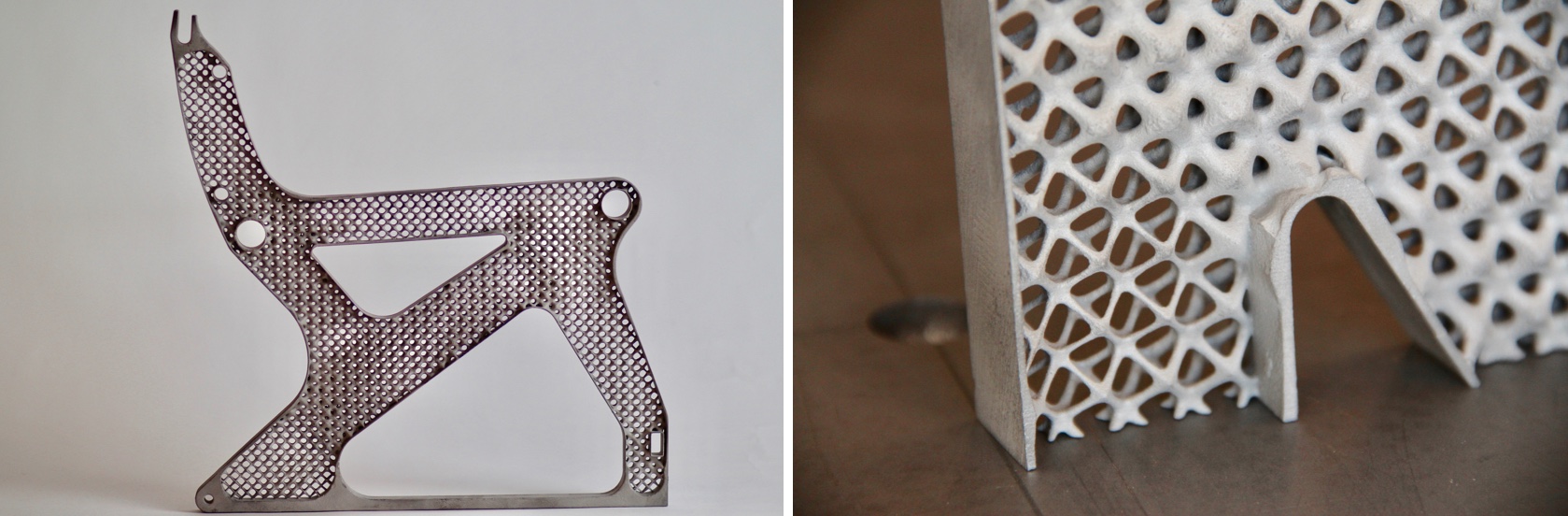
After the success of 3D printed bike seats, many types of pads have been explored, from backpack pads to those for boxing gloves and helmets.But can we also find success with larger components in other types of seats? What about 3D printed aircraft seating? Aircraft seating is a very challenging application for a number of factors.Firstly, the industry is very regulated and safety-conscious.
Polymer 3D printed parts are on thousands of aircraft, either as AEC ducting, small Ultem housings, and the like in General Aviation, or as maintenance, repair, and overhaul (MRO) components.However, achieving close proximity to cost targets while maintaining safety is challenging for us due to the high material costs of 3D printing materials, particularly those that are safe.Whose Seat is it anyway? Whereas in MRO, costs can balance out due to the ability to quickly replace a part and get a plane moving, it’s more difficult to do this with large seat pads.
To outperform a cushion, you have to do so noticeably.Airlines frequently speak of comfort, but there is no objective measure of comfort; there is also no megapixel for comfort, either.I’ve heard a lot of opinions about airlines, but no one has yet tried to sell me on a particular airline’s seats.
Sometimes people talk about lying flat or having more space, but the cushions themselves are hardly ever mentioned.Except, of course, when people on long flights decry all and any seats.Could 3D printed seats be a draw? If they were indeed more comfortable, and perhaps let people accumulate less heat.
If they gave your butt a completely different feeling depending on your weight distribution, they may actually be more comfortable.But if the hype were over, would a 3D printed seat make you go for a different airline? Weirdly, the things we spend our time flying in are too rarely discussed.Be Seated Another issue is that long-term durability and cleanability can also be problematic.
Our materials don’t tend to hold up well under cyclical loads, and we’d need many hundreds of thousands of cycles in this application.We’re not amazing with solvents or some lubricants and oils either, which can be a problem too.Yet another issue is the aviation business, which is a weird one.
You, as an airline, “buy” a plane, but it’s probably owned by an Irish leasing company that buys the engines separately.You then get an interior made by Diehl, Collins, or JAMCO, depending on the part.With it all, Geven or Recaro could do the seats, and Collins or Safran can tie it all together.
Depending on where you or they are from, or who is BFF with whom at what moment, could change many things about your cabin.Stelia could win a part of a deal and, as part of Airbus, fulfill that order.Collins could work with its own seats or, conceivably, those of Adient or another supplier.
A company like King could come up with a solution for your corporate jet, or a supplier could, in fact, be preselected due to a design from aircraft interior design firm Tangerine.It’s tough to determine who is in the driving seat of the aircraft seating industry.This is also an industry with many customers and uncertainty about who the end customer is.
Advantages AURA Enhanced business-class seating concept by RECARO Aircraft Seating.Image courtesy of RECARO Aircraft Seating.There are, however, a few advantages that could make this uphill challenge a reality.
One potential advantage is weight.This prototype reportedly weighs 50% less than other models.Ogle also showed a Zodiac prototype seat that used 3D printing.
A more interesting development was a 2017 Autodesk project where a researcher came up with a seat frame that weighed “766 grams, each individual seat frame is 54% lighter than the conventional 1672g aluminum seats in use today.” They also believed that, over the lifetime of an entire fleet of 100 A380s, they would save $206,648,920.Fuel is a third of airline expenses.According to some estimates, “for every 1 kg of weight reduction, fuel burn is reduced by approximately 0.003 kg per kilometre,” with “Fuel Cost: Averaging around $0.675 per kg,” and that “Under these conditions, saving 1 kg of weight can lead to an annual fuel saving of roughly 6,241.5 kg.
Translated into cost terms, that’s an estimated $4,210 in fuel savings per year for every kilogram saved.” That points to lighter seating as being potentially very interesting.If we can make cushions lighter by replacing them with 3D printed pads, that alone would bring significant savings.A metal 3D printed seat frame would add more cost savings.
Meanwhile, if we could 3D print the entire seat backing out of, say, carbon fiber, further savings could be possible.The padding could also make the seat thinner.Coupled with a carbon fiber 3D printed back, the seat could be significantly thinner.
A thinner seat could have a significant impact on airlines.According to some estimates, an extra row would generate an average of $1,968 in extra revenue per flight.If all planes in the US had an extra row, these calculations estimate that the industry would net $31 million per day.
For the price of extra peanuts, they could make more profit and revenue quite inexpensively.If all their planes could carry more passengers, they would be much more profitable.Globally, the airline industry has a 3.6% profit margin.
The global industry average profit per passenger is just $7.The profit per flight, therefore, is also very low.If we could just alter this slightly, the impact could be significant indeed.
Compared to other applications, airline seating is a long shot.But if it could be made to work, lighter, thinner seats with more rows could make a real impact.Subscribe to Our Email Newsletter Stay up-to-date on all the latest news from the 3D printing industry and receive information and offers from third party vendors.
Print Services
Upload your 3D Models and get them printed quickly and efficiently.Powered by FacFox
Powered by 3D Systems
Powered by Craftcloud
Powered by Endeavor 3D
Powered by Xometry
3DPrinting Business Directory
3DPrinting Business Directory

