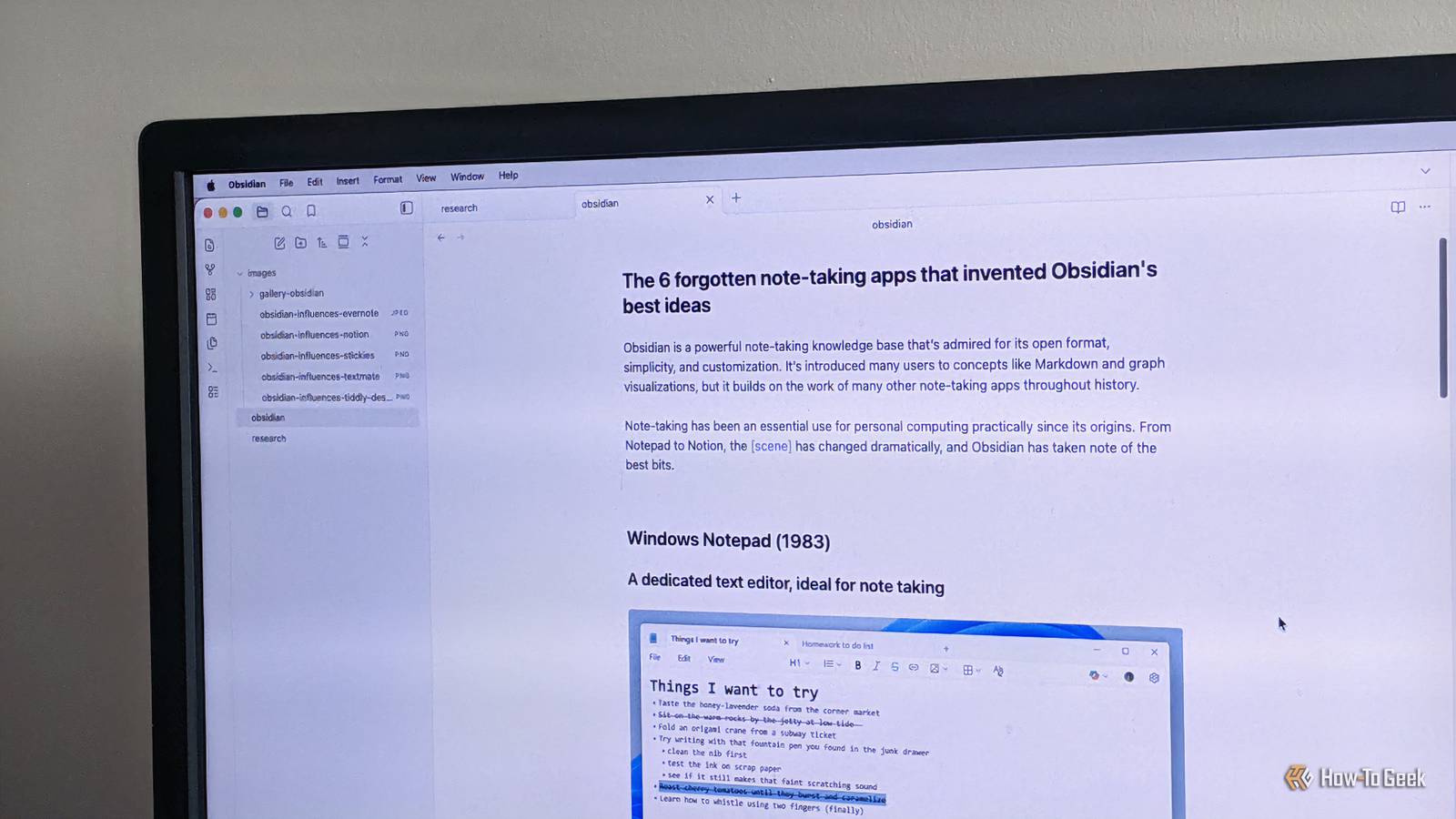
Obsidian is a powerful note-taking knowledge base that’s admired for its open format, simplicity, and customization.It’s introduced many users to concepts like Markdown and graph visualizations, but it builds on the work of many other note-taking apps throughout history.Note-taking has been an essential use for personal computing practically since its origins.
From Notepad to Notion, the landscape has changed dramatically, and Obsidian has taken note of the best bits.Windows Notepad (1983) A dedicated text editor, ideal for note-taking For many, the original, although few of us would describe it as the best.Windows Notepad is an enigma that, alongside Clippy and the Blue Screen of Death, has practically achieved meme status.
Notepad’s origins began as a plain-text alternative to what would later become Microsoft Word.It also served to introduce the mouse to users who had never heard of such a device, let alone used one.But its lack of formatting confuses beginners, while its limited feature set is often derided by experts.
Notepad is a bad approximation of a text editor to some and a poor cousin of the word processor to others.In recent years, Notepad has drifted from its minimalist roots by adding features like tabs, spell check, and AI assistance, causing some users to seek lighter alternatives.But it’s still positioned awkwardly: less a focused app that targets note-taking, and more a simple text editor that doesn’t really excel in any one area.
Close Stickies (1994) Post-it notes with simple formatting In the early nineties, when personal computing was starting to become widespread in offices and homes alike, the metaphor was king.Desktops, folders, and trash cans were familiar items from our everyday world, and another commonplace object seemed like a natural fit: the Post-it note.Almost every OS and desktop environment has flirted with this concept, and many still feature sticky note apps to this day, although they may be gathering dust in a corner of your disk, forgotten and unloved.
Nowadays, macOS has a similar feature which integrates with its modern Notes app; it uses the system’s widget feature to pin notes to the desktop.Microsoft also maintains its version to this day, although it introduced Sticky Notes for Windows back in 2002.Many people may struggle to recognize a real-world sticky note today, but it doesn’t stop fans from appreciating the digital equivalent many decades since it was launched.
TiddlyWiki (2004) Brought the benefits of hypertext to the masses Since the turn of the century, one feature has stood among all others when it comes to utility and pervasiveness.It’s been added everywhere, in every conceivable app, wherever it might fit in to add value.I’m talking about the humble hyperlink.
When hypertext became truly widespread in the early 2000s, it began to elevate our documents from standalone, isolated information sources to interconnected, interactive experiences.Multimedia was gaining great open support via HTML, and linking helped tie everything together.So it wasn’t much of a surprise to see note-taking and publishing systems evolve from single-document affairs to full-blown data repositories.
Underpinning much of this was the humble wiki; at the time, less of an abbreviation for “Wikipedia,” more a term in its own right to describe an ecosystem of online publication and collaboration.Wikis were haphazard affairs, loosely connected documents in a big pile, but they added much-needed structure and enabled cooperative writing and editing like never before.Projects like TiddlyWiki (and MediaWiki, TWiki, Trac) popularized document collections with easy navigation via linking, and today’s note-taking apps are clearly influenced by them.
TextMate (2005) Made Markdown a first-class citizen The Markdown format arrived in 2004, but it took a little while before widespread adoption beyond website back ends and the occasional use for programming.I’ll admit to being one of the naysayers at first: I’d fully bought into HTML as a publishing language, and I couldn’t see the benefit from an even simpler, more restricted version.How wrong I was! Markdown’s limited language proved to be its success, taking full advantage of a plain-text format that approximated the syntax we were already using in email and short-form messages like SMS.
As such, it offered a perfect foundation for note-taking, and Markdown is now commonplace in apps like Joplin, Obsidian, Zettlr—even Notepad.TextMate was one of the first editors to offer Markdown support, not long after the language was proposed.With a rich library of tooling to support it, and a presence in everyday apps like Slack and Discord, Markdown is so important that any emerging note app would be foolish to overlook it.
Evernote (2008) Introduced synchronization and collaboration In 2008, Evernote made the first big play in the world of note-taking apps, launching a system that elevated notes far beyond the mostly unstructured, text-only files they had been until this point.It stored individual notes in hierarchical notebooks, with tagging and annotations, search, and multiple forms of media—images, audio, web content—embedded within.Evernote also helped pioneer email integration, geolocation data, and optical character recognition—this software is so full of features, you may not even be aware of many.
But, overall, Evernote’s killer feature might well be its cross-platform, seamless synchronization.Document sync is now something we take for granted, whether it’s part of multi-user collaboration in OneNote or checking all your files into a git repository from Vim.Notes are an obvious fit for the small, mobile devices we all carry, but they have to be up-to-date with any changes we make elsewhere, on our desktops.
While Obsidian doesn’t have built-in support for synchronization, it is available via a paid extra service, Obsidian Sync.Notion (2016) Moving note-taking into productivity territory Obsidian arrived in 2020, building on several decades of notable prior art.But its greatest influence may have been another productivity-focused note management tool that arrived just four years earlier: Notion.
Notion takes note-taking to the extreme, bringing it to the realm of knowledge management and general-purpose data organization like perhaps no other tool since the humble spreadsheet.It can be an intimidating interface to get to grips with, but Notion’s system of databases built around rich documents can pay off if you understand it.While Notion may have influenced Obsidian, it was less of an inspiration and more of an example of how to do things differently.
Obsidian went a different route: rather than act as a kitchen-sink collection of features with unlimited flexibility out of the box, it aims for simplicity.By leveraging simple Markdown files and extending its basic features through plugins, Obsidian clearly aims for the note-taking/knowledge base domain.This echoes the Unix philosophy of small, simple, extendable tools that do one thing well.
Note-taking has experienced many revisions, but now it’s production-ready Note-taking is such a basic facility that you might expect computers to have mastered it long ago.It turns out to be one of the great unsolved problems of computing; who would have thought?
Read More