The Sunlu i10 is a filament dryer that I’ve been testing for the last few months.It’s a practical, easy-to-use cabinet that keeps your filament in tip-top shape.Sunlu gave me the drying cabinet to keep, but we don’t have an affiliate marketing agreement with them, and they didn’t pay for the review.
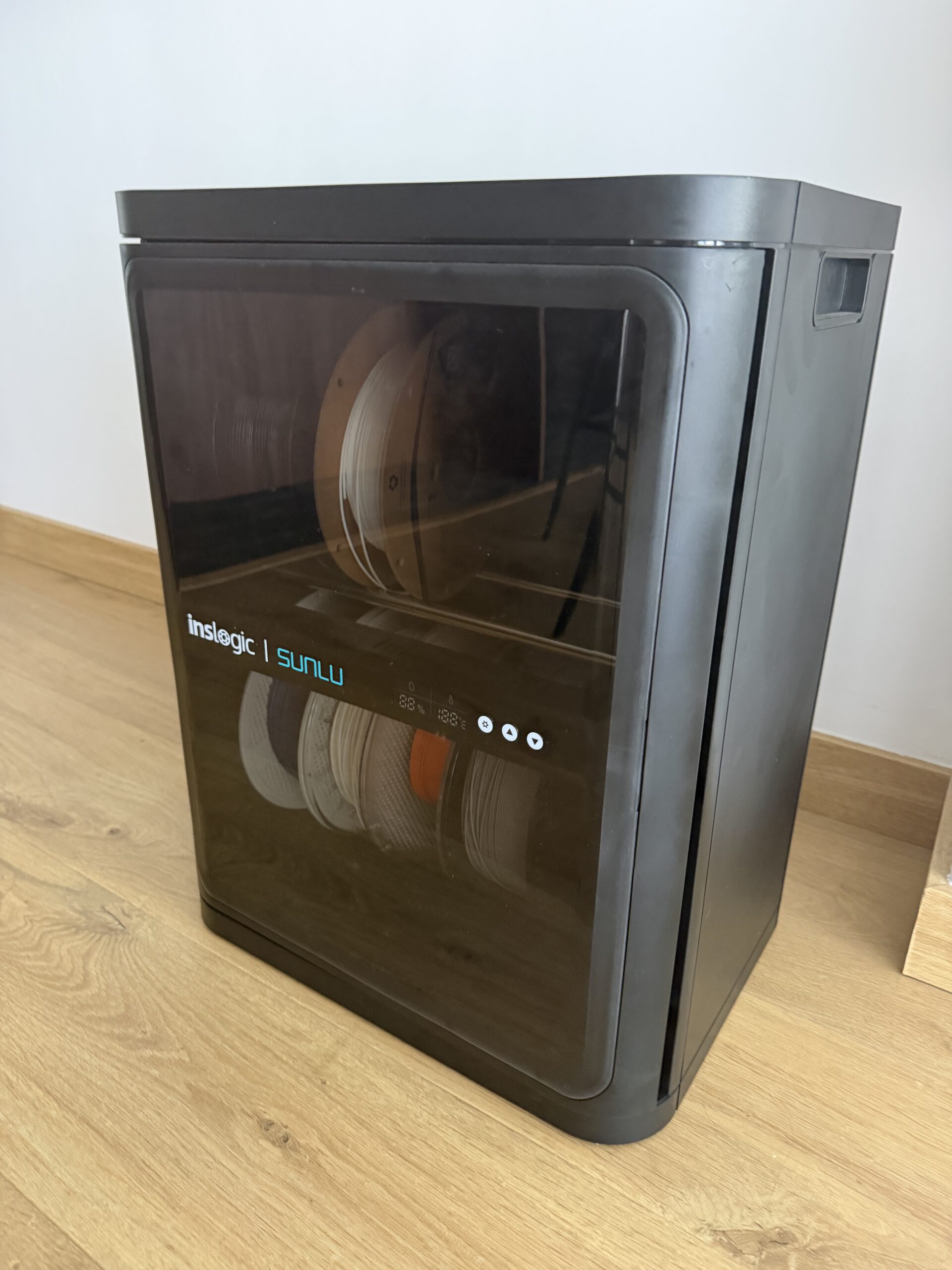
I tested the unit on old filament, filament I left open on a machine for 24 hours, stringing PETG filament, and various rolls of PLA, among others.The cabinet costs around $180.The cabinet is 395mm × 300 mm × 508 mm, and installing it is as simple as taking it out of the box.
It looks nice, is compact, and is as simple to use as plugging it in.My only concern with the build is the door hinges and assembly, which feel a bit flimsy.The cabinet gives a nice thud when closed, and the door works very well.
The humidity touch screen is easy to operate.The Sunlu i10 filament dryer.To operate it, set a target humidity level, and you’re off to the races.
The cabinet easily fits ten regular spools, and taking them out or putting them in is simple.The main advantage of this cabinet over other solutions is its low per-operating-hour power consumption and the fact that it keeps the filament in a stable state rather than continually heating it.How does it work? In the back of the cabinet is a desiccant storage unit with molecular sieve desiccant pearls.
Essentially, the cabinet sees to it that a constant humidity is maintained.If the desiccant itself is wet and can’t continue to maintain the drying process, a PTC heater is turned on next to the storage unit, a vent opens, and the unit warms only the desiccant while venting the moisture outside.That regenerates the molecular sieve material.
This is a pretty nifty solution.After heating stops, the desiccant can absorb moisture again.This regeneration process should last for many cycles, perhaps hundreds, and perhaps over 3 to 7 years.
And because it’s not trying to heat the entire cabinet or continually heating, and it has expensive parts, the energy cost and the unit cost are low.The Sunlu i10 filament dryer.Living with it day to day? I never heard either of the two fans inside the body.
It’s just there, doing its thing, perfectly unobtrusive.I’ve pretty much got printers running all the time in the room it’s in, but even when not, I never hear it.If you open the door a lot, performance suffers, and it will take a day or so to fully level out initially.
When I turned off the unit and replaced all the filament rolls, it took about a full day to level out the humidity.I got optimal printing results a week after that (8 days total).For weeks, I kept all the filament I was using in, switching out multiple rolls daily, and it performed well.
During that period, we had very high temperatures here in Valencia and big temperature swings in the house, too.We also had wide humidity swings.There were also sudden weather shifts.
All the while, in these conditions, it worked well, which is admirable.I used the unit for several weeks on end with PETG, PLA, TPU, and PA.I used filament from Polymaker, Prusa Research, Bambu Lab, and 3D4Makers.
I also put in “wet” old rolls that were brittle and rejuvenated them in the unit.This worked less well, but performance improved.When using dry or new rolls of filament, it kept the material well conditioned for over two weeks.
Stringing effects, especially in PETG, were significantly reduced.PLA brittleness was reduced as well.Issues? The Sunlu i10 filament dryer.
For best performance with wet filament, wait eight days.New filament is conditioned from the get-go, however.If you’re looking for this to solve all your problems with hygroscopic filaments, it won’t.
If you print with an open spool, then keeping PETG and PLA in the cabinet when not printing will generally lead to better results.If you use an AMS or other dry box and then pop it back in here, then your filament will almost always be well conditioned.Open-spool printing with PA really doesn’t work well, so you may want to use an active heater to dry it before printing.
So it’s really an expectation management thing.If you use all-new filament and keep it in here, then print closed, performance will be very good.For whom is this? The Sunlu i10 filament dryer.
If you use a lot of filament and swap it out across several machines, you’re going to love this.If you work in a makerspace, school, or shared space of some sort, you will love this too.In these spaces, its ease of use will be even more valuable.
Rather than everyone popping spools in the wrong boxes, not putting them in a dry box, forgetting the desiccant, etc., everyone can just pop them in the box.I really think this could be a great solution for hackerspaces and schools, helping everyone print better.Right now, I’m testing two different printers and using two more.
And I’m continually switching out several of the same spools.For that kind of thing, it’s a great solution.Verdict I’ve had some terrible experiences with Sunlu filament.
So I put this thing to use with some trepidation.But I really like it.It works.
What’s more, for the filaments that you need closest at hand, this is a great little storage solution that’s compact and makes it easy to find and use rolls while keeping them well conditioned.Image courtesy of Joris Peels/3DPrint.com Subscribe to Our Email Newsletter Stay up-to-date on all the latest news from the 3D printing industry and receive information and offers from third party vendors.Print Services Upload your 3D Models and get them printed quickly and efficiently.
Powered by FacFox Powered by 3D Systems Powered by Craftcloud Powered by First Mold Powered by Xometry 3DPrinting Business Directory 3DPrinting Business Directory
Read More