
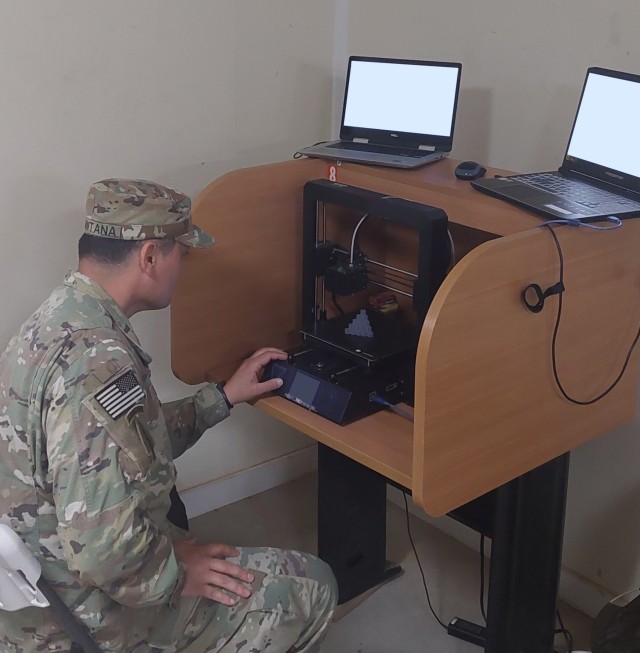
Cybersecurity has been something of a blind spot for the additive manufacturing (AM) industry.In the second half of this year, this started to change: in September, leading prosumer brand UltiMaker, for instance, launched the “Secure Line” of 3D printers, and about a month later, Bambu Lab announced it was establishing a “Trust Center” to assure customers that the company treats privacy concerns as a top priority.Meanwhile, in November, the enigmatic Czech AM thought leader Josef Prusa wrote an op-ed entitled “China’s grip on 3D printing is becoming a military security threat for the British,” not long after declaring that “open hardware desktop 3D printing” is dead.
Prusa, of course, very much has a dog in this fight, but generally, his perspective seems valid.To be sure, all of this concern largely stems from the steady rise in AM adoption by militaries around the world.Defense remains the market that the vast majority of companies in the AM space are most preoccupied with, and this doesn’t look like it’s going to change any time soon, given that global defense spending continues to hit record highs.
At the same time, the private sector isn’t immune to anxiety surrounding the security of its AM operations.In an interview I did in September with Fadi Abro, Sr.Global Director of Automotive and Mobility at Stratasys, and Dallas Martin, AM Engineer at Toyota North America, Martin told me that the auto giant has started to weed desktop-grade printers out of its plants, mainly as a cybersecurity precaution.
Despite the fact that the AM industry has seemed to mostly downplay the issue until the last several months, at least one company exists that specializes in providing AM-centered cybersecurity solutions.The UK’s DEFEND3D has developed a patented technology enabling users to protect their IP while sharing print files (as well as the files related to a host of other digital manufacturing technologies).Anyone interested can check out this comprehensive white paper on the company’s core tech, but the most important detail to keep in mind for the present discussion is found in this sentence immediately preceding the paper’s conclusion: “The DEFEND3D solution does not send 3D files but allows a digital asset to be live streamed to a 3D Printer in real time, providing only necessary information to be accessed at any time before instantly deleting processed information.” The founder of DEFEND3D, Barrett Veldsman, is deeply convicted in his belief that the AM industry is at an inflection point when it comes to cybersecurity.
When I interviewed Veldsman just before Thanksgiving, the difference between data streaming and sending complete files was the touchstone that Veldsman recurrently came back to in order to reinforce that the shift in perception is imminent: “A lot of people casually use the word ‘streaming’ when they talk about blockchain,” Veldsman began.“Blockchain is not streaming.If it were, you’d see Netflix and Spotify using blockchain, but they don’t.
They stream: they don’t send you the whole file.“They stream the file in real time, and it’s important not to confuse the two, because the moment you deliver the whole file, it sits at rest.And files at rest can be copied, stolen, and hacked.
Streaming, on the other hand, doesn’t leave anything behind.” The RRS Sir David Attenborough.Image courtesy of British Antarctic Survey.DEFEND3D’s tech has been validated by UK Strategic Command, part of the nation’s Ministry of Defence (MOD), and the company’s software enabled a bracket to be printed in Antarctica aboard the RRS Sir David Attenborough, in an environment where bandwidth issues would’ve made file downloads unusually difficult.
The difference between downloading and streaming files, then, is a matter of overall performance, not solely a cybersecurity consideration: “You can’t send a 10 gigabyte part to the Sir David Attenborough,” Veldsman asserted.“That file’s just never going to get there.“We tested it, we sent the same part file to the ship, and it never downloaded.
We streamed the file at the same time, and the captain was able to print it in real time while the first file was still downloading onto his email.Not being able to stream parts into austere environments is holding back the potential for distributed manufacturing.“Let’s say a ship like the Sir David Attenborough doesn’t have a metal 3D printer on board.
When they enter a port, if there’s a metal printer in the area where they’re porting, they can stream the file while they’re on their way and pick it up once they arrive.“Everything is in the cloud.We stream our games, our movies, our music, our photos.
The only thing we’re not streaming is manufacturing data.” Taking the example of streaming music as a frame-of-reference, I asked Veldsman if he thinks that a fair comparison for where the AM industry is right now would be the Napster era.Music was rapidly starting to digitalize, but it was still in a grey zone: the lack of participation by major stakeholders and the non-existence of cloud capabilities meant that the widespread availability of infrastructure that could support streaming was still a way away.Veldsman lit up when he heard that comparison: “That’s exactly where we are right now.
We’re in that Napster era where people are taking their innovations, making them available for download, and leaving them sitting on every hard drive they’re transmitted to.But the reality is, there’s another solution.“There will always be thieves, but when theft is as widespread as it was during the early stages of digital music, the vast majority of people were only stealing files because they had no other option.
Once streaming services existed, people were by and large happy to pay for subscriptions.“I think there are similar issues holding back right-to-repair.Right-to-repair is essentially just consumers saying, we want access to the file.
The OEMs response is that they can’t just let everyone have access to a file worth millions in IP and then have it sit on the average customer’s laptop.” Currently, the way that AM users approach cybersecurity still more or less hinges on airgapping: disconnecting the hardware from the internet.This is at best a crude solution, however, and according to Veldsman, it’s ultimately not a solution at all: “The whole attitude of, ‘We don’t plug the printer into a network’ — it means nothing,” Veldsman said bluntly.“The file will sit there until, say, two years later, when you have to do an update, all of the information sitting on your printer gets sucked out, and you don’t even know that it’s gone.
“Digital technology is always going to need updates, there’s no way around that.The problem isn’t the hardware, it’s the software.We can have the best of both worlds if we stop storing the files: you can still use your Bambu Lab printers, as long as you’re streaming the data.
“The problem is that, under the status quo, the norm is that printers require the entire file on the hard drive at any point, or they won’t print.Again, that’s like saying that when you use Netflix, you need to download the entire film in order to watch it.That’s not how it works!” Veldsman appears to be correct that a shift is coming.
Outside the confines of the AM industry proper, an article was published on Bloomberg Law, “Protecting Your IP Needs to Keep Pace With Additive Manufacturing”.While the author didn’t touch upon the streaming issue (to Veldman’s chagrin, he still emphasized blockchain as a key part of the equation), the general tenor of the piece illustrates how the topics at hand are even starting to filter into the mainstream: “A single leak can undermine millions of dollars in research and development, reduce the exclusivity of a breakthrough product, or flood markets with unauthorized, and potentially inferior, copies.Traditional IP frameworks were built for an era of centralized production.
Patent law assumes a visible chain of manufacture, where infringement was tangible and traceable.“But AM breaks that assumption.CAD files can now cross jurisdictions and networks invisibly.
Enforcement under existing frameworks is complex, time-consuming, and expensive.The disconnect creates an ‘IP gap,’ a growing divide between the pace of technological advancement and the speed of legal adaptation.” The author may not have identified all the best possible remedies, but the diagnosis of the underlying illness should be enough to sound like music to the ears of someone like Barrett Veldsman: “I’ve been screaming from the hills for a long time, but no one understood,” Veldsman concluded.“Now, I think people are starting to understand.” Unless otherwise noted, all images courtesy of the U.S.
Army
Subscribe to Our Email Newsletter
Stay up-to-date on all the latest news from the 3D printing industry and receive information and offers from third party vendors.Print Services
Upload your 3D Models and get them printed quickly and efficiently.Powered by FacFox
Powered by 3D Systems
Powered by Craftcloud
Powered by Xometry
3DPrinting Business Directory
3DPrinting Business Directory


