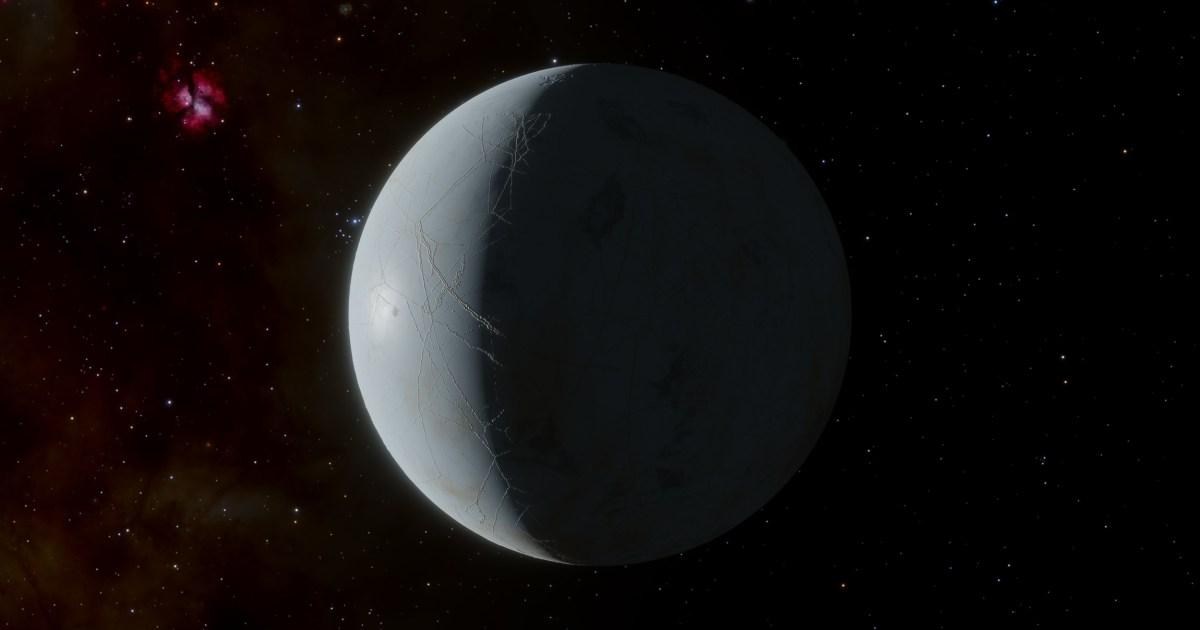
The further you get away from the sun, the weirder things in our solar system become.And one of the only things that seems to explain this – other than a ping-pong ball-sized black hole – is a ninth planet in the solar system.Only recently, some thought we might have found it, only for it to turn out to be a rocky dwarf planet – not quite big enough to be a proper one.
But a paper published today in Monthly Notices of the Royal Astronomical Society says a ‘Planet X2’ could, in fact, be out there.This hidden world is different from the so-called ‘Planet Nine’ or ‘Planet X’ idea, an orb 10 times the size of Earth, 155 billion miles from the Sun.‘The outer solar system remains an underexplored and poorly understood area of the solar system,’ Dr Alfredo Carpineti, a London-based astrophysicist not part of the study, tells Metro.
‘The possibility of larger bodies has been floated for several years.’ Wait, what is ‘Planet Nine’? A bunch of objects in the Kuiper Belt, a minefield of icy leftovers from the birth of the solar system beyond Neptune, orbit the sun in a similar way.For some reason, they all circle outward in the same part of the solar system and are tilted at about the same angle – the odds of that are one in 14,000, experts say.The thinking is that a planetary heavyweight is also doing laps in the deep outskirts of our neighbourhood, shoving them into a similar orbital path.
Its suspected orbit would be so wide that astronomers say the next time it will reach its closest point to the sun is in the year 26186.Still, nobody has yet seen this thing through a telescope.Not yet, anyway.
So, is ‘Planet X2’ something different? Researchers from the University of Southern Queensland in Australia made computer models of our solar system’s birth 4.5billion years ago.They worked out how Jupiter, Saturn, Uranus, and Neptune, thousands of small icy chunks, and 1,500 Pluto-sized worlds all tugged at one another.Over time, Neptune began hurling some icy objects far out into space while hoarding others.
When the team added Planet X2, its gravity pulled some icy objects out of Neptune’s influence and tilted others into weird orbits – sound familiar? Only a planet about twice the size of Earth orbiting hundreds of times farther away than our planet seemed to make this possible.Planet X2, or PX2, could have an elliptical orbit with a semi-major axis – how stargazers measure the size of an orbit – of 46,000,000,000 miles.PX2 differs from Planet Nine as it would be far smaller than this planetary white whale.
Trending Now Team GB basketball star charged with 11 counts of rape UK 20 hours ago By Josh Milton Man dies after being electrocuted while hanging Christmas tree lights in shopping centre Prince Harry 'could be stripped of titles by William' - and Charlotte could drop hers too Factory worker dies after 'destroying' own rectum in air gun mishap But Dr Carpineti, space and physics editor at IFLScience, says these ideas for the outer reaches of the solar system’s weirdness are just that, ‘ideas’.‘Fortunately, now we have the Vera Rubin Observatory,’ says Dr Carpineti, referring to the powerful telescope in Chile.‘As it performs its 10-year-long movie of the Universe, it will massively expand its knowledge of what lies beyond Neptune.
‘If there’s one or more planets there, we might finally spot them!’ Get in touch with our news team by emailing us at [email protected] more stories like this, check our news page.MORE: Fears Russia could launch a nuclear-armed satellite into space ‘within a month’ MORE: A giant planet just disappeared – and astronomers know why MORE: Space food is a step closer after spuds grown in ‘moon soil’ declared safe to eat Add as preferred source News Updates Stay on top of the headlines with daily email updates.
This site is protected by reCAPTCHA and the Google Privacy Policy and Terms of Service apply.Your information will be used in line with our Privacy Policy HomeNewsTech Related topics Space A giant planet just disappeared - and astronomers know why Tech 1 day ago By Josh Milton Is this the reason behind hundreds of little red dots in the sky? Tech November 12, 2026 By Josh Milton
Read More