Thanks to the internet, it’s incredibly easy to open an app and immediately get a detailed weather report.But what you might not realize is that your phone has some precise weather instruments of its own.Most phones have a barometer inside, and it’s more useful than you might think.
What does a barometer do? And why there’s one in your phone Let’s start with the basics.A barometer is a device that measures the gravitational pull on gases in the atmosphere—known as “air pressure” or “atmospheric pressure.” The weight of the air around us is constantly changing, and it can help predict the future.Old-school barometers use mercury and a graduated cylinder to measure air pressure.
The mercury rises or falls depending on how much the air is pushing down on it.Thankfully, there’s not a tube of mercury inside your phone.We now how digital barometers that measure air pressure with micro-electromechanical sensors.
Now, the reason why there’s a barometer in your phone has nothing to do with weather.Air pressure changes with altitude, and phones use that information to improve the accuracy of GPS.However, you can access the barometric readings and use them for other purposes.
Why is air pressure important? Don’t just scroll past it Why should you care about what a barometer has to say? Air pressure is one metric that helps meteorologists predict what type of weather is coming.You’ve probably heard them use the terms “low-pressure system” and “high-pressure system.” They’re talking about air pressure.High Pressure: When air pressure is rising and high—above 30.20 inHg—calm weather is coming.
Dropping pressure in this range means clouds and warming up.Low Pressure: When air pressure is rising and low—below 29.80 inHg—cooler, clear weather is headed your way.Falling pressure in this range means rain and storms.
Normal Pressure: “Normal” air pressure is in the range of 29.80 to 30.20 inHg, and it usually means the current weather conditions are steady.Rapidly dropping pressure in this range points to precipitation.Air pressure can tell us a lot about the weather, but your body also feels it.
Big changes in air pressure can cause migraines, joint pain, and affect your blood pressure and blood sugar.How to use your phone’s built-in barometer Offline weather readings There are clearly some good reasons for paying attention to air pressure.That’s why essentially every weather app that has ever been made includes current barometric pressure readings along with temperature, humidity, and dew point—another important overlooked metric.
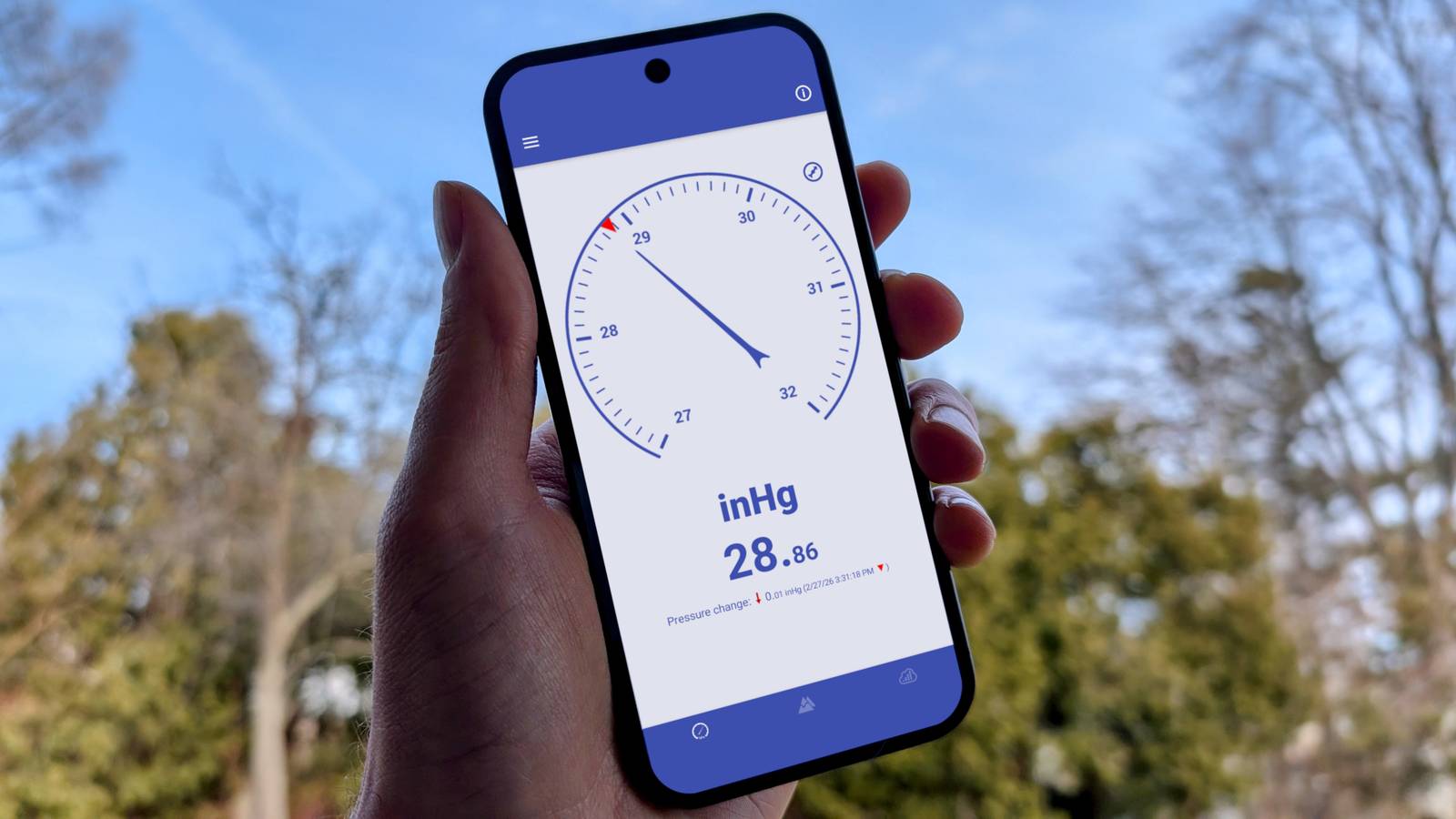
However, unlike all the other metrics you might use to get a sense of the weather, you can measure air pressure yourself without an internet-connected app.All you need is a simple app that can read the barometer tucked away inside your phone.Barometer & Altimeter by EXA Tools is a free app for Android and iPhone.
After installing the app, you just need to give it permission to access your location.Go into the settings and make sure "Pressure type" is set to "Station pressure.The app will then immediately show you the current pressure reading from your phone's barometer.
Tap the compass icon in the top corner to mark the current reading on the scale.A yellow triangle warning icon above the pressure reading means your device does not have a barometer built in.The app uses the nearest weather station if that’s the case.
As I explained earlier, the current air pressure is only one part of the equation.Changes in air pressure tell us a lot as well.You can use the mark on the scale to monitor pressure changes throughout the day.
Next time you open the app, it will report how the air pressure has changed compared to your previous mark.Subscribe to the newsletter for hidden phone sensors Want hands-on tips? Subscribe to the newsletter for clear, practical guides about phone sensors like barometers — which apps to try, how to read pressure offline, and simple ways to use built-in hardware for weather and altitude insights.Subscribe By subscribing, you agree to receive newsletter and marketing emails, and accept our Terms of Use and Privacy Policy.
You can unsubscribe anytime.At the time of writing, the air pressure at my location is in the Normal Pressure range.It’s been slowly dropping over the last few days, which usually means precipitation is coming.
So it’s no surprise that I see rain and snow in the forecast over the next couple of days.Admittedly, checking your phone’s internal pressure readings isn't the most practical way to plan your week.You’re probably not going to replace your favorite weather app with a barometer app any time soon—though the offline abilities are pretty handy.
That being said, it’s just cool to see data from a little-known sensor in your phone.A barometer is one of many sophisticated pieces of equipment under your phone screen that are constantly working behind the scenes.Even if you only open the app once in a while to see the "weight" of the sky, it's a fun little reminder of tech we often take for granted.
Related Forget Humidity, Dew Point Is How It Really Feels Outside Next time you open your weather app, skip the humidity number and look at the dew point.Trust me.Posts
Read More