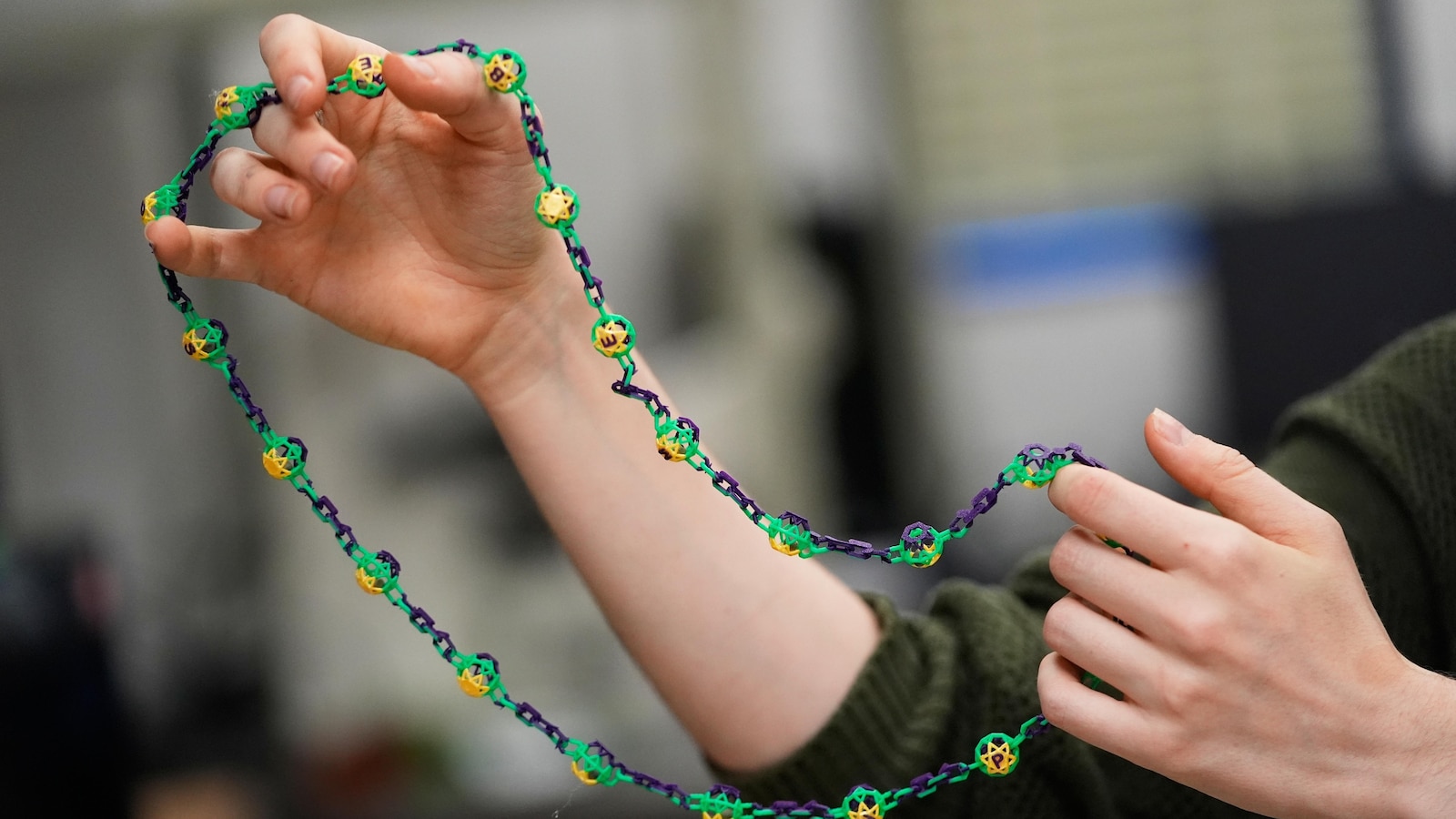
NEW ORLEANS -- It is Carnival season in New Orleans.That means gazillions of green, gold and purple Mardi Gras beads.Once made of glass and cherished by parade spectators who were lucky enough to catch them, today cheap plastic beaded necklaces from overseas are tossed from floats by the handful.Spectators sometimes pile dozens around their necks, but many are trashed or left on the ground.
A few years ago after heavy flooding, the city found more than 46 tons of them clogging its storm drains.The beads are increasingly viewed as a problem, but a Mardi Gras without beads also seems unfathomable.That is why it was a radical step when the Krewe of Freret made the decision last year to ban plastic beads from their parade.This year, beads are back, but not the cheap plastic ones.
Freret is one of three krewes throwing biodegradable beads developed at Louisiana State University.Kristi Trail, executive director of the Pontchartrain Conservancy, said plastic beads are a twofold problem.First, they clog the storm drains, leading to flooding.
Then those that aren’t caught in the drains are washed directly into Lake Pontchartrain, where they can harm marine life.The group is currently preparing to study microplastics in the lake.The trend toward a more sustainable Mardi Gras has been growing for years and includes a small but growing variety of more thoughtful throws like food, soaps and sunglasses.
Trail said there is no good data right now to say if those efforts are having an impact, but the group recently got a grant that should help them answer the question in the future.“Beads are obviously a problem, but we generate about 2.5 million pounds of trash from Mardi Gras,” Trail said.Strain works in the lab of Professor Naohiro Kato, an associate professor of biology at LSU.
He first got the idea to develop biodegradable beads in 2013 after talking to people concerned about the celebration's environmental impact.As a plant biologist, Kato knew that bioplastics could be made from plants and got curious about the possibilities.The first iteration of the lab's biodegradable beads came in 2018, when they produced beads made from a bioplastic derived from microalgae.
However, production costs were too high for the algae-based beads to offer a practical alternative to petroleum-based beads.Then Strain started experimenting with 3D printing, and the PlantMe Bead was born.For the 2026 Carnival season, LSU students have produced 3,000 PlantMe Bead necklaces that they are giving to three krewes in exchange for feedback on the design and on how well they are received by spectators.
Popular ReadsThe mysterious Nancy Guthrie abduction: A full timelineFeb 14, 4:12 PMNancy Guthrie live updates: Savannah sends message to abductor, 'do the right thing'2 hours agoMinneapolis surge ending, border czar Tom Homan saysFeb 12, 4:06 PMOne funny thing, Kato said, is that people have told him they love how unique the PlantMe Beads are and want to keep them.“So wait a minute, if you want to keep it, the petroleum-plastic Mardi Gras bead is the best, because this won’t last,” he said.Ultimately, however, Kato said, the goal should not be to replace one plastic bead with a less harmful one.
He hopes Mardi Gras embraces the idea of less waste.Rhoades said Freret is moving in the same direction.“In 2025, we were the first krewe — major parading organization — to say, ‘No more.No more cheap beads.
Let’s throw things that people value, that people appreciate, that can be used year-round,’ " Rhoades said.One of the most coveted items they throw is baseball hats with the Freret logo.He sees people wearing the hats around the city, and he says other krewes have noticed.“I really believe that we, and other krewes, are able to inspire your larger krewes,” he said.
“They want people to like their stuff.They want people take their stuff home, and use it, and talk about it, and post it on social media, and say, ‘Look what I just caught!’ ”___Loller reported from Nashville, Tennessee.
Read More