Fedora is known as the leading-edge Linux distro, offering an excellent balance between stability and access to the latest Linux features.Ubuntu, on the other hand, has traditionally offered a stable and reliable experience but has often lagged behind Fedora.It’s actually one of the main reasons I decided to ditch Ubuntu, even though it was my first Linux distro.
However, lately, Ubuntu has upped its game, shipping with more experimental and cutting-edge features while retaining the same stable and reliable core it’s known for.In the past, I always argued that Fedora beat Ubuntu in almost every single area, but I no longer feel that’s the case.In fact, I think Ubuntu is beating Fedora at its own game.
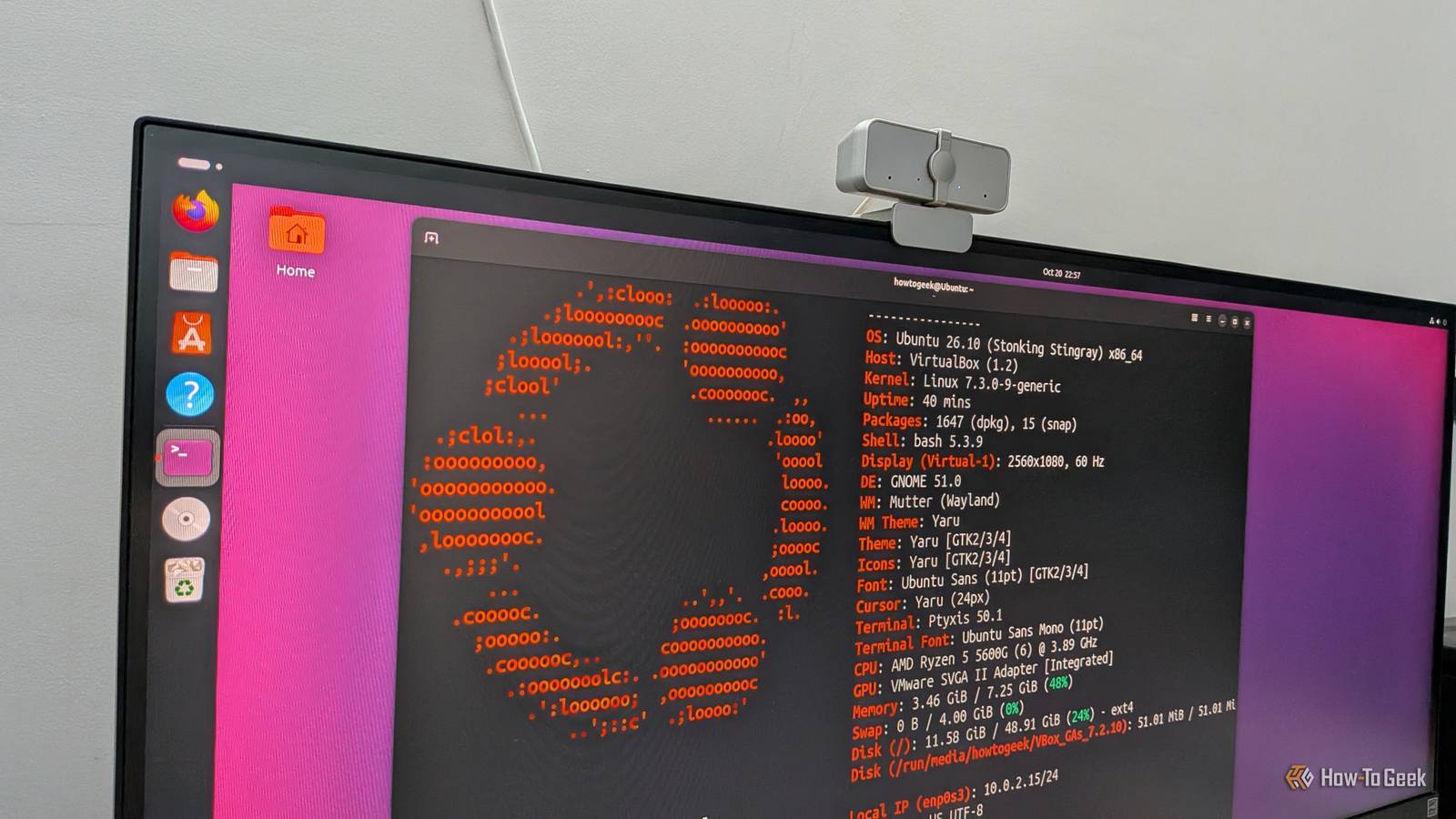
Ubuntu is now more cutting-edge than Fedora Ubuntu 26.10 is more up-to-date than Fedora 45 Close The latest Ubuntu 26.10 ships with Linux Kernel 7.3, while Fedora 45, which, at the time of writing, is still more than a week off, will ship with Kernel 7.2.What’s more interesting is that kernel 7.3 was scheduled for release October 18th, but Ubuntu 26.10 dropped with it on October 15th, making it the first stable-release distro to feature the latest kernel.I should mention that kernel 7.3 brings a bunch of welcome improvements, including noticeable I/O performance gains, scheduler improvements, better performance on low-VRAM GPUs, and support for the new Steam Controller.
And this isn’t the first time Ubuntu got the jump on Fedora.In April, Ubuntu 26.04 LTS shipped with Kernel 7.0, while Fedora 44, which also released the same month, shipped with Kernel 6.19.Now, some of you might be saying it’s just one point release, so why does it matter? And in a way, you’d be right, because Fedora users should be able to upgrade to kernel 7.3 with a regular dnf upgrade command within a few weeks.
However, this is more about giving Ubuntu an extra point than subtracting one from Fedora.Historically, Ubuntu has been slow to adopt the latest features and updates — pushing enthusiasts toward Fedora.So seeing Ubuntu take the initiative here is a welcome change.
Of course, both Ubuntu 26.10 and Fedora 45 ship with Gnome 51.Related Fedora isn't the best cutting-edge Linux distro anymore Fedora had a good run—but there’s a new distro on the cutting edge throne.Posts 84 By Dibakar Ghosh Other than this, Ubuntu is replacing the GNU coreutils with the new Rust-based uutils versions.
Most of the core system commands like ls, cat, and chmod were already replaced with Ubuntu 26.04 LTS, but a few commands like cp, mv, and rm were held back, until version 26.10, making the transition complete.This matters because it’s usually Fedora that’s first to replace old system pieces with newer alternatives.It was the first major distro to adopt Wayland and PipeWire, with Ubuntu coming on board years later.
However, at this moment, Fedora keeps the Rust-based uutils as an optional add-on, while Ubuntu is shipping them as the new system defaults.Granted, the new Rust alternatives aren’t objectively better in every way.For instance, the Rust versions remove a whole class of memory-safety bugs, but they still fail some GNU compatibility tests.
That said, I’m in the camp that thinks the Rust versions are the future, and I fully expected Fedora to be the one embracing this future, not Ubuntu.Related Why I’m Excited That Rust Is Coming to the Linux Kernel Liberating the kernel.Posts 5 By Bobby Jack Ubuntu shipped the CPU-optimized build that Fedora turned down Fedora hesitated — Ubuntu didn’t Ubuntu is also expanding its support to more hardware categories.
It already offers dedicated desktop ISOs for ARM and RISC-V, and with 26.10, the RISC-V image now delivers a full desktop experience on RVA23 hardware.However, the bigger news for most people is a new ISO built specifically for x86-64-v3 CPUs.This means if your system is running an Intel Haswell onward or any AMD Ryzen chip, you can use this ISO to unlock better performance.
The gains aren’t earth-shattering, but they’re real enough to make a difference.You can check out Phoronix’s breakdown to get an idea of where you’ll see the biggest improvements.Now, Fedora also had a proposal on the table to build x86-64-v3 packages for Fedora 45 as the primary architecture while keeping x86-64 (v1) for older systems.
It was debated for months, but was ultimately postponed to Fedora 46 at the earliest.The developers wanted more performance data before giving it the green light — which isn’t a bad thing, but the resulting conclusion is that the distro known for adopting things first just got beaten by Ubuntu, of all distros.Related 5 High-Performance Linux Distros for Modern PCs and Laptops Who says Linux is only for old and weak systems? Posts 5 By Dibakar Ghosh Ubuntu is currently ahead for developers running local AI Fedora might no longer be the best distro for developers Close While Fedora has never called itself an AI distro, it’s often considered the best distro for software developers.
And like it or not, a lot of modern software development now involves AI, or more specifically, LLMs.On that front, it appears that Ubuntu 26.10 is pulling noticeably ahead.The clearest example is ROCm (Radeon Open Compute) — AMD's GPU computing stack that local AI tools run on if you have a Radeon card.
Ubuntu 26.10 ships ROCm 10.0, while Fedora 45 comes with ROCm 7.2.With version 10, you’re getting support for vLLM and SGLang, two popular frameworks for serving local LLM models.So, at least at the time of writing, Ubuntu 26.10 is the better platform for developers who use local AI and run AMD GPUs.
Speaking of which, Ubuntu also introduced a new AI-powered speech-to-text tool called Myna.It works completely locally and the accuracy is also pretty impressive — good enough for you to could rely on it as your everyday dictation tool.Under the hood, you can pick between different transcription models like OpenAI’s Whisper and Nvidia’s Parakeet.
It's currently available as an optional installation.You can get it on your system by entering the following commands: sudo add-apt-repository ppa:canonical-desktop-team/myna ## add the apt repository containing the Myna Settings app sudo apt install myna-config ## install the Myna Settings app.This is what you'll use to configure Myna sudo snap set system experimental.user-daemons=true ## Turns on Snap feature for Myna to work sudo snap install myna --edge ## Install the Myna app To me, this counts as the first step toward the local-first (as opposed to a cloud-first) AI operating system Ubuntu is building.
While I do understand AI is a controversial subject, there’s no denying the fact that the technology is here to stay.It can be an asset when used responsibly — as is the case with local AI models, where all your data stays on your machine and isn’t shared with any third party.So the fact that Ubuntu is more proactive about this AI future clearly makes it the more “cutting-edge” distro.
Related AI is splitting Linux and nobody wants to say it out loud Distro leaders draw stark AI lines from outright bans to cautious embrace, upending contributor norms and trust networks.Posts 17 By Sydney Butler Fedora still beats Ubuntu — but in an area that doesn’t matter much Being on the leading edge is only one part of what Fedora is known for.The other, equally important bit is its strict adherence to free and open-source software (FOSS).
By default, Fedora ships only FOSS apps and packages in its official repo.While this is admirable in principle, in practice it creates a lot of unnecessary headaches.For example, if you want anything proprietary, be it media codecs or drivers for your hardware, you’re going to have to download it from a third-party source like RPM Fusion.
Now imagine trying to install Fedora on a laptop where the Wi-Fi requires a proprietary driver.This basically prevents you from installing that driver without reaching for another system.However, the major hiccup is proprietary NVIDIA driver support.
The open-source Nouveau drivers are lackluster, to say the least, which makes the proprietary drivers a must.And while they’re readily available from RPM Fusion, installing them can turn into a major technical headache.Compare this to Ubuntu, which has no such restrictions and includes both FOSS and proprietary packages in its official repos.
In fact, because of its popularity, almost every proprietary app that comes to Linux almost always has a dedicated package for Ubuntu.This makes it the most convenient distro to get started with.Related Want to try Linux? Just install Ubuntu or Fedora Tune out the distro wars, at least for now.
Posts 4 By Corbin Davenport
Read More