Maker Dzingof was doing tonnes of electroplating of desktop and other 3D prints years ago with his Metalizzr project.I’ve been playing, a lot less successfully, with electroplated 3D prints since before that.Electroplating is a new path to metalized parts.
Electroplated polymer parts have a metal coating that can withstand some environmental pressures.But, in terms of strength and performance, it can’t really be considered a metal part.The parts also always feel weird because they’re much lighter than they look.
Electroplating can also be complex, and depending on the process used, it leaves behind materials that you don´t want to spend much time with.It’s also way too finicky and difficult for most people.But it can provide conductive traces and some of the properties of metal parts.
Now, research by Gianluca Percoco, Nicola Larovere, Antonio Zagaria, Antonio Pavone, Rosanna Rifino, and Gianni Stano of the Department of Mechanical, Mathematical, and Management (DMMM) at Polytechnic University of Bari aims to make it easier for people to produce electroplated parts using desktop machines.Published in Advanced Materials Technologies, the paper is called “In Situ Copper Electroplating Turns Material Extrusion 3D Printers Into Metal–Polymer Hybrid Fabricators.” In the paper, the team shows how they’ve developed a small electroplating head, developed G-code to let you plate while you print, and, in certain areas, a printing method to go with it.The team then tests making a strain gauge and a circuit, and hopes that their research will enable desktop machines to be used to make electronics.
Over 10 years ago, Italian boutique machine builder RobotFactory developed a desktop electroplating device that you can use along with 3D printers.Others have always worked with a separate electroplating device and step.But now we may be able to do this on one device.
What’s more, with this technique, you’re really creating a hybrid polymer-copper structure that may have interesting capabilities.In this case, the team focuses on making electrically conductive polymers with a view to making circuits, actuators, traces, and other electronics.The printer used was a super inexpensive Bambu Lab A1, and the filament was good old PLA, as well as CPLA from Protopasta.
A power supply was connected to a syringe piston that, on demand, pumped electrolyte solution through the PTFE tube past a copper coil through a sponge on the electroplating head.Enclosed through a luer lock, the sponge can be in contact with a brush.Meanwhile, the normal head, with the AMS, prints the PLA and later on the conductive material.
The Arduino-controlled pump feeds electrolyte material to the sponge and brush head, closing the circuit and locally plating an area.The plating head just moves in X and Y, but after it is done, additional polymer can cover the copper area.To make this work, the team used a Machine learning algorithm to determine where and when electroplating can take place, and therefore when printing has to stop.
It also looks at where conductive material has been placed previously.The tool can translate the right target electroplating area into G-code that tells the printer when to stop, go, and switch heads.The BOM costs of the electroplating head were less than €95.
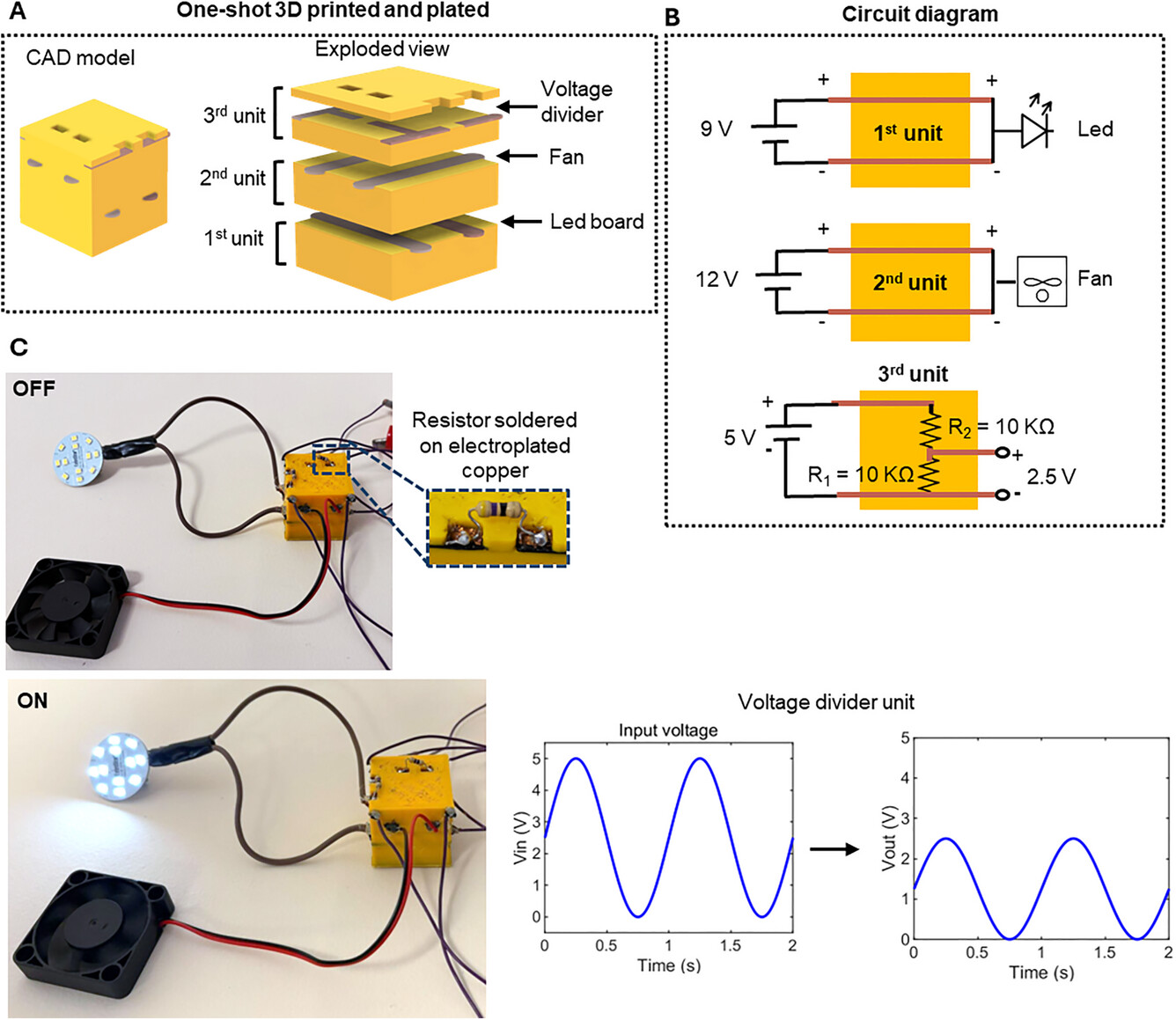
So, for around $300, you could develop a kit that could make this commercially viable.This could potentially mean that for $700, you could perhaps be 3D printing circuits at home.To test their work, the team made a piezoresistive sensor, traces, a voltage divider circuit, and other circuits.
They achieved a resistance of 0.15 Ω, 400% higher than that of Conductive PLA, with one pass of the nozzle.One interesting thing that they propose is that the copper parts can be heated while encapsulated by the polymer, triggering shape memory events, for example.A 3D printed circuit that could work while submerged in water was also a nifty demonstrator, as was a “smart dice” that could power three things at the same time.
This approach seems like it could actually work well.Of course, to make it work in Bari and then to have it work every time in your house is going to be quite a bit of work.But turning inexpensive desktop 3D printers into circuit 3D printers is an amazing piece of work.
Allowing for low-cost tinkering with electronics by many labs, students, and makers could lead to completely new devices and methods.At the same time, this is a powerful way of showing just how powerful desktop 3D printers have become.The tens of millions of units sold and their accuracy mean you can build real tools on top of them that millions of people can implement.
Subscribe to Our Email Newsletter Stay up-to-date on all the latest news from the 3D printing industry and receive information and offers from third party vendors.Print Services Upload your 3D Models and get them printed quickly and efficiently.Powered by FacFox Powered by 3D Systems Powered by Craftcloud Powered by Xometry 3DPrinting Business Directory 3DPrinting Business Directory
Read More