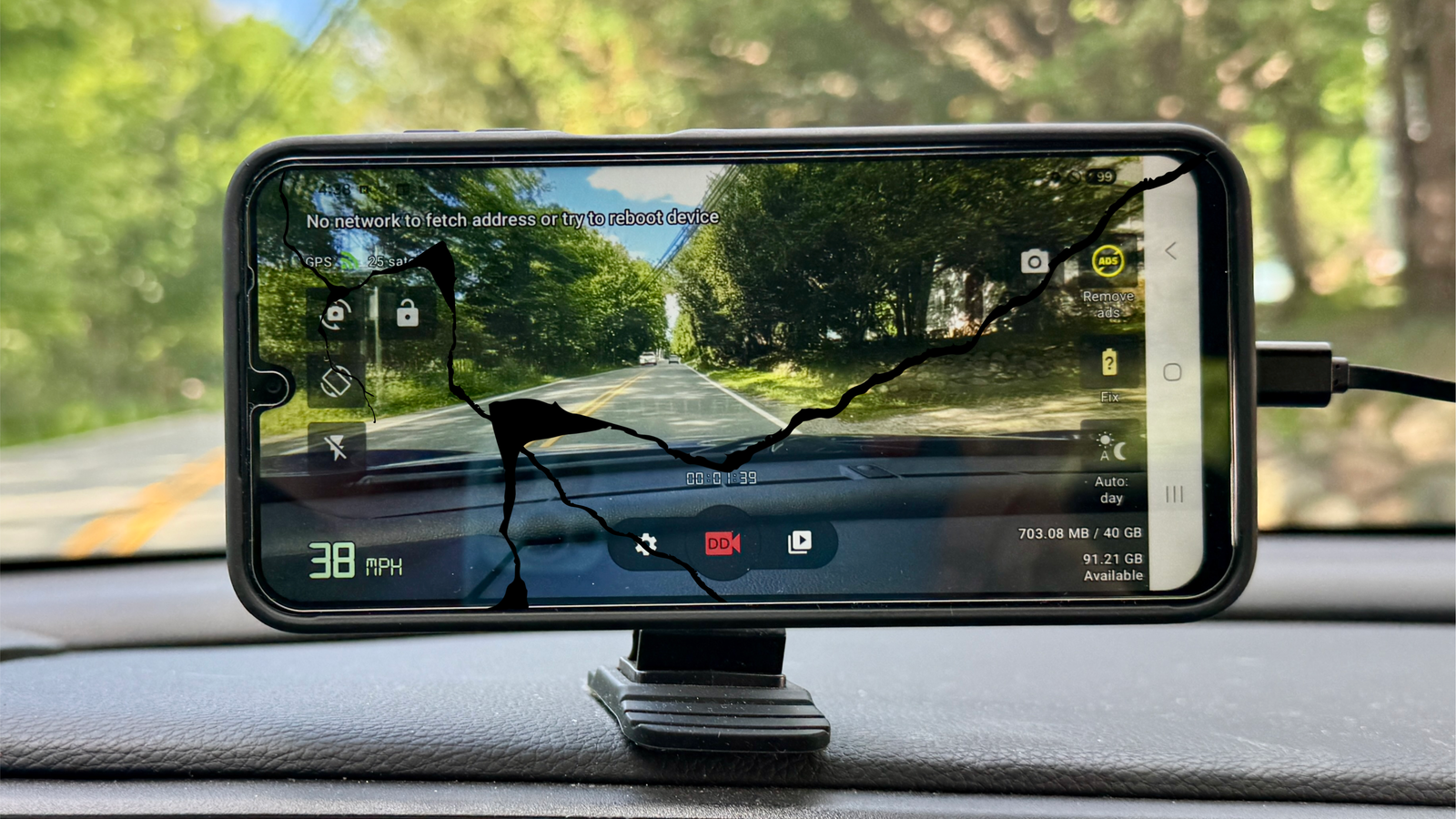
As our phones have become more powerful, they have evolved into much more than devices for making calls.However, just because our phones can do something does not mean they are the best tool for the job.As someone who turned an old Android phone into a dashcam, I can say that I regret doing it and will be switching back to a dedicated dash camera.
Placement was a pain to figure out Phones are bigger than a traditional dashcam While this might not seem like an issue at first, it quickly becomes a reality once you start setting everything up in your car.Finding a place to mount your old phone can be tricky since nearly every vehicle has a different dashboard layout.This became a problem for me when I traded in my car and got one with a completely different interior design.
Instead of being integrated into the dashboard, the infotainment screen sat raised from it.The car’s interior layout became a hurdle Due to that change, I could no longer mount my phone the way I had in my previous car, using a magnetic dashboard mount.There was virtually no feasible place to put it.
While I could technically place a mount behind the raised screen, it would be inconvenient to reach every time I got in the car.It also would not be in my line of sight while driving, meaning I could not easily glance over to confirm the phone was still recording and that the dashcam app had not encountered any issues.There is a mount that attaches around the infotainment screen and allows you to magnetically secure your phone to it, but I found the position it placed the phone and camera in to be impractical.
I tried using it in both portrait and landscape orientations, but neither provided a satisfactory view of the road for dashcam purposes.Additionally, I tried a mount that hangs from the rearview mirror, but it also quickly proved impractical, which is why I originally switched to a dashboard mount.I found that it obstructed my field of view while driving, which is obviously not safe, and it was also far too bulky for my liking.
Its positioning also caused the phone to sit too low, preventing it from capturing a field of view appropriate for use as a dashcam.But no matter how I set it up, I realized one thing: my old phone was much larger than a traditional dashcam.While the larger screen made it easier to see what was being recorded, it also took up more space and obstructed a larger portion of my field of view.
Overheating became a real problem My phone would overheat due to overuse and the weather Another issue I kept running into was my phone repeatedly getting hot from being on constantly.While I never touched it while driving, it was often excessively warm when I removed it from the mount.This happens because the phone is processing several demanding tasks at once, with the CPU, GPU, and camera sensor all working simultaneously.
Together, they have to capture, process, and encode video footage, which generates significant heat.On top of that, recording video drains the battery quickly, so I had to keep the phone plugged in to ensure it stayed powered throughout my drives.Constant charging adds even more heat to the device.
To make matters worse, the sun is another major contributor.Due to the phone sitting near the windshield—which is often exposed to direct sunlight—it can become even hotter as the windshield amplifies the heat inside the vehicle.So, with all these factors combined, my phone quickly got hot throughout my drive and was uncomfortable to hold when I took it off the mount.
However, it was not just my hand that suffered from the heat; the phone itself did, too.If a phone consistently gets too hot, it can damage the hardware inside.This includes battery degradation, which can affect how much charge the device holds, and in some cases, lead to battery swelling.
But it is not just the hardware that takes a hit—the software does too.To cool itself, the phone reduces CPU and GPU performance, resulting in thermal throttling.This can cause lag, stuttering, and app crashes.
This happened to my device multiple times.The screen would dim, making it difficult to see what the app was recording.Then, when I tried to quickly check on everything, the phone became sluggish and glitchy.
Unable to get location data No cellular plan meant no location information While the app I use does a great job of accurately showing my driving speed, it falls short in location tracking because it cannot consistently access location data.This is not the app’s fault, but rather a limitation of my old phone, which is no longer connected to a cellular plan.Since I don’t use the phone as my primary device, I don’t pay for a cellular plan on it, meaning it can only access the internet when connected to Wi-Fi.
Personally, I didn’t see the value in paying for a separate phone line for a device that I rarely use outside of dashcam duties.Deals Save on Dashcam Gear and Accessories — Deals Now Find discounts on car tech, mounts, chargers, and dashcam alternatives in Accessories & Everyday Tech deals.Score savings on compact cameras, power solutions, and hands-free mounts to improve safety, reduce overheating, and simplify installs.
Deals Explore Accessories & Everyday Tech Deals I technically could use my phone’s hotspot while driving, but my plan has a hotspot data limit.As a result, I didn’t want to become reliant on it only to run out of data when I need it most.Garmin Dash Cam Live Get the new Garmin Dash Cam Live with LTE, allowing for always-on recording, live feeds, and more, starting at $399.
$400 at Amazon Expand Collapse Garmin Dash Cam Mini 2 Garmin's Dash Cam Mini 2 is small enough to hide behind your rearview mirror, records crisp 1080p video, and more.If you have Wi-Fi in your vehicle, it can alert you even while you're away from the car. See at Amazon Expand Collapse Many dedicated dashcams include location tracking at no additional cost.While the app I use offers similar functionality, it is not comparable in my situation because my old phone does not maintain a constant cellular connection.
Good for short-term, not for long-term My old phone came in handy when I needed a dashcam for a short period, but with extended use, I began to notice its shortcomings.If you’re in a pinch or on the fence about buying a dedicated dashcam, repurposing an old phone can be a practical temporary solution.However, over the long term, its limitations become much more apparent.
Read More