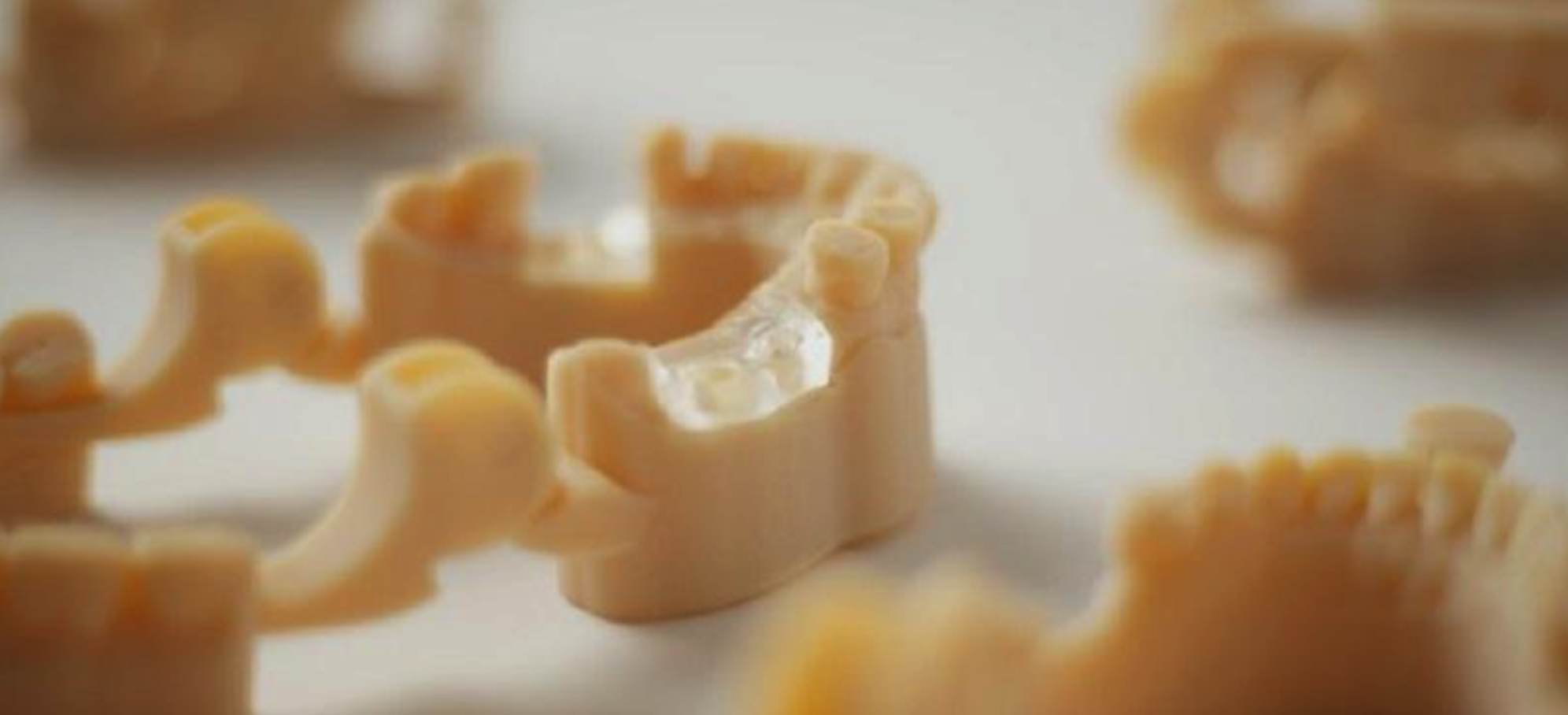
The dental industry has undergone a dramatic transformation over the past decade.Traditional fabrication methods, such as manual casting, milling, and hand finishing, are being steadily replaced by digital workflows that leverage 3D scanning, CAD design, and additive manufacturing.Dental labs use a variety of additive technologies, including SLA (stereolithography), DLP (digital light processing), and PolyJet to produce highly accurate dental components directly from digital impressions.
These technologies offer: Faster production times High precision and fit Customization at scale 3D printed models at Neus Dental.Image courtesy of PostProcess Technologies.But while printing itself has matured, post-printing workflows, specifically cleaning resin and removing supports, has remained a manual, messy bottleneck that limits scalability.
PostProcess Technologies has emerged as the industry leader in solving this challenge, offering automated systems that replace labor-intensive methods with software-driven efficiency and safer detergents.Eliminating the Hazards of Isopropyl Alcohol The traditional standard for cleaning resin dental models involves Isopropyl Alcohol (IPA).While effective to a degree, IPA presents significant health, safety, and environmental risks.
It is highly volatile, flammable, and requires strict adherence to safety regulations.This not only endangers operator safety but also increases the risk of workplace accidents, leading to stricter safety protocols and higher operational costs.PostProcess Technologies systems utilize proprietary detergents like PLM-403-SUB, which are non-flammable and have very low volatility.
This shift yields immediate safety benefits.For example, Schollmeier Dental reduced their chemical consumption from 180 liters of IPA per year to just 60 liters of PostProcess detergent, creating a safer environment for their technicians and a significant cost savings.Unmatched Chemical Longevity and Cost Savings DEMI X 520.
Image courtesy of PostProcess Technologies.A major inefficiency of IPA is its rapid saturation rate, leading to inconsistent results and frequent, costly fluid changes.In contrast, PostProcess chemistry is designed for longevity.
A single bath in a DEMI X 520 can process approximately 40,000 dental models before needing replacement.“Before using the DEMI X 520, we relied on Isopropyl Alcohol (IPA) to clean all of our models, but the constant need to replace the IPA each day was a significant inconvenience.Since switching to the DEMI X 520, the detergent we use hasn’t needed to be changed once in the three months we’ve had the system.
This has saved us considerable time and made the post-processing workflow much easier,” said Sean McPhail, Additive Team Lead, Great Lakes Dental Technologies.Boosting Throughput with Intelligent Automation Manual cleaning is a time-consuming, repetitive task that monopolizes skilled technicians’ time and slows overall throughput.PostProcess systems automate this workflow using intelligent software and “recipes” to ensure every part is treated with the same parameters.
The throughput gains are substantial.The DEMI X 520 is a powerhouse for high-volume production, capable of cleaning up to 150 dental models in under 10 minutes.This system is also versatile enough to handle PolyJet support removal, offering a streamlined solution for labs using printers like the Stratasys J5 DentaJet.
At the Ninety! Dental Production Center, Co-Director Olivier Mangot, reported that the technology allowed them to clean 20 times more parts than before, achieving 100% quality consistency compared to the 70-80% achieved with manual methods.In addition to the significant reduction in labour dedicated to cleaning and a clear increase in cleaning quality, the machine also proves to be low in electricity and consumable consumption.Dental operator at Ninety.
Image courtesy of PostProcess Technologies.Tailored Solutions for Every Lab Size PostProcess solutions are scalable to fit different production needs.While the DEMI X 520 serves mass production for both resin and PolyJet removal, the DEMI X 200 Plus offers a compact, “all-in-one” solution for resin removal that is ideal for smaller footprints.
This system consolidates the entire workflow, cleaning, rinsing, drying, and curing, into a single automated process that delivers finished parts in under 30 minutes.Uniquely, the DEMI X 200 Plus can be configured for post-treatment to accommodate any curing process, thanks to its high UV power across a very wide wavelength range, integrated heating, an onboard vacuum pump, and a port for nitrogen.3D printing is revolutionizing the dental industry by enabling digital, high-precision manufacturing of dental models.
But the value of additive manufacturing can only be fully realized when post-printing workflows keep pace.PostProcess Technologies automated solutions deliver faster, safer, and more consistent cleaning of 3D printed dental parts, empowering labs to boost productivity, reduce costs, and focus on creating a safe work environment for their employees.DEMI 200 Plus.
Image courtesy of PostProcess Technologies.About the Author Dean VonBank is Chief Experience Officer at PostProcess Technologies, where he focuses on improving how manufacturers adopt and scale post-print automation in additive manufacturing.With deep experience across AM workflows, Dean works at the intersection of technology, strategy, and customer experience to help companies translate advanced 3D printing capabilities into real-world production value across industries such as aerospace, automotive, and medical.
Before joining PostProcess Technologies, Dean held roles that combined operational leadership with a passion for innovation, helping organizations optimize complex processes and scale new manufacturing paradigms.Dean holds a keen interest in how software, hardware, and user experience intersect to drive adoption and measurable outcomes, making him a prominent voice in the evolution of industrial 3D printing.PostProcess Technologies will participate in Additive Manufacturing Strategies (AMS) 2026 on February 25 as part of the panel “From Mainstream to Ubiquity: 3D Printing for Dentistry.” Moderated by Laura Griffiths (TCT), the session will explore how additive manufacturing is becoming standard in dental workflows, with speakers from PostProcess Technologies, Glidewell, Stratasys, and ATLIX.
Subscribe to Our Email Newsletter Stay up-to-date on all the latest news from the 3D printing industry and receive information and offers from third party vendors.Print Services Upload your 3D Models and get them printed quickly and efficiently.Powered by FacFox Powered by 3D Systems Powered by Craftcloud Powered by Xometry 3DPrinting Business Directory 3DPrinting Business Directory
Read More