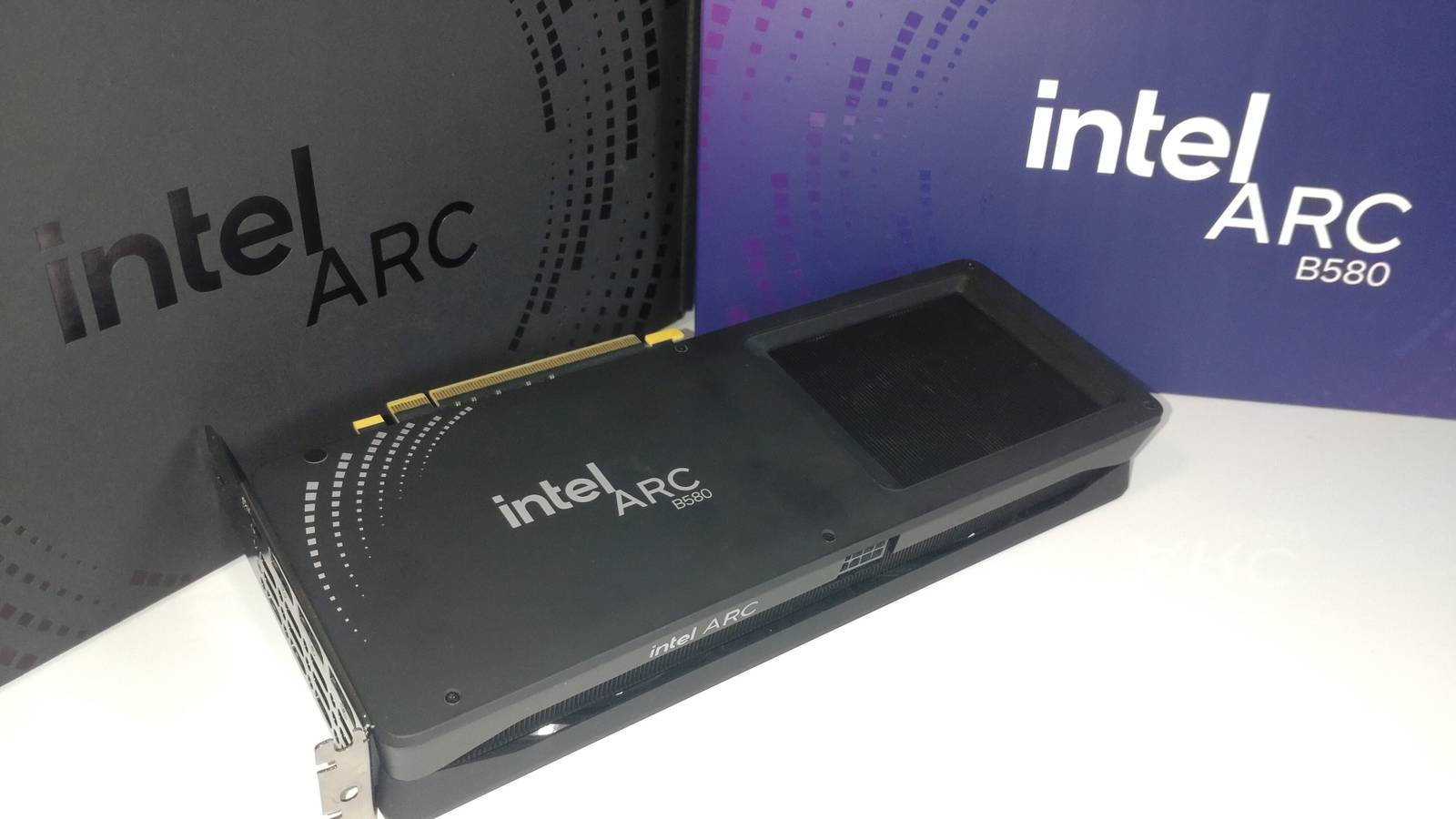
Hot take: If I were buying a GPU right now, in 2026, I wouldn't touch Nvidia with a ten-foot pole.I wouldn't buy AMD, either.I'd buy Intel.
No, I'm not joking.Intel Arc graphics cards have had an uphill climb ever since they first hit the market after many delays.And no wonder—I think that any new (well, new-ish) GPU vendor would struggle when entering a market that's been dominated by Nvidia for many years.
But, although Intel Arc faced its set of struggles, those struggles are now mostly long gone—and I'm tired of being told otherwise.Things went south before it even launched First impressions and all that I've been reporting on GPUs and the state of the GPU market for years, and those years kind of just blur together after a while.Nvidia did this, AMD did that ...
There's some hype and then we're back to waiting for the next GPU launch cycle.That's not the case with Intel Arc, though.I still vividly remember the lead-up to the launch of the Arc Alchemist lineup, which eventually hit the shelves in October of 2022.
Intel had a lot of obstacles to overcome before Arc ever became available.Let's face it, the GPU market is dominated by Nvidia, and whatever pushback Nvidia ever gets comes from fans of AMD.Both sides of that everlasting conflict were skeptical when a third player emerged, even though Intel's reputation for CPUs was unblemished at the time.
Sure, gamers started flocking to AMD, but Intel was well-known for being all around solid.The problem is that Intel's good reputation didn't extend to its GPU range, at least not at first.Arc Alchemist went through multiple delays before ever becoming available, and when it did finally launch, it was openly known that the cards had many driver issues.
Optimization on older titles was abysmal, too, with no native DirectX 9 hardware support, but Intel readily acknowledged those issues and promised to work on them.And work on them Intel did.Intel definitely went the extra mile I quickly went from feeling dubious to feeling impressed Following the launch of Arc Alchemist, Intel's dev team really showed us what a company can do when it seemingly genuinely cares.
And no, I'm not being paid to say that—the early driver efforts were impressive, helping many people lose the sour taste that Intel Arc's growing pains left behind.Instead of cutting its losses and moving on, Intel kept shipping driver updates, kept fixing compatibility problems, and kept going back to the exact weak spots people were criticizing at launch.The biggest example was older games.
Early Arc Alchemist cards were notoriously rough in DirectX 9 titles, which was a terrible look when so many long-running PC games still rely on older APIs, but Intel kept chipping away at that problem until Arc looked a whole lot less shaky there than it did at launch.The steady cleanup job made me look forward to Battlemage, Intel's second-gen discrete graphics card range, with enthusiasm instead of dread.I'm happy to report that my intuition didn't fail me this time.
Arc is legitimately good now, but it's still at a disadvantage The B-series is seriously so good Intel's Arc Battlemage arrived after months of speculation.We always knew that Battlemage wouldn't rival Nvidia's latest flagships, but many hoped we'd see the Arc B770, with 16GB or more VRAM, and see it shake things up a little.Unfortunately, Intel seems to be sticking to the budget segment with this generation.
The top consumer GPU is the Arc B580, and it's unironically one of my favorite GPUs to launch in recent years.Although the Arc B580 launched with a $249 price tag, you won't find it for less than $300 now.But that's still a palatable price for a GPU that serves up 12GB of VRAM across a 192-bit bus.
Performance-wise, it's often considered a better deal than Nvidia's RTX 4060 and RTX 5060, but it's cheaper, and it serves up an extra 4GB of VRAM.That's an important factor in future-proofing a GPU these days.Subscribe for clear, practical Intel Arc GPU analysis Gather focused Intel Arc GPU insights—subscribe to the newsletter for deep analysis of Battlemage performance, VRAM and driver developments, real-world buying guidance, and clear comparisons to help you evaluate Arc B-series and future Intel graphics.
Get Updates By subscribing, you agree to receive newsletter and marketing emails, and accept our Terms of Use and Privacy Policy.You can unsubscribe anytime.Of course, Intel still lags behind in certain areas, such as frame generation, upscaling, and so on.
But with Lossless Scaling, that's much less of an issue, and that 12GB VRAM will do well even in newer titles.Intel Arc had a bumpy road But a difficult start doesn't mean it's bad now From the launch of Arc Alchemist to the current state of things, Intel's discrete GPU division hasn't had it easy.I think that even if a relatively new player in the GPU space suddenly arrived with fantastic cards at half the price of Nvidia, many would still approach such a company with skepticism.
Tribalism aside, Intel's Arc GPUs had their own legitimate set of problems at launch, too.But just because they had a rough start, that doesn't mean they're not great now.Give Intel Arc a chance Intel's Battlemage range is affordable (compared to Nvidia, at least), much more optimized, and readily available.
I actively recommend these GPUs to friends who are building entry-level rigs.It's not going to be the best GPU you've ever seen in your life, but it'll be more than good enough.I only hope that Intel will still launch the next-gen Arc Celestial GPUs someday in the future.
Intel Arc B580 Intel's Arc B580 is an excellent entry-level to midrange GPU.With 12GB VRAM and a steady $300 price tag, it's honestly the budget king right now.$300 at Amazon Expand Collapse
Read More