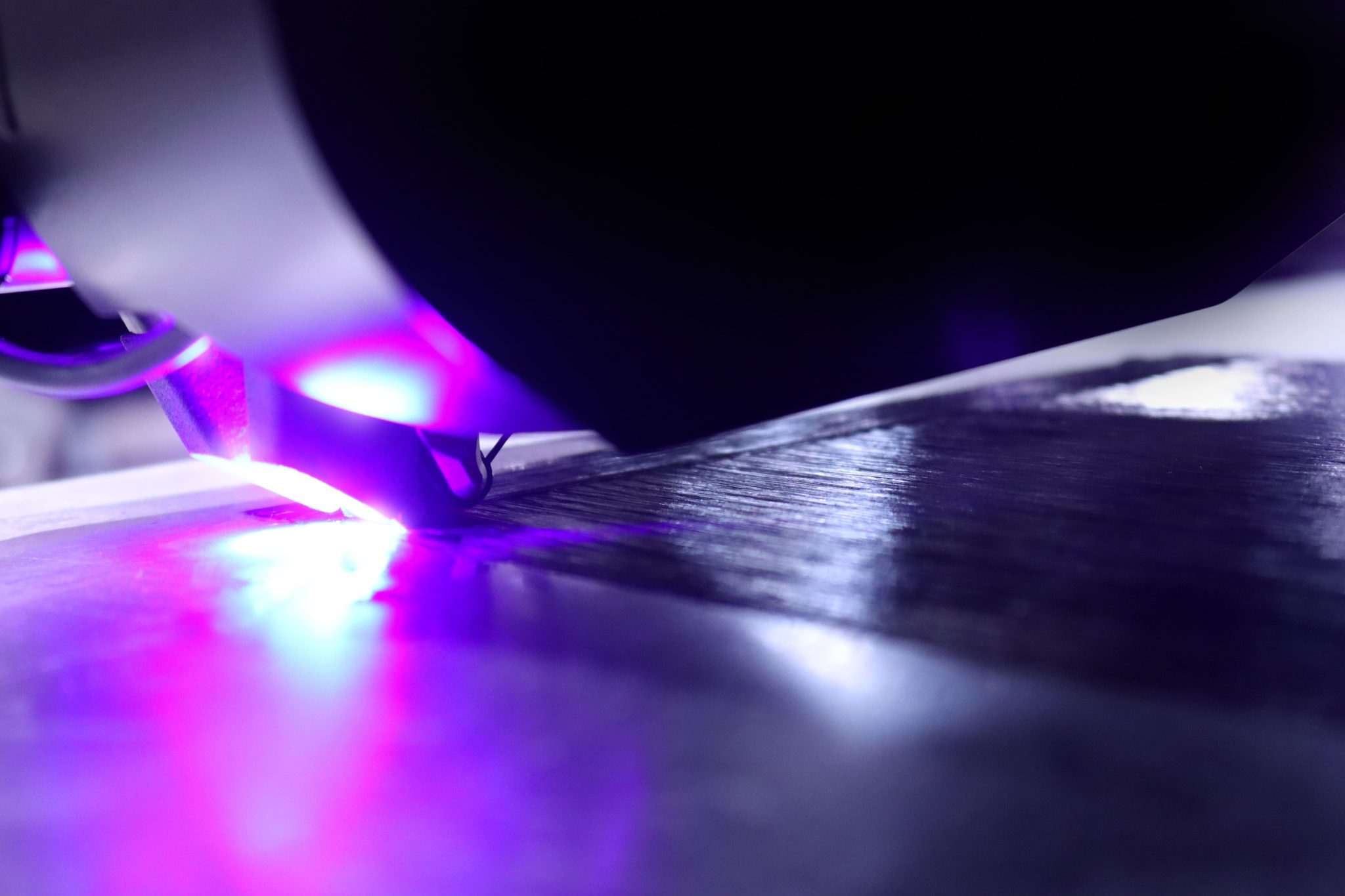
In a diversification effort, Continuous Composites has decided to seek work outside of the courtroom.The company that has been successful in defending its patent portfolio in composite 3D printing has gotten a Phase II Small Business Innovation Research (SBIR) US NAVY contract for unmanned aerial vehicle (UAV) parts.The company has previously received four Phase I and four Phase II SBIR awards and has, to date, gotten a total of $6.4 million from SBIRs.
The awards include composite structures for the Air Force in 2021, an isogrid structure for NASA, a low cost airframe for the Navy, a we probably should not have made this public 3D printed Navy submarine shaft, structures with embedded sensors for the Navy, a topology optimization software tool, a testing plan for drone parts together with Aurora Flight Sciences, an AFWERX Manufacturing Challenge contract for bonding with other structures and more.We can see that through these SBIRs, Continuous is advancing its capability, especially in making functional UAV structures.Continuous Composites’ robotic additive manufacturing system.
Image courtesy of Continuous Composites.The current work deals with making structures with embedded sensors, wiring alternatives, and electronics generally inside 3D printed composite structures.If we could reduce wiring via traces or similar methods, we could save a lot of weight.
Just enabling a reduction in wiring or the mass of wire harnesses would be significant.Indeed, consistently, wiring has been reduced in aircraft with technologies like fiber optics, electrohydrostatic actuators (EHAs), and solid-state power controllers, which are now used to significantly reduce weight on modern aircraft.Just shortening wiring paths, reducing housings, and reducing some fasteners would save additional weight here.
Your fuselage is a housing, a fastener, and the best path for your fiber-optic cable.Here, the goal is to “enable load-bearing components that also serve as integrated power distribution systems.” Previously, they were able to print electronic components, copper, and fiber optics within the composite, while tests showed minimal impact on mechanical integrity.Now the company will go deeper by “incorporating higher-capacity conductive pathways into load-bearing components while maintaining mechanical performance and electrical isolation through controlled material placement.
Emphasis will be placed on preserving structural integrity as functionality is introduced — enabling composite components that carry both load and power without compromising performance.” That work could radically alter UAV design.Form factors could be very different indeed.A plane could essentially be all wing or engine, with everything else embedded in the necessary components.
At the same time, the company hopes for more of a Lego approach to UAVs where components could be swapped quickly.You could, for example, just remove the middle component immediately and, within seconds, install a new battery and payload in a UAV.Print process diagram.
Image courtesy of Continuous Composites.Continuous Composites CEO Steve Starner stated, “This program represents a shift from printing structure alone to printing functionality directly into the structure.By embedding electrical pathways into load-bearing composite components, we’re enabling a new class of multifunctional UAV systems designed for real-world operational environments.” The work will take place over 30 months and include materials, process validation, and embedded conductor integration at the coupon and sub-scale structure levels.
This effort is followed by a one-year option period to deliver a functional, system-level demonstration, advancing the technology toward deployment in operational UAV platforms.This is very important work by Continuous.The US currently has no advantage in small UAVs.
Indeed, China currently has a major advantage in small UAV production: most of the 15 million UAVs used in Russia and Ukraine have Chinese components or are made in part on mostly Chinese-made 3D printers, and, given China’s expanding industrial base, the country is likely to outproduce the US in drones at scale.Despite its technological capabilities, the US could be at a significant disadvantage in a conflict heavily dependent on small drones.What Continuous is working on is a definite technological advantage.
If you can integrate pretty much anything into structures, save on fasteners, and need less wiring, you can make smaller, faster drones that can be more maneuverable and/or carry more.This work therefore has very definite implications for the UAV market and the future defensibility of the US.Subscribe to Our Email Newsletter Stay up-to-date on all the latest news from the 3D printing industry and receive information and offers from third party vendors.
Print Services Upload your 3D Models and get them printed quickly and efficiently.Powered by FacFox Powered by 3D Systems Powered by Craftcloud Powered by First Mold Powered by Xometry 3DPrinting Business Directory 3DPrinting Business Directory
Read More