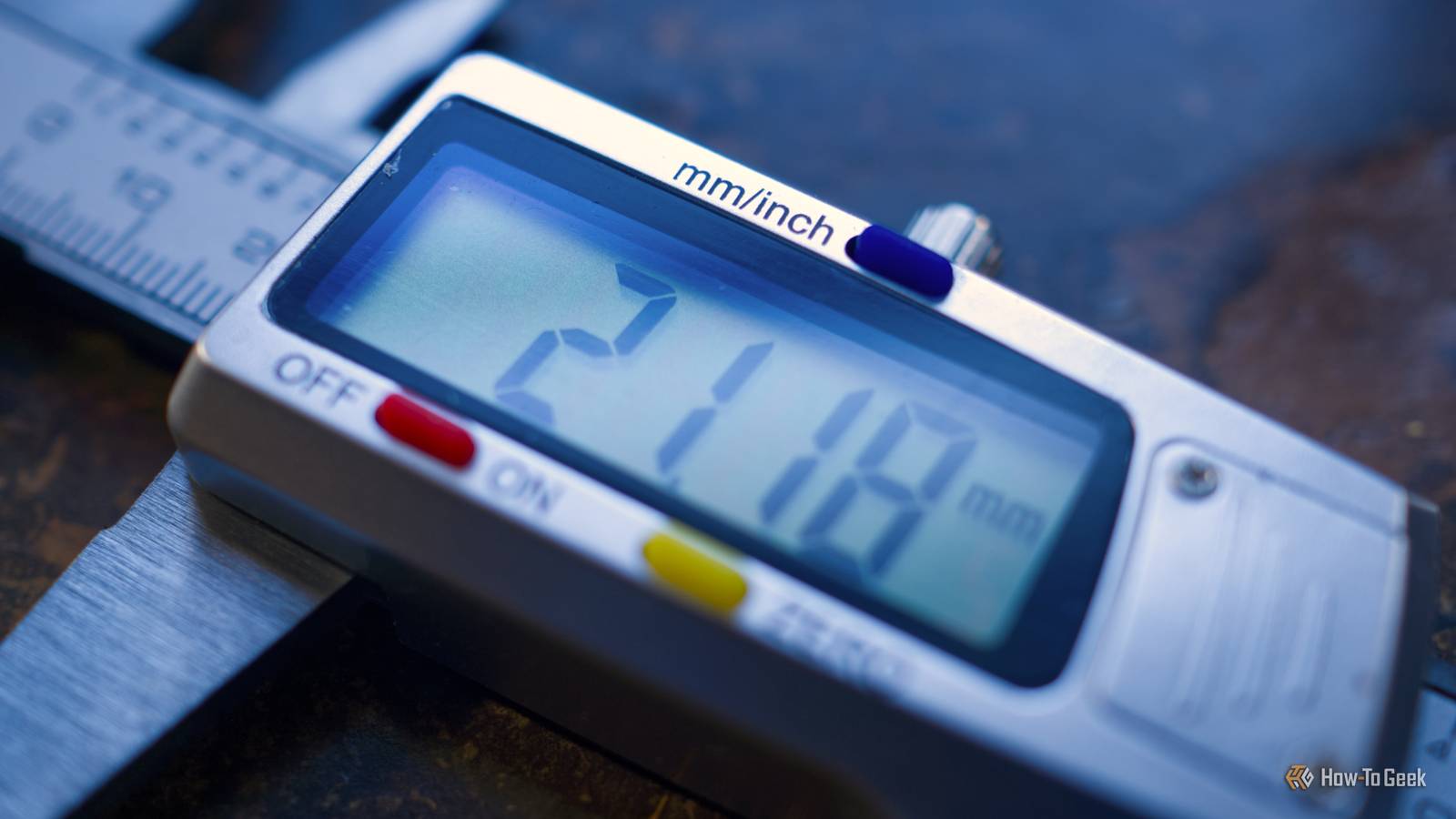
3D printing fixes for broken items is one of the simple pleasures of owning a printer.Why pay over the odds or wait for replacement bits of plastic to arrive when you can just make your own? There’s one tool you really can’t do without if you want to start making your own fixes.A digital caliper is the first thing you should buy After you’ve got a 3D printer, of course Close Digital calipers offer a reliable and accurate way of measuring distance.
Unlike traditional calipers, which use an “analog” ruler measure, digital calipers have a digital display that gives you a large reading of whatever it is you’re measuring.Vernier calipers (pictured below) are perfect for taking measurements when you want to model a replacement part.These are capable of measuring the size of an object and the size of a gap using the inward- and outward-facing points of measurement.
At the bottom of a vernier caliper, you should find a depth probe that extends as you open the caliper and correlates with the main reading.Calipers traditionally had a “zero point” error, which means that zero on the scale doesn’t correlate with the jaws being closed.Digital calipers get around this with a “zero” button that allows you to set the zero point.
Most include metric and imperial measurements, but for modeling you’ll likely be working in millimeters.Getting an accurate reading with a caliper is a matter of opening or closing the caliper to the point where the object is surrounded, the gap is filled, or depth is reached.Take care not to over-extend when measuring flexible or softer materials like plastic and some woods.
Cheap calipers do the job just fine, at least for a beginner.I spent about $14 on my digital caliper from a brick-and-mortar hardware store.I could have saved some money by buying online, but I could have spent more since the same store was selling a pair right next door for around $150.
These were undoubtedly superior, but not necessary for my amateur modeling needs.NEIKO Digital Caliper NEIKO's digital calipers are perfect for taking your accuracy to the next level.Designed to show millimeters as a decimal, as well as inches as either a fraction or a decimal, these calipers can give you extremely precise measurements with ease.
$28 at Amazon Expand Collapse You can always upgrade later if you find yourself really getting into it.Calipers are surprisingly useful for all manner of things around the house beyond 3D modeling.I’ve used mine to measure hole depths for screws, check drill bit thickness, and other tasks where a ruler isn’t quite precise enough (or is too difficult to fit).
Some modeling skills required (sort of) Designing prints is all part of the fun With your measurements taken, you can create a model that will fit with a high degree of accuracy.But this in itself is a skill that requires patience and practice if mastery is to be obtained.Choosing to invest your time in the right 3D modeling tool will pay off long-term.
For simple tasks, Tinkercad will do the trick.Throw simple shapes and holes together and then group them to merge and subtract.There are limits to what Tinkercad can do considering the tools you’re working with, which is where apps like Fusion, Shapr3D and Blender come in.
I’ve also got to shout out the self-hosted open-source tool SketchForge (below), which is my current favorite simple modeling tool of choice.While proper mastery of a 3D modeling tool is a skill worth learning, if you’re not up for it, then you still might find a use for a digital caliper.Parametric 3D models allow you to customize various parameters to your liking, no modeling skills necessary.
These take the form of CAD files you can modify, with model repositories like MakerWorld even integrating web-based model generators.Feed them your dimensions, and they’ll spit out a model that you can send straight to the printer.Some things you can make If you can measure it, you can model it It’s amazing how much of the world is held together by small and fiddly bits of plastic that cost way too much to replace.
My clothes dryer has a clasp that has snapped off twice in the best part of a decade I’ve owned it.Both times required that I order a replacement, which cost money and time.The next time it happens (and it’s only a matter of time), I’m just going to print a replacement.
Recently, I used a digital caliper to measure the aerator on a faucet that was firmly stuck with limescale.I then printed a little attachment which sits on the end that you fill with white vinegar to descale it.This avoided damaging the finish of the tap or having to replace it, and meant I didn’t have to buy a new aerator (and it cost a few cents in filament).
There are all sorts of household repairs out there just waiting to be printed, from shims for doors to custom wall plugs for any hole.Looking for more problems to fix with your 3D printer? Start by preventing GPU sag in your gaming PC!
Read More