Recently, I had the realization that phone cases are underdeveloped real estate.Few things are with us as often as our phones, and that includes anything attached to them.So, why not have a phone case that can also be used as a tool? As an avid DIYer with hobbies that span from 3D printing to woodworking, I often find myself measuring things.
However, I rarely actually have a tape measure or ruler on me.There is, of course, An App For That, but it’s hard to trust digital measurements.It’d be cooler to simply have a physical measuring device with me all the time without thinking about it.
This was more difficult than I expected Some projects test your creativity I’ll admit I thought this was going to be an easy 3D printing project.I already had a good case model to work from, and I assumed adding some sort of measuring apparatus would be simple.That last part was very much not true.
When I’m designing something into a phone case—as I did with an extra charging port and microSD card reader—my top priority is to keep it slim.No one wants to add a thick, bulky case to their phone, regardless of how useful it is.At one point, I thought about adding a MagSafe ring to a small tape measure, but that would be hard to pocket.
Related My phone doesn't have a microSD slot, so I 3D printed a case with microSD built in Unless you’re willing to settle for mid-tier hardware, it’s an unfortunate fact that phones don’t come with expandable storage anymore.As a response, external storage accessories are becoming more popular, but they lack the convenience of a built-in microSD card slot.I attempted to solve this problem with a 3D printed phone case.
This isn’t my first attempt at addressing this conundrum.Previously, I designed an enclosure that can be attached to the back of a phone.It included a microSD card slot and an extra USB-C port to allow for charging while the enclosure is plugged into the phone.
The idea was well received, but there was a common request: make it into a case.Good idea.Posts 6 By Joe Fedewa Integrating the measuring device into the case was clearly the best path to explore.
As I always do, I started by browsing MakerWorld and Printables for inspiration.One of the first models I stumbled upon seemed perfect.It was a measuring wheel specifically made for a phone—the CMF Phone’s mounting point.
However, upon downloading, I quickly realized it was a proof-of-concept, not functional.The second model I found took advantage of a nifty mechanism called a Geneva drive.It’s a type of gear system with wheels that move at different rates.
One wheel moves constantly, and it moves the second wheel a little bit after each full rotation.It’s perfect for measuring.Here’s a quick video of the Geneva Measuring Wheel by Highrise Workshop in action.
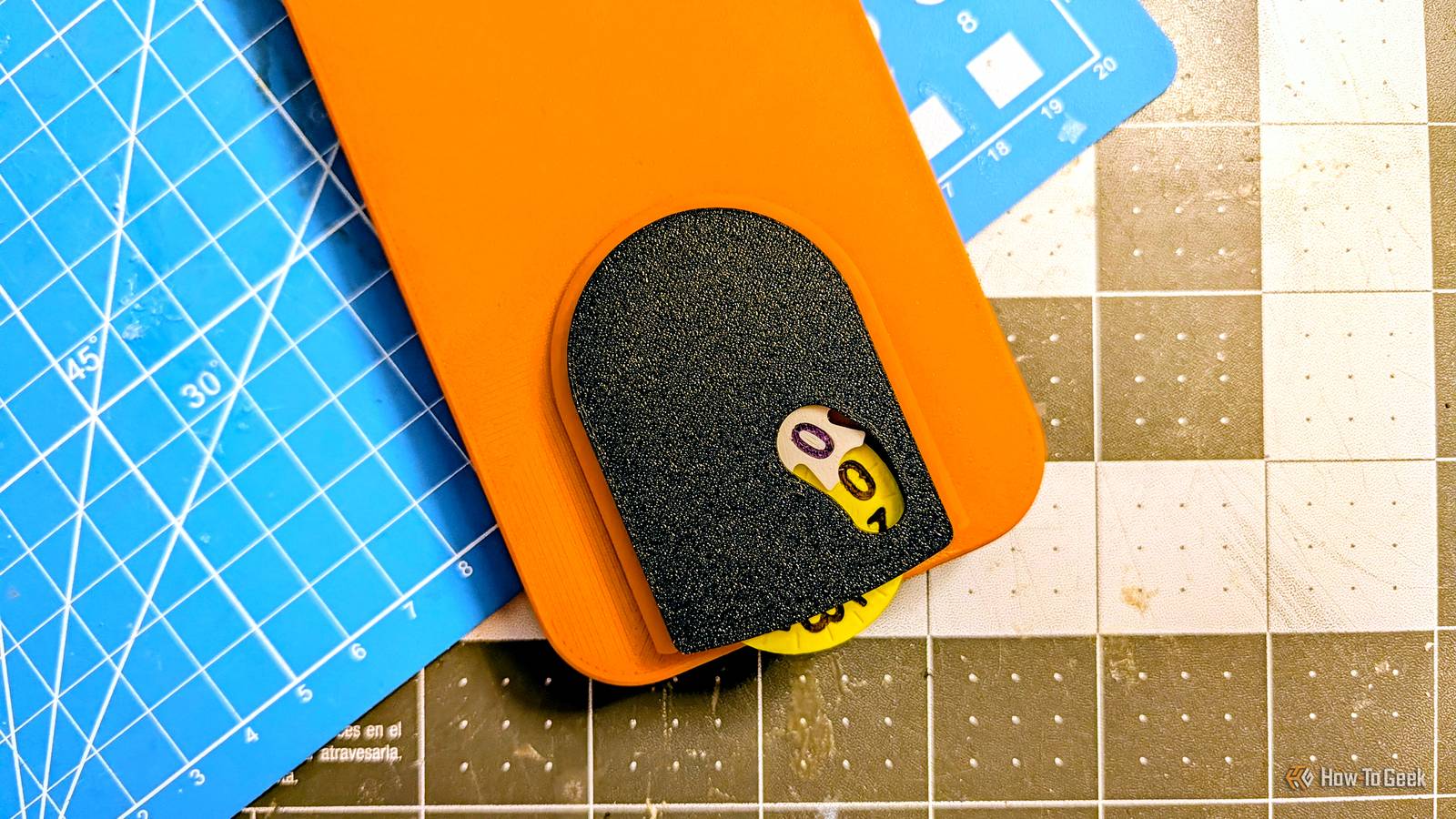
As you can see, the two wheels each have digits numbered from 0 to 9.When the bottom wheel rolls around one full time, it turns the top wheel by one digit.At any point, you can stop rolling and read the measurement (in millimeters).
If the top number reads 2, and the bottom number reads 5, that’s 25 millimeters.This clever mechanism allows for measuring from 0 to 99 millimeters without needing a wheel with a 99 millimeter circumference.Optimizing for a phone case Must go slimmer As I said, keeping the case slim is my top priority, which is what made this project so tricky.
I liked the Geneva Measuring Wheel, but it was 12mm thick—nearly a 1/2-inch.After messing around with a few other ideas, I decided to simply trim it down as much as possible.Close I reduced the thickness of both wheels, redesigned the case, and simplified a few other elements.
The end result came in under 6mm.Not wildly thin, but acceptable.From there, it was just a matter of adding it to an existing Pixel 10 case model and printing it out.
I colored in the numbers with a Sharpie for better visibility.Close Honestly, this thing is super cool (and fun to play with).It actually does what it’s supposed to do, too.
I had my doubts about accuracy, but it’s spot on.I kept it in millimeters since that’s what I use for 3D models, but this same concept could be used for literally any unit.You just have to scale the wheels accordingly.
As with all my projects, there are improvements that could be made.It would be more ergonomic if the entire back of the case were the same thickness as the wheel enclosure.Of course, that opens up the opportunity to add even more gadgets to the case.
A phone case is your oyster! Related 7 tools you can officially stop buying because of your phone It’s a known fact that smartphones have replaced a lot of things.You know the obvious ones: cameras, GPS navigators, MP3 players, etc.However, there are a handful of household tools that your phone can also replace.
Let’s put all those fancy sensors to good use.Posts 12 By Joe Fedewa
Read More