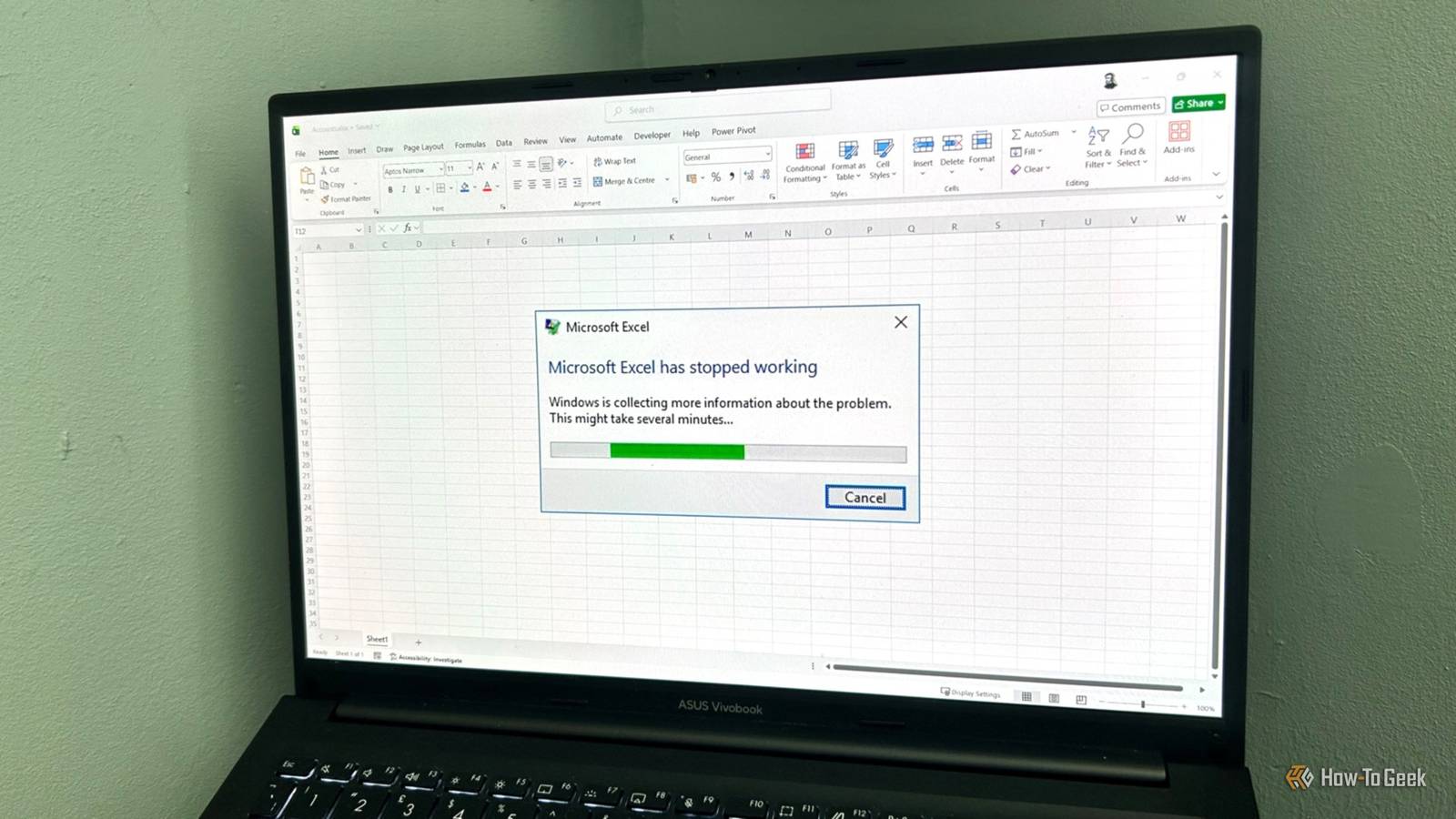
Bad Excel habits rarely cause problems straight away.Instead, they quietly build up until your workbook becomes difficult to update, troubleshoot, or trust—and by then, fixing everything can take longer than rebuilding it.None of these five habits will break a small spreadsheet overnight, but once your workbook grows or someone else has to use it, they become much harder to undo.
Stop hard-coding numbers into formulas Keep your variables out of your math logic Close I learned this lesson the hard way after updating the exact same tax rate across dozens of formulas because I'd hard-coded it instead of referencing a single input cell.It usually starts innocently enough.You need to calculate total price including a 20% tax, and typing something like =B2*C2*1.2 directly into the formula bar feels like a massive time-saver.
But that convenience vanishes the second that rate shifts, and you have to hunt down every single formula containing the hard-coded value.Miss a cell buried in a hidden column, and your workbook will quietly contain flawed calculations without ever throwing an error.I now make a point of keeping raw data inputs separate from math logic.
I place static variables into individual cells, label them clearly, and reference those cells instead.I also like turning those cells into named ranges, especially if there are several of them, because it makes formulas much easier to read and audit later on.I usually keep these variables on a dedicated Inputs section or tab—and that naturally leads into the workbook structure I use for almost every project.
Don't cram everything onto one worksheet Give each part of your workbook a clear job Close One reason I stopped hard-coding values into formulas was that I started separating inputs, calculations, and reports into their own dedicated areas.Early on, I used to throw everything onto a single sheet, as it felt easier to keep everything visible at a glance without having to jump between tabs.However, that single-sheet habit became a nightmare as my project grew.
Scrolling across dozens of columns to find a specific formula makes auditing painful, and worse, when I deleted a row to clean up raw data, I ran the risk of accidentally wiping out part of a summary chart sitting further down the page.I don't use a multi-tab structure because it's a rigid rule—I use it because I've inherited too many impossible workbooks over the years.I treat three core tabs as the starting foundation for almost any project: Inputs: Holds raw data uploads, external imports, and manual user entries.
Calculations: Handles intermediate math and logic safely out of sight.Report: Houses final presentation charts, executive summaries, and dashboards.Depending on the size of the project, I'll often add extra sheets for README info or a dashboard.
But starting with that basic three-tab separation makes any file much easier to navigate.Microsoft 365 Personal OS Windows, macOS, iPhone, iPad, Android Free trial 1 month Microsoft 365 includes access to Office apps like Word, Excel, and PowerPoint on up to five devices, 1 TB of OneDrive storage, and more.$100 at Microsoft Expand Collapse Plain cell ranges are holding your spreadsheets back Let tables do the heavy lifting for you Close Converting my datasets to tables is probably the single biggest change I've made since I first started building spreadsheets in Excel.
Keeping data in raw, unformatted cell ranges feels safe because it looks familiar, but static ranges simply don't adapt as your data grows.When you add new rows of transactions, existing formulas, charts, and PivotTables end up pointing to outdated data ranges unless you remember to manually update every single reference.Unlike Excel tables, ordinary ranges don't automatically extend calculated columns when you add new rows, leaving your sheet vulnerable to broken logic when someone forgets to copy a formula down.
Converting a raw block of data into an Excel table (Ctrl+T) gives you structured column references (like [Amount]) that expand automatically whenever new rows are added.Tables also keep connected charts and PivotTables linked to the growing dataset, so new records appear without manually updating your ranges.Merging cells breaks more than you think Keep your underlying grid aligned and flexible Close I used to merge cells constantly because I thought it made reports look much more polished.
If I needed a title or a label spanning multiple columns, hitting "Merge & Center" felt like the obvious formatting choice.The problem is that merged cells stop Excel from behaving like the neat coordinate grid it's supposed to be.The tidy layout comes at a cost.
The moment you try to sort a column, filter a dataset, write a dynamic formula, or copy and paste a block of data, merged cells can quickly get in the way.In many cases, you won't even need to merge cells if your data is structured properly inside an Excel table.However, if you absolutely center a header or label visually across multiple columns without altering the grid, use Center Across Selection instead.
Select the range, press Ctrl+1, head to the Alignment tab, and select Center Across Selection from the Horizontal drop-down menu.You get the clean visual appearance you want while keeping every individual cell fully functional underneath.Giant formulas become impossible to maintain Break complex calculations into smaller, digestible steps Close I've written formulas in the past that I was ridiculously proud of, only to look at them six months later and have absolutely no idea how they worked.
There's a brief thrill in solving a complex problem with one massive formula—nesting five IF statements inside an XLOOKUP, combining it with INDEX/MATCH, and seeing the correct value appear.If you've ever opened a spreadsheet and been greeted by a 200-character formula, you know how intimidating it can be.Staring at an endless wall of nested logic makes troubleshooting nearly impossible when it eventually throws an error, and it stops anyone else from feeling comfortable editing your file.
I stopped trying to solve every problem inside a single formula once I realized how much time I wasted debugging my own work later.Breaking complex calculations into smaller, digestible steps using helper columns makes your workbooks far easier to audit, but it also makes the results much more useful.Those intermediate values can feed directly into PivotTables, charts, and other Excel tools instead of being trapped inside one giant formula.
If you need to keep a calculation inside a single cell, the LET function is another way to make complex formulas easier to understand.It allows you to assign names to intermediate calculations within a formula, reducing repetition and making the logic easier to follow.Every mistake taught me something useful Nobody taught me to avoid these habits—I learned most of them the hard way, so you don't have to! That's true of plenty of Excel skills: the more you use the program, the more you discover what works and what doesn't.
Looking back, there are also plenty of habits I wish I'd learned years earlier, from opening two views of the same workbook to avoid constant tab switching to using Analyze Data and Power Query to work more efficiently.But many of Excel's best features are still discovered through experience, experimentation, and a little trial and error.
Read More