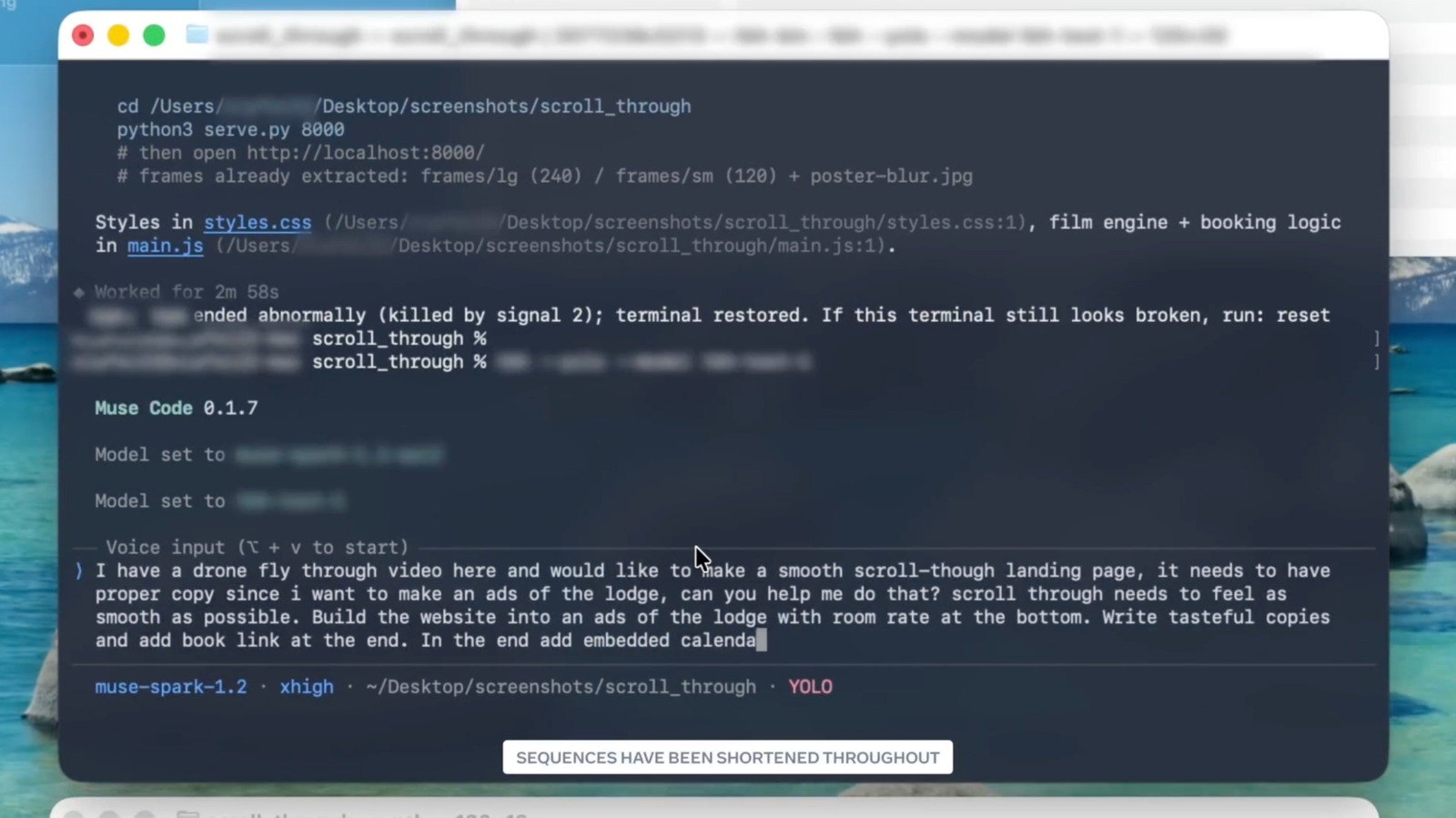
Meta is finally entering the AI coding agent space dominated by the likes of Anthropic's Claude Code and OpenAI's Codex.The social media giant has released a Muse Code beta that it claims can be affordable while matching rivals in performance.The terminal-based agent is built on the Muse Spark 1.2 model and handles "complete" tasks even across large code repositories, according to Meta CEO Mark Zuckerberg.
It can plan changes, write code, and validate results.Background agents build context, and larger projects are assigned to isolated "sub-agents" that won't interfere with each other.Every model call and tool use is logged, and the agent will resume its place in the event of a crash.
The hook is the low price of entry, AI chief Alexandr Wang tells AI in an interview with .There's still a pay-as-you-go choice that costs $1.25 per million input tokens and $4.25 for a million output tokens, but you can also use a contributor tier that Wang claims is "more than 10 times cheaper." It requires that you help improve the model like you do with other agents, but might be better if you're just starting out or are part of a larger team.Meta is now accepting requests to avoid data retention, helping companies that don't want their potentially sensitive information used to train AI models.
How does Muse Code compare to Claude Code and Codex? It works best within Meta's universe Muse Code is a coding harness that lets you manage multiple models, and can be used for third-party platforms.However, Wang explains that Muse Spark 1.2 will work best as it was developed in tandem with the agent.In those conditions, Meta claims Muse Spark 1.2 performs on par with or better than the competition.
It edges out GPT 5.6 Terra (there's no mention of Sol) in the Terminal-Bench 2.1 software engineering benchmark, and comes close to Claude Opus 5.In the long-horizon DeepSWE 1.1 test, it falls behind both but is still ahead of X.ai's Grok and Google's Gemini 3.6 Flash.Related How I run heavy open-source LLMs for free without a GPU You don't need a fancy GPU to train and test your favorite large language models.
Posts 8 By Faisal Rasool With Meta's in-house coding benchmark, its model sits between Claude Opus 5 and GPT 5.6 Terra.You're not choosing Muse Code for raw speed at this stage.Rather, it's that Meta is already competitive with peers in coding four months after releasing the first Muse Spark model.
Its pricing strategy could also be appealing in the right circumstances, although you could quickly find yourself looking at subscriptions with frequent AI coding.
Read More