Have you ever wanted the watch face on your smartwatch to change automatically depending on what you’re doing? A minimal watch face when you go to sleep, and then one with lots of health data when you start exercising.If that sounds useful, then you’re in the right place.I’ve configured my Galaxy Watch to automatically change its watch face based on what I’m doing—here’s a detailed overview of how you can do the same.
How to set up automatic watch face changes It’s incredibly powerful and barely takes two minutes Close To do this, we won’t need to install any third-party tools or apps.In fact, we’ll be using one of Samsung’s best-kept secrets for Galaxy devices: Modes and Routines.Now, technically speaking, the option is readily available as soon as you open the Settings app on your Galaxy smartphone.
However, I’ve rarely found anyone talking about this feature, and most Galaxy users I know in real life don’t even know about it—which is a shame because it’s one of the most powerful smartphone automation tools out there.The feature basically lets you pair a condition with an action to create an “if this, then that” automation.For example, let’s say you’ve set your sleep schedule from 12:00 a.m.
to 8:00 a.m.In that case, you can create a routine that automatically turns on Do Not Disturb and switches the display to grayscale whenever it’s sleep time.There are a lot of settings you can automate this way, including things like your wallpaper and lock screen.
And if you have a Galaxy Watch paired with that phone, you can also set a watch face to be used when a specific mode or routine runs.This means that whenever a specific mode or routine triggers, it can potentially change the watch face on your Galaxy Watch.This feature only works if your Galaxy Watch is paired with a Samsung Galaxy phone.
If you’re using a Galaxy Watch with, say, a Google Pixel—you won’t be able to do this because Pixel phones don’t have Samsung’s Modes and Routines.This makes it one of those exclusive features that’s locked behind the Samsung ecosystem.Related Google Pixel "Rules" are a joke compared to Samsung's Modes & Routines Pixel Rules can do 8 things.
Samsung Modes & Routines can do everything.Posts 1 By Joe Fedewa Different triggers that can change watch faces Samsung gives you more triggers than you'll ever use Close Out of the box, a Galaxy smartphone comes with a handful of modes already preconfigured—Sleep, Driving, Exercise, and Work—that need very little configuration.You can turn each of these on manually, or you can attach conditions so they turn on automatically.
And every one of them lets you pick a watch face, alongside a lot of other options.However, if you’d rather build one from scratch, you can create a new mode, give it a name and an icon, and then you’ll land on a screen asking you to choose when the mode should turn on.You can technically skip this and leave it without a condition, in which case it’ll become a mode you need to enable manually.
That said, if you do want to automate things, Samsung offers a wide collection of really interesting conditions.The most basic options are setting a specific time period or geographical location.However, there are also many more context-based ones, like when you wake up from sleep or are about to go to bed.
You can also set conditions for when you’re driving, using mobile data instead of Wi-Fi, connected to a specific Wi-Fi network, in airplane mode, using wired headphones, and even based on your battery percentage.Even if you have a very obscure automation planned, you should be able to find the necessary condition triggers to make it work.After you pick a condition, it asks you to choose an action—what should happen when the condition is met.
There’s a lot you can do here, and it’s way beyond the scope of this article, so for our purposes, we can leave the actions alone.Once you’re through that, you get a screen that looks a lot like the one for the built-in modes, and that’s where you pick the watch face for this mode.Choose one, and from then on, that face shows up on your watch whenever the mode kicks in.
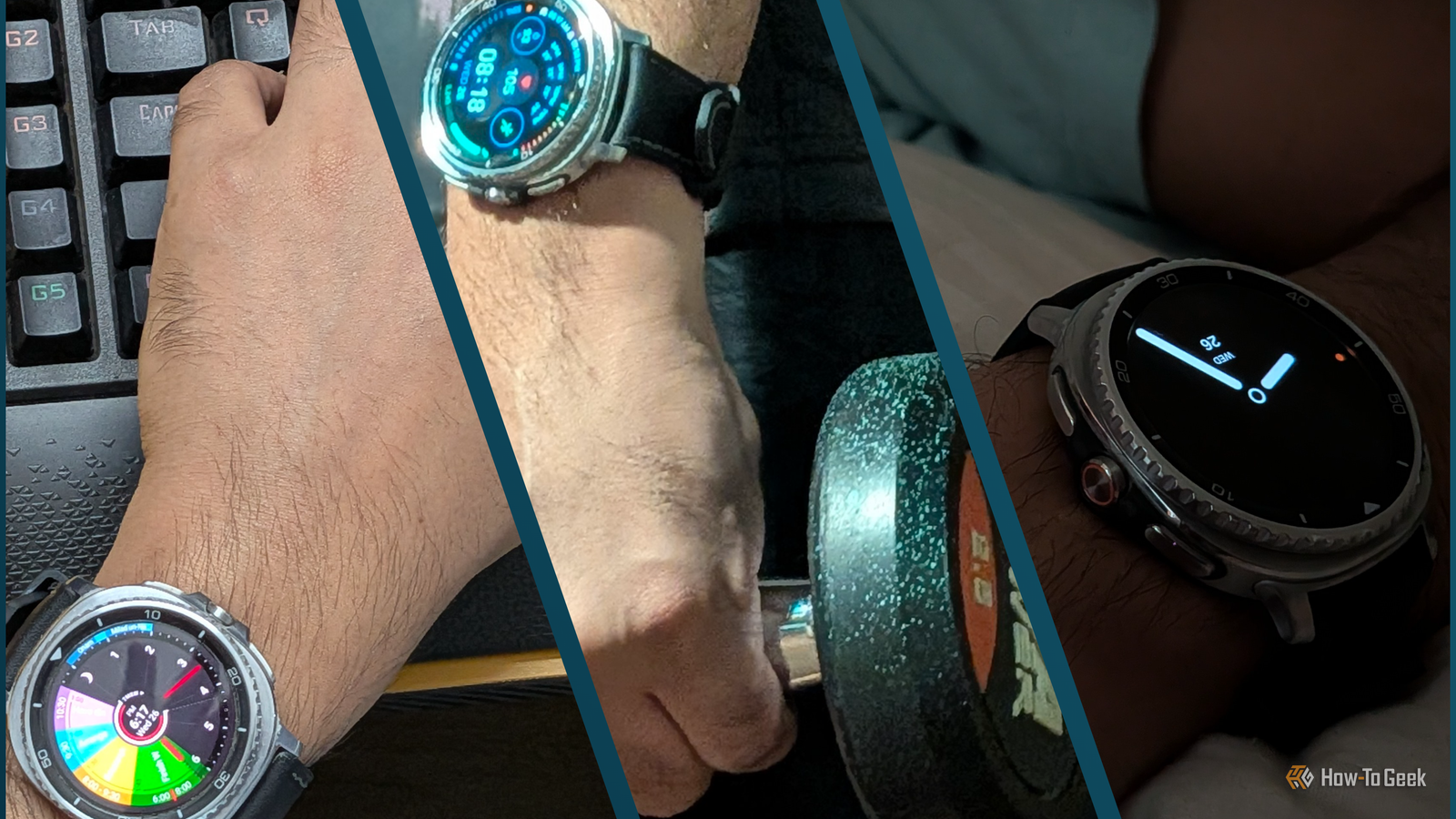
Related Most Wear OS watch faces are ugly—these 6 actually look good Your smartwatch deserves better than a default watch face.Posts 1 By Joe Fedewa How I use automatic watch faces Steal these setups if you’re confused about how to start Close I personally stick to three primary modes and routines for switching between my watch faces: Sleep Mode: This triggers when my bedtime starts.It switches my Galaxy Watch to a minimal watch face.
This is primarily because if I wake up in the middle of the night and look at my watch, I don’t want to see unnecessary information that could disrupt my sleep.Exercise: This triggers when I’m exercising.The watch face switches to a health dashboard watch face that shows my heart rate, steps, stress levels, and other data points.
Work: This is time-based and triggers Monday through Friday from 9 a.m.to 5 p.m.For this one, I use Sectograph as a watch face.
It’s a third-party app that shows all my upcoming calendar events as time blocks on the watch face.On top of those, I have a couple of location-based ones that are more for fun.For example, when I’m at my parents’ place, the watch switches to a photo frame showing a family group photo.
Related I built a Wear OS watch face without knowing how to code—Gemini did the heavy lifting This is what happens when you ask Gemini to build a watch face from a screenshot.Posts By Joe Fedewa Manually switching watch faces is so old school One of the fun things about owning a smartwatch is having access to all the well-designed watch faces.Every day, your watch can take on a new personality.
However, manually switching watch faces can be a chore, and you can easily forget.For example, maybe you’re at work and still have that funky watch face you put on for the party you went to last night, which can lead to an awkward conversation with your boss—trust me, I’ve been there.As such, if you’re using a Samsung Galaxy Watch paired with a Galaxy smartphone, why not automate your watch face changes to make your watch both more functional and more personalized?
Read More