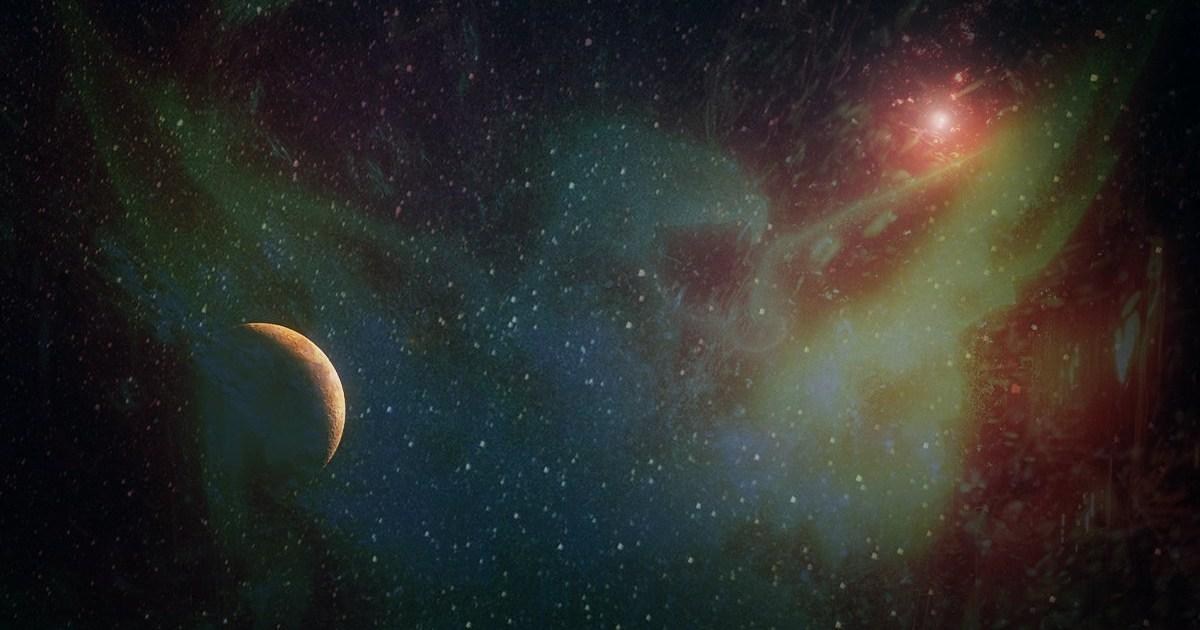
Scientists have discovered a planet that somehow formed after its sun died, a researcher has told Metro.HS0209+0832b is orbiting HS0209+0832, a wispy ember known as a white dwarf about 1,580,000,000,000,000 miles from Earth.Strangely, the planet and the star seem to be made of similar chemicals, suggesting HS0209+0832b formed after HS0209+0832’s fiery death.
They’ve called it a ‘phoenix planet’, named after the mythological bird, according to a paper published today in Nature Astronomy.‘This planet was formed from the “ashes” of the dying star,’ says Jamie Williams, a PhD student in astronomy at the University of Warwick and the paper’s first author.‘Therefore, it can be thought that the planetary system is “reborn”, just like a phoenix bird.’ Williams’ team spotted the planet orbiting So, why is this a big deal? Scientists know that when a star reaches the end of its life cycle, it balloons in size into a red giant and incinerates nearby planets.
Afterwards, it collapses under its own weight and blows away its outer layers, leaving behind a faint but very hot stellar speck.Planets have been known to survive a star’s demise, but Warwick researchers found what could be the first observational evidence that new planets can form around white dwarfs.‘Almost every planet is formed around a young star whilst it is alive,’ Williams says.
‘Although second-generation planets have been discovered around neutron stars – very dense dead stars formed from very massive stars – they have never been found around a white dwarf.’ Williams suspects that the planet formed because, by some cosmic fluke, a companion star spun HS 0209+0832’s leftover layers into a disc.Over time, gravity clumped some of this celestial junk into a planet.HS 0209+0832’s outer shell contains niobium, a metal used to make batteries and cars, which has never been detected in a white dwarf before.
Niobium, as well as other metals the star’s outer layers were made of, like zinc, has been discovered swirling around the reborn planet.So Williams and his team think the star is ‘feeding’ off the planet, essentially inhaling the very materials it was once made of.What is the planet like? According to data from Nasa’s TESS satellite, the planet is a gas giant, so it has a tiny core with the strength to pull in a vast volume of gases.
It’s so close to the star that a ‘year’ on the planet would be just 4.4 Earth days, which was a giveaway that it formed after the star passed.So, in bad news for sci-fi fans, alien life probably doesn’t call the planet home.‘It would also be very hot because it very recently formed, like over 1,500°C,’ Williams says.
‘This makes life impossible.’ Still, there’s not a 0% chance life could begin.HS 0209+0832 is burning at 35,227°C but will cool in a few hundred million years.‘This planet will briefly be in the habitable zone for a few tens of millions of years,’ Williams says.
Trending Now 'American Covid' strain warning after cases surge in England UK 2 days ago By Brooke Davies Londoners warned to stockpile food as 'Godzilla' El Niño could cause 'polar vortex' Pneumonic plague fears after scientist died after 'dropping tube of pathogens' Residents shaken as fourth person dies after plunging from luxury London tower block ‘I think life is very improbable on this planet, but other second-generation planets around other white dwarfs could form and could exist in the habitable zone for 10s of billions of years – much longer than Earth – so this class of planet could be a good candidate to search for life in the future.’ If their findings are confirmed, stargazers could search for more ‘phoenix planets’ by looking for similar heavy elements in the light of dead stars.The planet also provides clues as to what our solar system could be like when our sun burns out in roughly five billion years.‘Given that the progenitor star for this white dwarf was similar to that of the sun,’ Williams says, ‘I would say it is possible a second-generation planet could form after our sun dies.’ Get in touch with our news team by emailing us at [email protected].
For more stories like this, check our news page.MORE: UK Space Command chief suspended over sexual offence and theft allegations MORE: Nasa releases panoramic images revealing what a day on Mars looks like MORE: Bizarre ‘footprints’ spotted on Mars leave scientists scratching their heads Comments Add as preferred source News Updates Stay on top of the headlines with daily email updates.This site is protected by reCAPTCHA and the Google Privacy Policy and Terms of Service apply.
Your information will be used in line with our Privacy Policy HomeNewsTech Related topics AstronomyNasaSpace Nasa releases panoramic images revealing what a day on Mars looks like Tech September 20, 2026 By Ryan Prosser Brits increasingly rely on tech and AI to find presents for hard-to-buy-for loved ones Tech 3 days ago By Mark Worgan
Read More