Projectors are display devices like TVs and monitors, so you’ve always been able to use them for gaming.But until recently, buying a projector to play games was a no-no.Thankfully, that’s all changing.
Add How-To Geek on Google Add as Preferred Source Follow on Google Discover Here’s why you might be playing on a 120-inch screen.Projectors have long been a poor choice for gaming Just because you can, doesn’t mean you should Plugging a console or PC into a projector and throwing an image up on a wall seems like a no-brainer.Technically, this works—projectors can easily accept signals via HDMI or DisplayPort, after all.
That said, there are some big drawbacks if you choose to go down this route.Chief among them is latency.Sometimes known as input lag, latency is the time it takes a display to react to any input provided by the player.
It encompasses the entire process from hitting a button to having the display device show the result on the screen.Measured latency of 15 ms (milliseconds) or less is what most gamers aim for, though many displays get this down to 1ms depending on the resolution and refresh rate.Projectors have typically struggled to get anywhere near this number, with input lag exceeding 50ms (that’s half a second) or more.
In a fast-paced game, latency like this would be very noticeable.Pixel response is another area where projectors have been known to struggle.Sometimes confused with latency, pixel response is a measure of the amount of time it takes a pixel to change from one color to another.
The faster the better, since lower pixel response times can negatively affect motion clarity with ghosting or smearing.Refresh rate is another consideration, with projectors not exceeding 60Hz at 4K resolution until fairly recently.While games that exceed this refresh rate are still the exception rather than the rule on current-generation consoles (like the PlayStation 5 and Xbox Series X), 120Hz has been seen as the standard for TVs for a while now, and something PC gamers have long blown past.
There are other features that gamers look for in TVs that have traditionally been absent on projectors.Two examples are variable refresh rate (VRR), where the refresh rate can be varied to match the frame rate to avoid ugly screen tearing; and auto-low latency mode (ALLM), where the display device optimizes the display mode for the fastest response times.Then there are the considerations associated with projectors that don’t apply to TVs, like having adequate space, figuring out where to hang your projector, acquiring a proper screen for best results, controlling light levels, and making sure the room is compatible so that you’re not constantly walking in front of a blinding light.
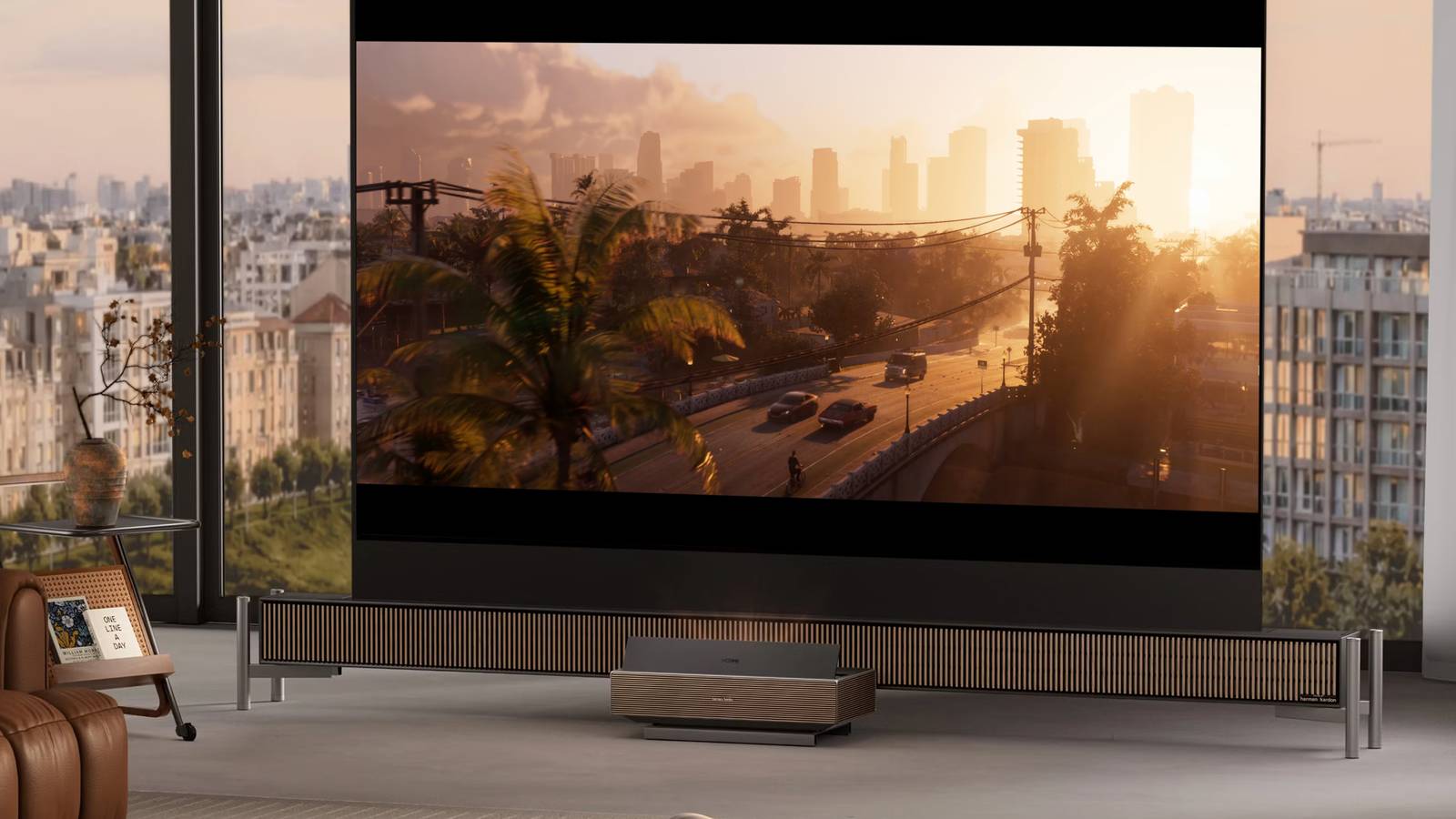
Modern projectors have fixed most of these problems Many now even advertise their suitability for gaming Thankfully, many of these problems have been fixed on modern projectors.One example is the AWOL Vision Aetherion Max, an ultra-short throw projector that you can buy right now, which delivers low-latency gaming, OLED-like pixel response times, and gaming features like VRR.It’s an ultra-short throw (UST) projector that can sit right in front of the wall.
You can even buy a retractable screen so that your gaming setup disappears when you aren’t using it.Strides have also been made in the non-ultra-short-throw space, with models like the XGIMI Titan Noir Max (first shown off at CES 2026) also focusing on gaming performance, low latency, and advertising their support for technologies like Dolby Vision Gaming.Much of this comes down to the way that laser projectors work.
Compared with traditional bulbs, lasers have faster response times, they last longer than bulbs, they produce more consistent images, and they don’t require prolonged warm-up periods either.They might be more expensive than your average OLED or mini-LED, but the lack of maintenance (bulb replacement) brings them in line with most TVs.With that in mind, they’re generally cheaper than buying a massive 100-inch-plus TV, and you’ll be able to fill a wall with an image that’s 200 inches (or larger) if you have the space.
Your space and watching habits need to be compatible with a projector.The Aetherion Max mentioned earlier projects only 3,300 lumens, and the image will be greatly affected by ambient light.You’ll need a proper ambient-light rejecting (ALR) screen and a light-controlled environment for the best results.
A new generation of projectors is on the horizon We’re on the precipice Close While those aforementioned projectors are on the market right now, two others that are arriving very shortly are the XGIMI Aura 3 Max (and slightly dimmer Pro model) and the AWOL LuxVision.These are both 4K projectors capable of 120Hz output, with claimed brightness levels of 6,000 and 5,700 lumens, respectively.They’re also both UST projectors, which means they work well as TV replacements provided you have the space on a wall (or the desire to invest in a decent ALR screen).
Both are currently available for preorder, with the XGIMI expected to start shipping before the end of the year.Personally, I’m ditching my OLED for the Aura 3 Max and gaming is one of the main motivators.Time will tell if my decision was worthwhile.
While I won’t have my shiny new projector before November 19, there are some other things I can start doing right now to get ready for .
Read More