Skuld will work on the Defense Advanced Research Projects Agency’s (DARPA) Rubble to Rockets (R2R) Program, which turns scrap metal into missile components.Skuld will help with alloy design, characterization, and casting.Using AI, Skuld will analyze microstructure, determine properties, and perform spark testing.
Spark testing is literally grinding metal to see what it is composed of.The company then hopes to make parts using its Additive Manufacturing Evaporative Casting (AMEC) process.The work will focus on wrought aluminum, such as 6061 and 7075.
Skuld’s AMEC process combines 3D printing with lost foam casting to produce net-shape metal parts.Image courtesy of Skuld.Skuld’s AMEC process is already very inexpensive, able to produce parts using low-cost materials and printers.
The process can also scale rather quickly, as you can add more printers and capacity in a granular way.Now the firm will be making compact portable casting setups for the project.This could be a very exciting development.
Skuld’s desktop 3D printers and other inexpensive printers could easily be made to be portable, ruggedized, or containerized.Its foam printing process also seems to lack a lot of the exploding powder and high-energy laser problems that other processes have.Individual printers and casting units need not be expensive either.
So if one gets mortared, it doesn’t cost the military two million dollars.This should be really doable for them to make a super cheap, super compact unit that can actually make stuff.For a lot of the other options out there, like combining a Meltio with a Hass VMC, the resulting machine still weighs over 1800 kilos, for example.
One of the smallest metal solutions, therefore, may very well be Skuld.This could see these being pressed into service very remotely indeed.Rather than a large airbase overseas, e.g., Rammstein, this could go to the US’s Djibouti Camp Lemonnier, or perhaps an even more remote in-country outpost.
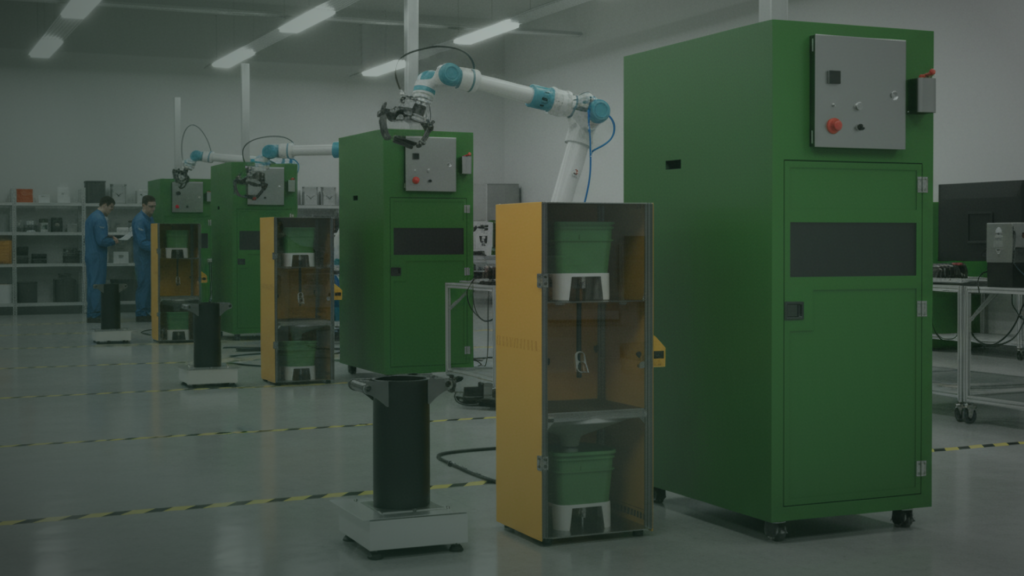
Just getting these units there would be so much less expensive in weight and volume that it would let the military test more and try out more in more remote places.Smaller, they can be transported by more vehicle types, making them much more flexible to deploy than larger units.The Lightning Metal Model LM16, on-site micro foundry.
Image courtesy of Skuld.Skuld will work with the Worcester Polytechnic Institute (WPI), Foundry Casting Systems, and MatMicronia on the project.Previously, WPI got $6.3 million for the same project to do a lot of the AI bit on software developed by Citrine.
ASU, SRI International, and TRIEX (the company behind the Filabot) are also involved.DARPA indicated that a key part is adaptive design, whereby the system efficiently updates a baseline design to enable structural changes for components with newly predicted material properties that meet or exceed the minimum programmatic metrics.WPI researchers aim to revolutionize on-site additive manufacturing by combining materials science, artificial intelligence, and 3D printing.
Image courtesy of Worcester Polytechnic Institute.Skuld’s CEO, Sarah Jordan, said, “Through the R2R effort, we are evaluating casting approaches, alloy behavior, and the use of AI tools that expand options for producing components in challenging environments.” Last year, we already speculated that a tie-up with the militarily connected University of Tennessee would be good for Skuld and its ability to meet the needs of the Army in particular, in its low-cost deployability.In the Army context, Skuld could be a real winner in developing an easy-to-deploy, easy-to-use solution for certain parts families.
Remember, 3D printing technology doesn’t have to work for everything to be useful.If Skuld can make certain parts from certain recyclable materials, then it could meet a real need.Every kilo of material that can be successfully turned into a part saves tens of thousands of dollars in transport costs while quickly fulfilling an immediate need.
Coupled with Skuld’s work on thin-walled structures, such as bridges, the company could be a real beneficiary of the Army’s increased spending on 3D printing.Subscribe to Our Email Newsletter Stay up-to-date on all the latest news from the 3D printing industry and receive information and offers from third party vendors.Print Services Upload your 3D Models and get them printed quickly and efficiently.
Powered by FacFox Powered by 3D Systems Powered by Craftcloud Powered by Xometry 3DPrinting Business Directory 3DPrinting Business Directory
Read More