So, you've finally caved and decided to buy an OLED.Add How-To Geek on Google Add as Preferred Source Follow on Google Discover The only problem is that OLED TVs are notoriously expensive, so it's tempting to grab the cheapest one, thinking you'll get all the benefits of OLED without paying a premium for a better model.But before you make the same mistake I did and buy a budget-friendly but still incredibly expensive OLED, here's why you should reconsider and save up for a better one.
Not every OLED panel is created equal OLED has its own panel subcategories Close One of the biggest differences between OLED TVs at different price points is the underlying panel technology, which plays a major role in how good the overall image looks.While we broadly categorize TV display technologies as IPS, VA, and OLED, there are some major differences in how OLED panel technologies produce an image that the catch-all term doesn't tell you about.The two primary types of OLED panels in the TV world are WOLED (white OLED) and QD-OLED (quantum dot OLED).
WOLED, made by LG Display, uses a self-emissive white light source that shines through red, green, and blue color filters, plus another white-only subpixel that increases overall brightness.QD-OLED, on the other hand, starts with a self-emissive blue OLED light source.Quantum dots convert some of the blue light into red and green, while the remaining blue light is used for the blue subpixel.
Generally speaking, QD-OLED panels deliver more saturated colors, especially at high brightness.They have a more vibrant pop that looks impressive in the right conditions.WOLED, on the other hand, tends to maintain deeper-looking blacks in brighter rooms because of its panel structure.
They also generally can achieve a higher overall brightness, especially in newer generations of the technology like MLA and the newer Tandem WOLED panels that have been making waves this year.An interesting fact you should be aware of if you're shopping for an OLED TV is that LG Display is effectively the sole large-scale manufacturer of WOLED panels for consumer TVs, while Samsung Display makes QD-OLED panels.All other brands, whether it's Sony, Panasonic, or Roku, source their OLED panels from these two companies.
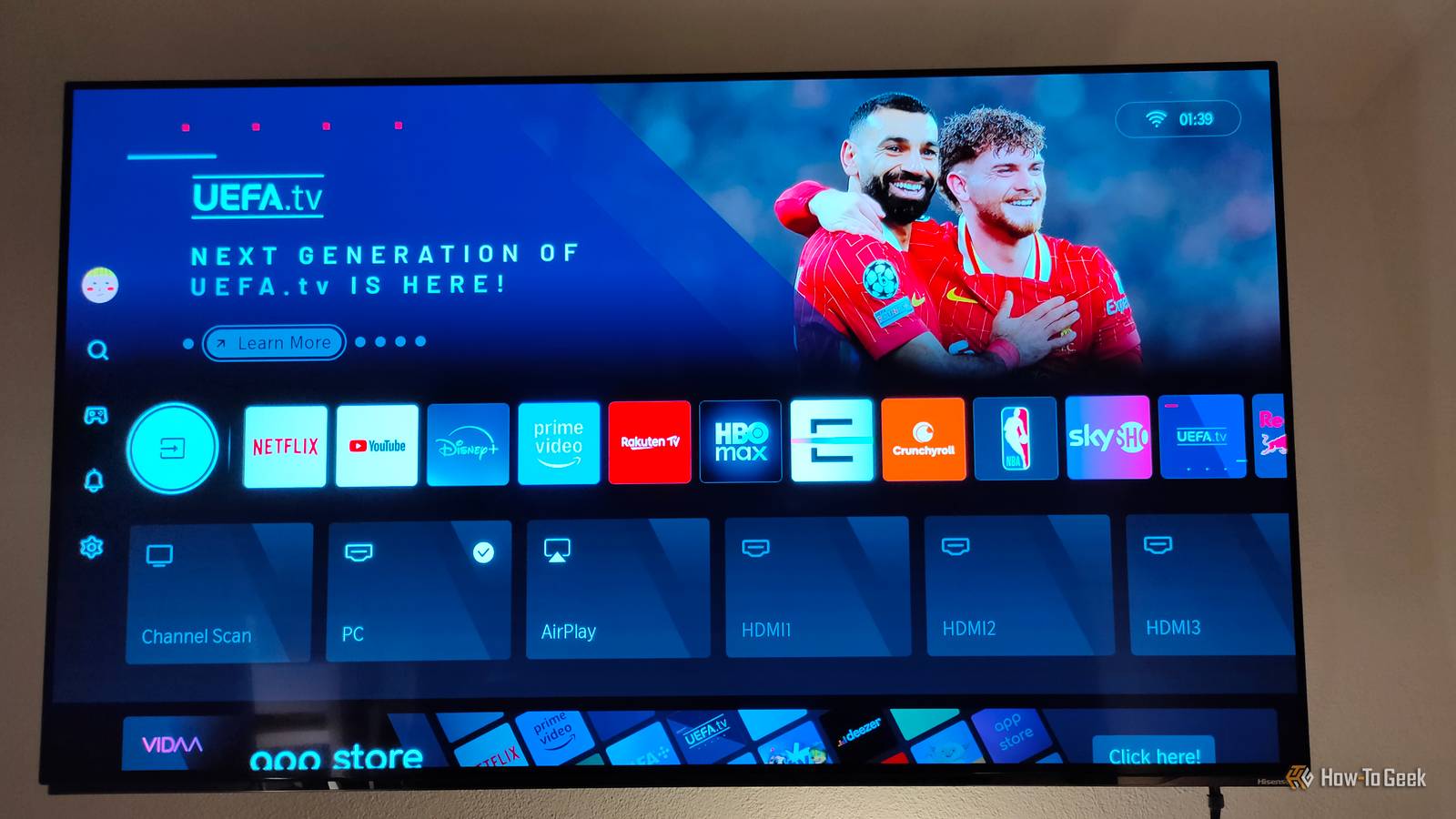
The cheapest OLED TVs often use LG Display's WOLED panels, and many feature older designs without MLA or the newer Tandem technology.My Hisense 55A85K is a good example: it launched in spring 2023, just as LG and its partners were bringing their first MLA-equipped TVs to market, but my panel lacks the brightness-boosting technology.Brightness makes all the difference, especially with HDR Perfect blacks don't always guarantee impressive HDR All OLEDs have one massive advantage that people buy them for: pixels emit progressively less light as the image gets darker, and they switch off completely for pure black.
This results in a technically infinite contrast ratio, which is often reason enough for someone to buy an OLED (I know because it was for me).However, an infinite contrast ratio doesn't automatically make a TV good at HDR.The TV also needs to be bright enough to make that contrast really pop in real life.
Completely black pixels surrounding a bonfire don't mean much when the fire that's supposed to shine brightly in the center looks more like a dimly lit torch.Sunlight, explosions, and scenes that were shot in broad daylight that are supposed to look alive can all feel a little dull on a budget OLED.Brightness is an area where budget OLED TVs often struggle the most, especially heavily discounted older models like mine that use an older-generation panel.
A TV can support HDR10, HDR10+, and Dolby Vision, but HDR support alone doesn't guarantee good HDR performance.Unlike monitors, TVs lack a widely used brightness-based certification system like VESA DisplayHDR, so you'll need to look up independent brightness measurements, including peak HDR brightness, full-screen brightness, and SDR brightness, to get a better idea of the TV's HDR capabilities.A weak processor spoils the whole experience A great panel can't fix bad processing Processing power is yet another area where cheap OLED TVs cut corners.
The first sign is a sluggish user experience, with dropped frames in the interface and apps that take forever to load, but that's only the beginning.These weak processors can actually hurt image quality, as they have to rely on simpler image processing and upscaling algorithms.Instead of the latest onboard AI neural networks that enhance images in real time, cheap OLEDs may rely on less advanced processing that can introduce all kinds of visual artifacts, like harsh edges, graininess, noise, color banding, and motion artifacts.
Whether you like some of these effects is a matter of subjective taste, but some aspects of image processing are objectively better, especially upscaling, which is incredibly important whenever you watch non-native 4K content.Related I've owned an OLED TV for 8 years—here's how I prevented burn-in Stop worrying about OLED burn-in—My 8-year-old TV has no issues because I follow a handful of careful rules to keep anything from happening.Posts By Jorge A.
Aguilar Build quality, included stand, ports, and the built-in speakers all take a hit, too The savings show up everywhere The cost-cutting measures on cheap OLED TVs don't end with the panel and processor.Everything else takes a hit, too.Overall build quality and cooling capabilities are often cut to the bare minimum; the included stand likely feels cheap and lacks adjustments, and there are often fewer HDMI and audio output ports.
The built-in speakers can be worse, too.At least the good news is that these disadvantages aren't as impactful as everything else I've discussed.Build quality doesn't matter as much on a TV that you mount once and rarely handle again.
You'll probably wall-mount it anyway, making the stand irrelevant, and you might not need more than one HDMI connection.You can also easily replace underwhelming built-in speakers with a cheap soundbar or surround sound system.Going a tier above the cheapest OLED is often worth saving for (or just buy a mini-LED) Although a cheap OLED can still be a legitimately good choice if you want to enjoy its uniquely amazing contrast, you need to know what you're getting yourself into.
Even the cheapest OLED TVs often start at around $1,000, so they're an expensive mistake to make.I'd say buy once, cry once, and get the next tier of OLED TV that you can still afford.But if even those entry-level OLEDs were pushing your budget to begin with, perhaps a higher-end Mini-LED TV would be a better choice.
They offer a few unique benefits of their own, like higher overall brightness that can result in better HDR in some scenarios.Plus, you can go up a screen size without breaking the bank, which is what I wish I had done.Hisense U8G Display Size 55-inches Dimensions 1.9"D x 48.4"W x 28.1"H The Hisense U8G is one of the best 4K LED TVs.
It offers excellent picture quality, advanced HDR support, and two HDMI 2.1 ports.Operating System Google TV Display Resolution 16:9 Connectivity Bluetooth, Ethernet, HDMI, USB, Wi-Fi Refresh rate 165Hz See at Amazon Expand Collapse
Read More