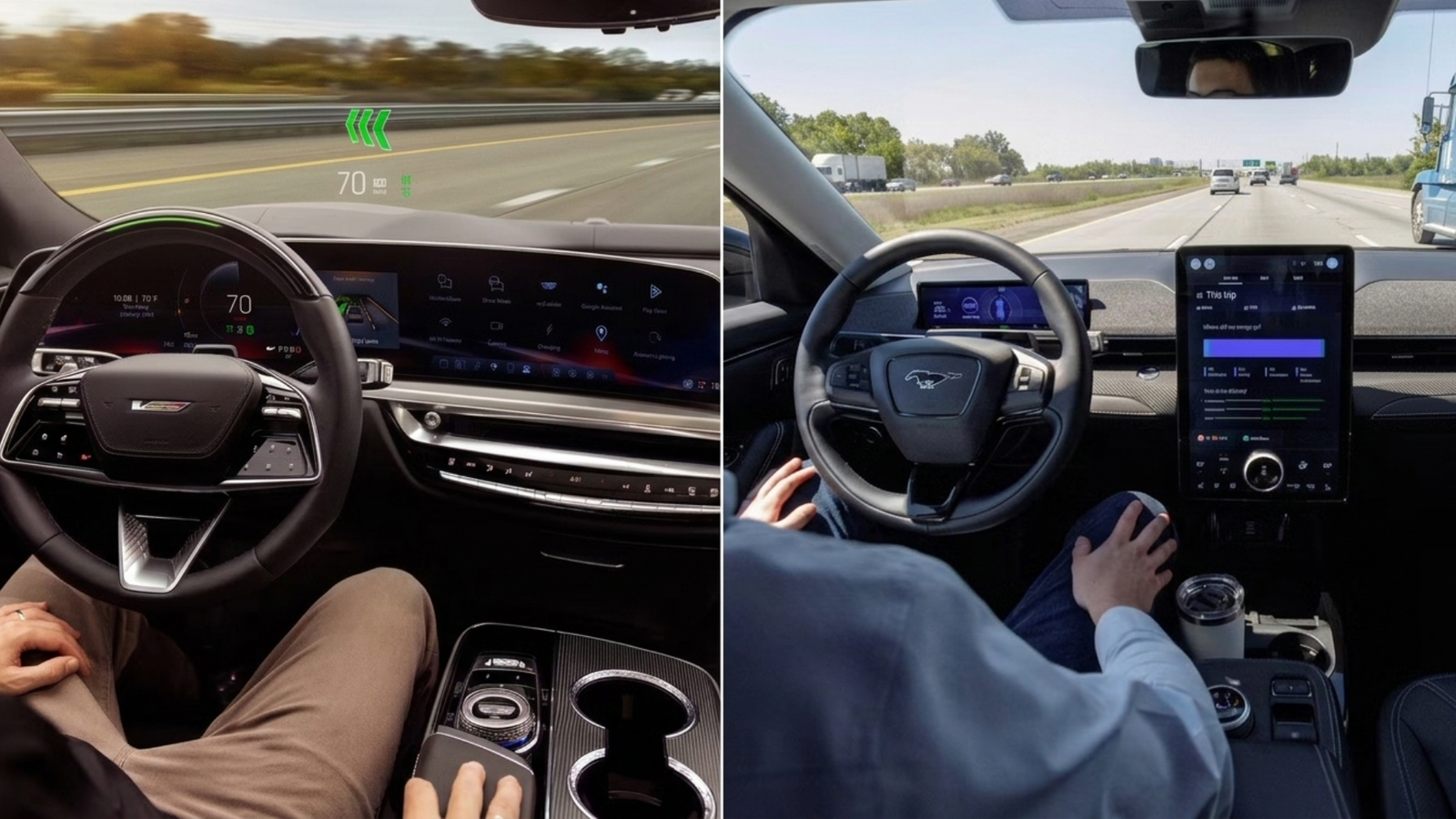
Hands-free highway driving has grown from a novelty feature into a full subscription business over the past decade, with GM's Super Cruise and Ford's BlueCruise combining for more than 1.8 billion hands-free miles driven so far.Both systems handle steering, acceleration, and braking on compatible highways with a driver-facing camera to confirm the person behind the wheel is still watching the road.GM introduced Super Cruise in 2017 for the Cadillac CT6, with Ford following in 2021 with BlueCruise for the best-selling F-150 and Mustang Mach-E.
GM added Super Cruise to the CT4, CT5, and Escalade in 2021 as well, then extended it beyond the Cadillac lineup for the first time on the 2022 Chevy Bolt EUV.As of this writing, Super Cruise is available on more than 20 models across the Chevrolet, GMC, Cadillac, and Buick lineups, including GM's all-new truck lineup for 2027.Customers have logged more than a billion hands-free miles on the system as of April 2026, with GM expecting to surpass 850,000 paid Super Cruise subscriptions by the end of 2026 (the additional revenue from Super Cruise for GM is projected to reach almost $400 million for the year).
BlueCruise is available on the Explorer and Expedition in addition to the F-150 and Mustang Mach-E.The Lincoln Aviator, Nautilus, Corsair, and Navigator offer the same technology as Lincoln BlueCruise.According to Ford, customers have logged roughly 840 million hands-free miles with BlueCruise as of the second quarter of 2026.
As of January 2026, about 1.22 million Ford vehicles worldwide were equipped with the feature.The appeal for drivers is largely the same across both systems.Long highway stretches become less tiring because the vehicle handles the repetitive work of steering and speed control, reducing the physical strain of hours of small corrections.
Drivers may also find that they can pay closer attention to traffic and their surroundings instead of keeping the vehicle centered in its lane.The result tends to be a smoother, more consistent ride in heavy or fast-moving highway traffic.How the technology works Mapping and sensors Super Cruise relies on LiDAR to build its maps, though the LiDAR itself is part of a separate GM mapping fleet, not fitted to the vehicle a customer drives.
GM's Super Cruise documentation describes those mapping vehicles as bouncing light beams off the road ahead of time to build a 3D model accurate down to the lane, similar to how Google Street View cars work.Those finished maps download to the customer's vehicle (which is not equipped with a LiDAR sensor).From there, the GM vehicle relies on front and rear radar, a front camera, surround-vision cameras, a lane-sensing camera, and GPS to match its position against the map, while a driver-attention camera on top of the steering column tracks head and eye position.
BlueCruise relies on cameras, radar, and GPS, paired with map and software data developed by Latitude AI, Ford's driver-assistance subsidiary.Ford's planned "eyes-off" driving system for 2028 is expected to use LiDAR technology, separate from the BlueCruise system sold today.In addition to handling steering, acceleration, and braking, both systems can also change lanes without the driver touching the wheel.
Super Cruise offers two lane-change options.With Turn Signal Activated Lane Change, a light tap of the signal has the vehicle check its blind spot and move over on its own.Automatic Lane Change goes a step further, passing slower traffic or exiting an ending lane with no driver input.
GM has made both standard on most Super Cruise-equipped vehicles since 2022, including newer Cadillac, GMC, and Chevy trucks and SUVs, though neither works while towing.Related Super Cruise costs $40 a month, but 60% of GM owners skip it Whether it’s worth paying for after the free trial comes down to where and how often you drive.Posts By Carl Anthony BlueCruise's Lane Change Assist works on the same basic idea.
Tap the turn signal between 40 and 80 mph, and the vehicle completes the move once the adjacent lane is clear, a feature available on vehicles like the 2026 Lincoln Navigator.A newer version, BlueCruise 1.5, adds fully automatic lane changes with no signal needed, though it's currently limited to the 2025 and 2026 Mustang Mach-E and the 2026 Explorer.Like Super Cruise, lane-change functionality for BlueCruise is also disabled when towing.
Coverage is where the two systems separate the most.Super Cruise works on more than 600,000 miles of North American highways and some non-divided secondary roads.BlueCruise covers about 130,000 miles of what Ford calls Blue Zones, up from about 100,000 miles when the system launched in 2021.
Super Cruise's network is more than four times as large, which may matter for buyers who see either system as a must-have when choosing between a Ford or GM vehicle.BlueCruise pulls ahead on Consumer Reports' scorecard for functionality, despite a smaller coverage map.The publication rated BlueCruise 84 out of 100 in its active driving assistance testing, including a nine out of 10 for keeping drivers engaged, compared to Super Cruise's score of 75 out of 100.
BlueCruise also holds the edge on ease of use, rated six out of 10 against Super Cruise's four out of 10, since GM's instrument cluster gives drivers little more than a small steering-wheel icon to work with.What owners are saying Forums offer insight into how the systems work In a thread on the Cadillac Owners Forum, a driver who bought a used 2019 CT6 spent more than a week troubleshooting a Super Cruise system that wouldn't activate anywhere, despite driving on interstates within GM's coverage map.A dealer visit didn't turn up a clear cause, but the system started working again on its own later.
Others point to a separate issue where a pre-owned GM vehicle may need a Super Cruise recalibration over the course of multiple test drives by a dealership technician, a process one owner put at about $600 in total repairs.The same thread noted that construction zones with altered lane markings can trigger a temporary handoff back to the driver, while direct sunlight may blind the steering-column sensor that tracks eye position.Related Ford's BlueCruise costs $50 a month, but here's who actually needs it Whether it's worth paying for after the free trial boils down to how often and where you drive.
Posts 1 By Carl Anthony Meanwhile, owner forums like MacheForum are a useful resource for tracking how BlueCruise changes with each software update, since Mustang Mach-E owners tend to compare notes as soon as a new version rolls out.Reception was up and down with BlueCruise 1.3, with owners in one widely discussed thread reporting a dozen or more disengagements over a 350-mile drive, along with abrupt braking triggered by misread speed-limit signs.Feedback on BlueCruise 1.5 has been more positive, with one 70-mile test resulting in smoother, more natural lane-centering and minimal disengagements.
However, a separate thread describes the BlueCruise system braking hard mid-lane-change, badly enough that another driver nearly rear-ended the owner.Monthly and yearly costs for Super Cruise and BlueCruise As of this writing, Super Cruise costs $39.99 a month or $399 a year, following a three-year trial included with an eligible GM vehicle.GM doesn't offer a one-time (or lifetime) purchase option.
Super Cruise's three-year trial carries over to a second owner if time remains, and a later owner can start a fresh subscription once it runs out, as long as the vehicle has the hardware.BlueCruise costs more overall, at $49.99 a month or $495 a year.However, Ford offers a one-time payment option for $2,495, which guarantees at least seven years of service.
BlueCruise buyers get a much shorter trial, just 90 days from purchase, compared to Super Cruise's three years.Ford's one-time BlueCruise purchase is linked to the vehicle's VIN rather than the buyer, so the benefit passes to a new owner with no refund or credit for the seller.If the pre-owned Ford vehicle does not have a current BlueCruise plan, buyers can activate one on their own.
Super Cruise's larger network of compatible roads offers better value for those who log serious highway miles, whether for work or pleasure.GM's longer three-year trial period is also an advantage.However, based on Consumer Reports' evaluation, BlueCruise may be easier to use day-to-day, though its monthly and annual costs are higher than Super Cruise.
GM customers who want an electric vehicle with Super Cruise capability may find the Chevy Equinox EV an accessible entry point.Buyers need the LT2 or RS trim plus the $3,000 OnStar Super Cruise extension, bringing the total MSRP to around $46,595.By contrast, one of the lowest barriers to entry for BlueCruise is a pre-owned Mustang Mach-E, which has had BlueCruise-capable hardware on every trim since the 2024 model year.
While both Super Cruise and BlueCruise have benefits, those who drive primarily on lower-speed roads or live in a smaller town or rural area may see little value in a monthly or yearly subscription, since neither system will engage outside its mapped highway network.Likewise, if most of a day's driving happens in stop-and-go traffic, neither subscription is probably worth it.
Read More