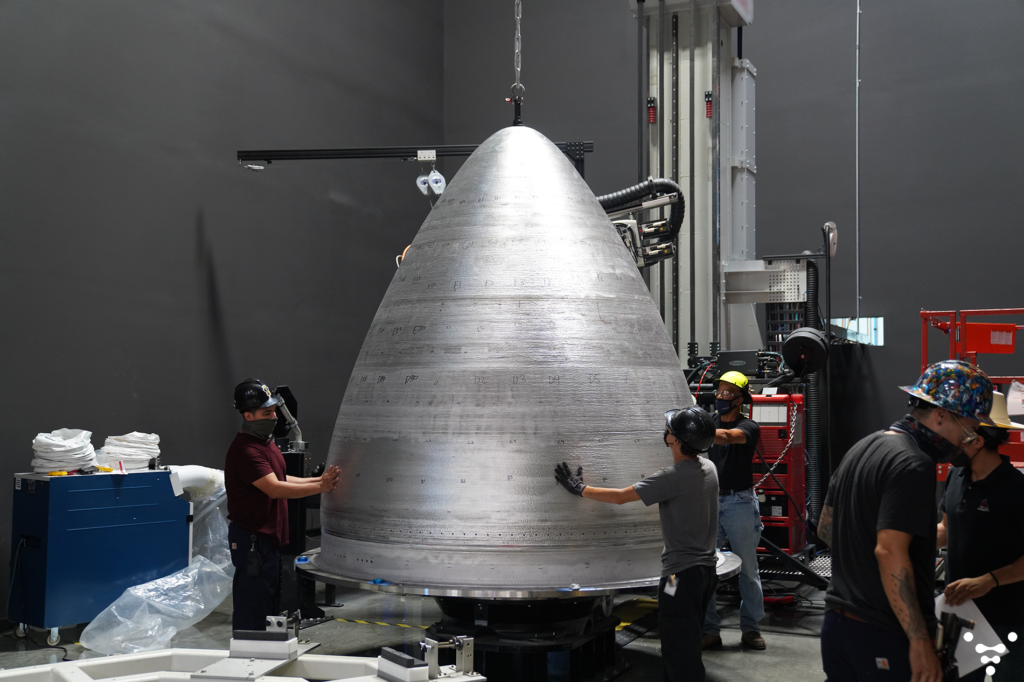
Recently, Metalysis, Skyrora, and Thermo-Calc Solutions started to try to commercialize Tanbium.This alloy has been created for use in combustion chambers and rocket nozzles.Tanbium is a Refractory Complex Concentrated Alloy (RCCA), a class of materials that is believed to be key to hypersonics, missiles, engines, and space.
It’s kind of like if you took Dubai chocolate and mixed it with Pumpkin Spice to make a healthy breakfast muffin with extra protein that was yummy and lowered your blood sugar.Refractories are already a class of materials that lend themselves well to parts with high creep, strength, and temperature applications.Many of the in-demand alloys for space and defense, especially in engines, are in this category.
High Entropy Alloys are already in high demand as well, and these can be refractories, as are the now popular alloys in additive niobium, tantalum, and tungsten.These are sometimes called Refractory High-Entropy Alloys (RHEAs, also called Refractory HEAS).But not all of the refractories are HEA.
Non-Refractory HEAS have a lot of chromium, cobalt, iron, and nickel in them, so they’re not refractories.What they are is an alphabet soup of things such as AlCoCrFeNi (which could see marine use) and CrCoFeNi (Cantor also used in marine and turbine blades).VCoNi is an example of a Medium-Entropy Alloy, a distinct category.
Some of the materials have a Face-Centered Cubic (FCC) structure, which they share with more well-known materials such as aluminum, platinum, and gold.But alloys can be many things at once.Oak Ridge darling CrCoFeNi is FCC, for example, but can also form Body-Centered Cubic structures, while the wear-resistant FeCoCrAlCu is seen as a Body Centered Cubic HEA.
Imagine a kind of Linnaeus-like classification system, but where some starfish can also be eagles, and some cows are also cacti, some of the time, and you get modern metallurgy.The best thing to compare it with really is the Pokémon universe, only that seems more logical with easier-to-remember names.There is a group of Complex Concentrated Alloys that have fewer than five elements in them.
HEAs can be seen as similar and, indeed, can be seen as a category of CCAs, but they have a disorderly structure.Traditionally, in alloying, a primary material is mixed with some small additions of other materials to improve performance or processing.In HEAs, we have large proportions of individual materials that lead to very different structures and properties.
The category of intermetallics, such as the titanium aluminide used for turbine blades, is also a promising one.These can be mixed with HEAs to form High-entropy intermetallic compounds (HEICs), while alternatives are High Entropy Ceramics (high entropy oxides), which include things like carbide alloys and rocksalt.Helical growth of grains in the high entropy alloy fabricated by a chessboard scan strategy.
An IPF-BD map of a section along BD of HEA.RCCAs such as the high-yield-strength MoNbTaW, but also TiZrNbTa and WMoTaNbV, have been processed by DED, and indeed, using LPBF, one can make these alloys.RCCAs are a new frontier for metals; these high-performance materials will probably be much more suited to extreme heat applications, especially where fatigue strength is concerned, than superalloys and other high-performance materials.
Furthermore, if you want something to resist high heat, then you have options from the 70’s a plenty; but if it needs to have good creep strength and not be too brittle at your temperature of choice, while being readily made into a specific design, your options are limited.It becomes more difficult if you need higher temperature performance above 1100 °C.Meanwhile, you’re also trying to avoid certain materials that you may not have, but the other guy has plenty, and you get the metallurgical whack-a-mole with ODS, intermetallics, and bulk metallic glasses all being bandied about and developed for the same types of parts and processes we have now.
Automotive piston additively manufactured using the ORNL-developed DuAlumin-3D alloy.Image courtesy of Amy Smotherman Burgess/ORNL, U.S.Dept.
of Energy.RCCAs are a different approach in which refractories such as hafnium, ruthenium, titanium, tungsten, and others can be combined in relatively large proportions to achieve an optimal mix, typically a Body-Centered Cubic, disordered alloy with a complex microstructure.The resulting class of materials is much more resistant to corrosion and degradation through oxygen, can have melting points in excess of 1000 °C, and has excellent yield strength in the material that can lead to better creep, fracture toughness, and fatigue properties in parts, while being potentially lighter and more ductile than existing materials.
Unobtainium, therefore, contemporary quicksilver.The CCA family of materials and the HEAs are a palette through which we can construct many more incredibly specific materials.And out there somewhere is some mythical combination that could be the very best thing for your nuclear reactor or aircraft engine.
Yet another could be designed to be better than all others for your plane skin or car.RCCAs are like a magical hamster wheel for the Department of Energy.It’s also important to note that Inconel 625 and 718 still dominate many demanding applications and were both made in the 1960’s.
Finding the perfect refractory smoothie could mean more than a better vehicle or program; it could lead to decades of material dominance.RCCAs have been challenging to produce, with cracking evident, and researchers have taken to cold spray and essentially every which way to make these materials.Combining different elements with very different properties that need different temperatures has been difficult.
Alloying can take place before additive or the material can be made during the 3D printing step itself, giving companies perhaps too many not-so-successful paths to volume manufacturing of these alloys and parts made from these alloys.But now several developments are occurring simultaneously that make RCCA particularly opportune.A new form of great power competition is making the world both more globalized and fractured.
This is leading to worries about supply chains.Difficulty in sourcing certain materials is now a real worry for governments and firms.This is fueling the search for new materials that can be obtained from the feedstock available in the country.
And the search is on for alternative materials.Hypersonics may be the new high ground, allowing countries to place, in an hour or two, a vehicle that is difficult to track and shoot down, surpassing anyone else traveling at 20 times the speed of sound.If maneuverable, this vehicle would not come over the horizon, and be easy to see, but from wherever, and be impossible to predict.
Furthermore, given the speed, any kind of Iron Dome interception system, even a laser system, would be difficult to do, just given the time.A hypersonic vehicle could travel, in an evasive path, 100 KM in 15 seconds, while the Iron Dome reaction time is 15 seconds.Essentially, all current stage missile defense and things like the Carrier Battle Group go out the window if you truly take into account hypersonics.
You need a new class of materials to make hypersonics, and one of these classes could be RCCA’s.Advances in computational software, but also raw computational power through Moore’s Law, have made a lot more alloy design and optimization possible.RCCAs are, in effect, a palette that one can use to make many different materials from, all benefiting from advances in computational power.
At the same time, AI hype has created more development of GPUs and other hardware suited for alloy development, while also perhaps leading to AI-based methods to find and predict new alloys.Electrolysis systems, such as the Metalysis FCC Cambridge process, as well as other developments in powder creation, including 6K, Metal Powder Works, Continuum, and others, have created more paths towards powders and alloying, democratizing research and making more possible.Making alloys using E-Beam, LPBF, and DED is coming to the fore in composite armor, new space components, turbo machinery, and in defense more broadly.
It is now cheaper to make new alloys, and we can make them in completely new ways, through different paths than previously.At the same time, the need for new alloys has never been greater.Hypersonics, advances in aeroengines, the infinite-energy glitch Tokamaks, and nuclear technology more broadly all require very specific alloys.
There is, in effect, a flywheel in operation, where anxiety about being behind on materials and hypersonic needs is driving advances in computational discovery of new high-performance alloys.This is being aided by Nvidia, AI hype, and the general march of computing.That is speeding up discovery, while the making of the alloys is more available and cheaper through additive and new powder manufacturing.
This promise is fueling new searches for specific alloys meant to win in hypersonic and advanced materials, which makes the whole merry-go-round go round again.It is in effect a flywheel, the most consequential flywheel worldwide at the moment.Given these materials’ extraordinary capabilities, their advances are truly of importance to nation-states and some of the most important industries globally.
But, we’re not just looking for one perfect high-temperature material meant to displace niobium C103 or the Inconels.We’re looking for pathways to create lots of designer alloys that can optimally function better than any other material in key areas.And this material can now be much more specific while being cheaper to manufacture than before.
Instead of a few materials, there may be one specific one best for the skin of an aircraft, another for a turboprop, another better for in the turbine, another for in a combustion chamber, another for a nose cone, and so on.The search, therefore, is not on to find the ideal Goldilocks porridge but rather Goldilocks’ Porridge making machines to replace many of the most prevalent material systems of the world.Subscribe to Our Email Newsletter Stay up-to-date on all the latest news from the 3D printing industry and receive information and offers from third party vendors.
Print Services Upload your 3D Models and get them printed quickly and efficiently.Powered by FacFox Powered by 3D Systems Powered by Craftcloud Powered by Xometry 3DPrinting Business Directory 3DPrinting Business Directory
Read More