Dutch firm 3devo is a pioneer in desktop filament makers.Where other players make tools for makers, 3devo is the filament maker that your filament company, polymer company, or local university uses.Research labs all over the world use 3devo’s machines to make test batches of innovative filaments or dial in production batches.
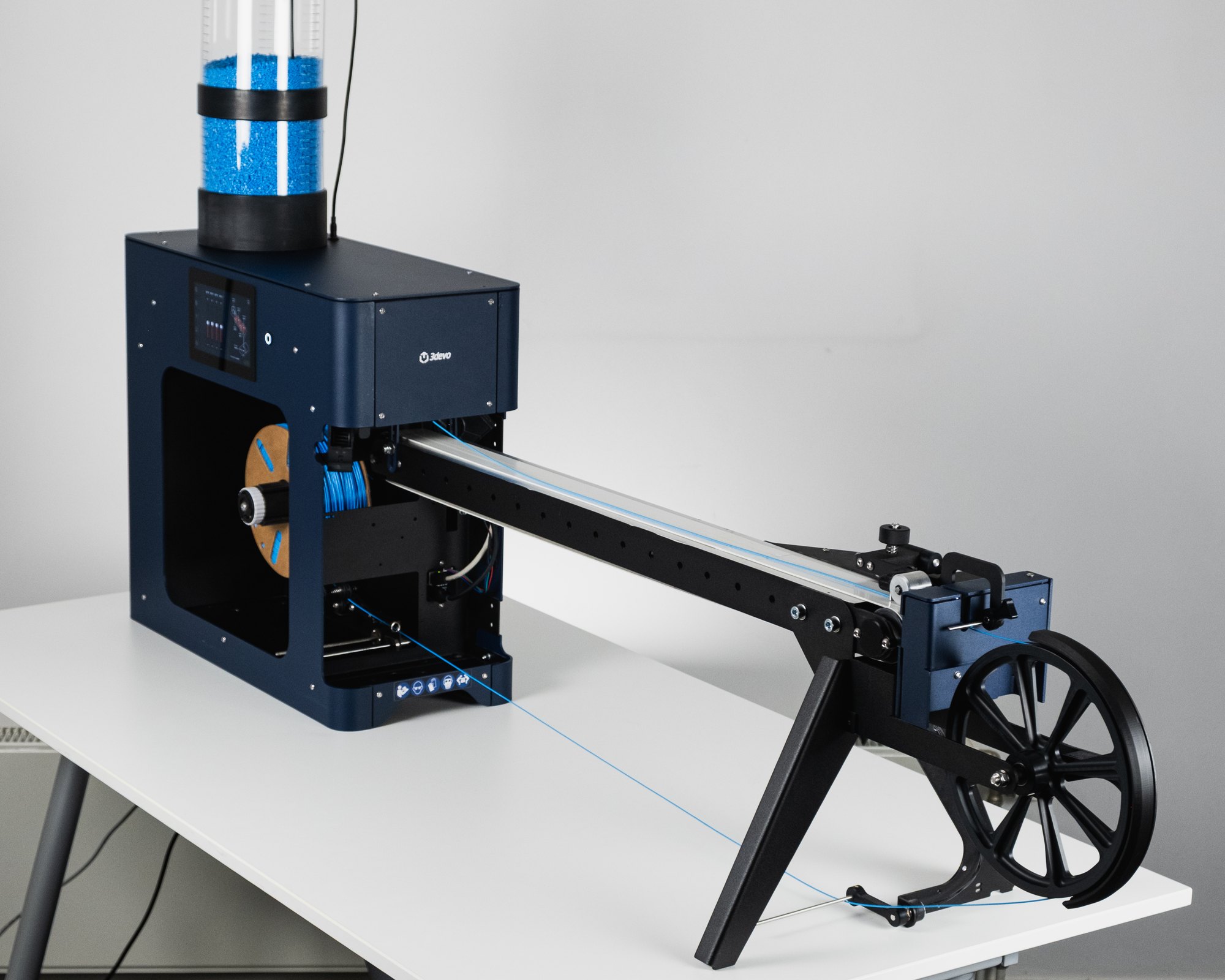
To date, the company has released its original filament maker and an updated Filament Maker Two, which will remain on offer as a lab machine.The firm also has a shredder, letting you recycle material or introduce new materials to add to the mix.Now 3devo has released the Filament Maker X10.
While the FMX10 can be used as a lab machine, it can also produce filament more readily in larger batches.The firm says it can make one and a half kilos of filament at high tolerances per hour.Indeed, for a university lab or company, this could be enough for you to completely supply your own filament.
Even with today’s high speed desktop machines, many people would be able to run a small prototyping shop or production unit with those volumes.I really like this because it means that if we’re some specialized oil and gas firm, we can make our own weird material that only we need in-house.As a university lab, I can make all of my prototyping filament out of PETG bottles.
Or I could, as a small producer of plant pots, make my own material out of coffee grounds and PLA right in my shop.As a designer, I could continually make cutting-edge new filament out of all manner of recycled, innovative materials or combinations, and use that to differentiate myself.As a print farm I could make a lot of my own filament and save considerably.
Assuming we can fund the FMX10 full time, then we could get 36 kilos per day.If we use 2 kilos of filament per printer per day, running it full time (this could also be 500 grams per day and depends on speed, nozzle, infill, layer height, how quickly we take out printed parts, and the model), then we can run 18 printers using one FMX10.Or if we’d have models and prints that used a lot less material, around a kilo (which is probably closer to the true number we’d actually get), we could potentially run 36 printers full time off of one machine.
Depending on the material, if we’d run 36 machines full time using one kilo a day, we may consume $150,000 in filament a year if we buy it for $12 a kilo.If we make the same out of $5 pellets using the FMX10, we may spend $65,000, meaning that for a relatively small farm, you could save up to $91,000 per year.Now of course you’re unlikely to ever run everything at capacity, and your price and usage varies greatly, but we can see that there could be significant savings here.
What’s more, these savings are available from a relatively low number of machines.Let’s do a conservative estimate and say that 36 machines only use 500 grams per day and I could buy filament for $9 per kilo and would have to pay $5 for pellets.Then we’d use 6,570 kilos per year and could either buy $59k of filament or $32k of pellets, saving $26,000 per year.
So there’s a real opportunity here.The tolerances 3devo expects are ±30 µm diameter across the entire spool.I know that you may have seen better tolerances advertised, but many of these refer to maximum and minimum, or only use one or two measuring points.
That’s relatively easy to do.But, across the entire spool, ±30 µm is actually very good, and is checked via a three-axis optical sensor.3devo thinks that, with production and manufacturing, “waste becomes worth recovering rather than worth disposing of.
Supply becomes a resilience question rather than a purchasing one.And material development stops being a research exercise and starts being a production requirement.” The company also makes a great point that “virgin PLA filament now costs around €10/kg, and a lab scrapping a couple of hundred kilos a year recovers a few thousand euros against a system costing many times that.On the other hand, PA12 powder from MJF and SLS printing costs €50–100/kg, and 50–60% of the powder in a build goes unused — a busy facility scraps well over a thousand kilos a year.
Same machine, same process.The difference is entirely what the waste is worth.” I’ve previously advocated for using filament machines in combination with LPBF waste, and think that many more firms should do this.The FMX10 is meant to be a plug and play machine, used unattended and able to be monitored remotely.
The trick of the FMX10 is to increase the travel, and therefore cooling, of the filament by 2.8 meters across a conveyor.The conveyor is air-cooled, which means that there will be no extra water in the material that negatively impacts intra-layer bonding.Interestingly, by going air-cooled, this filament maker may make for stronger parts than ones made on other water bath filament makers.
The extruder itself has four heating zones that can work up to 450°C at ±0.1.The machine has been tested with PCL, PEEK, PEI, PA CF, and PA GF.The spooling is done internally and the total travel of the filament is 2.8 meters because it goes across and is then returned internally to be spooled.
There’s a 7.25 L SmartFlow Hopper that can work for powders, regrind, or pellets.The FMX10 also has a feed zone cooling unit and a 58–62 HRC DC53 screw, as well as has specialized nozzles for abrasive and filled filament.To test the machine, 3devo used 2,000 kg of MJF PA12 powder waste, turning it into 3D printed parts.
3devo CCO Timo van der Laak said, “We want a world where recycling is economically viable, material innovation is accessible, and production is decentralised — where polymer doesn’t travel across the planet to reach a printer standing twenty metres from the waste it came from.But between a lab extruder and an industrial extrusion line, there was nothing.If filament making isn’t your core business, you cannot justify three-phase power, chilled water and somebody watching a machine all day.
The Filament Maker X10 asks for none of that, and still produces filament at the tolerance you would expect from a supplier.” I really like this machine.I think that if you run MJF or other LPBF printers, you should really look at using this internally to make high-quality, inexpensive recycled material in-house.And if you do production, then now is the time to consider making your own filament.
Yes, it’s an extra step, but the savings could really be significant.Subscribe to Our Email Newsletter Stay up-to-date on all the latest news from the 3D printing industry and receive information and offers from third party vendors.Print Services Upload your 3D Models and get them printed quickly and efficiently.
Powered by FacFox Powered by 3D Systems Powered by Craftcloud Powered by First Mold Powered by Xometry 3DPrinting Business Directory 3DPrinting Business Directory
Read More