Stephen Schenck / Android AuthorityRight now is an utterly fantastic time to get into head-mounted displays (HMDs).Whether we’re talking immersive VR experiences, lightweight smart glasses, or the new world of Android XR, there’s something for everyone.And as I learned while visiting XREAL at CES 2026 last week, this hardware has come a long way.I first got started with HMDs about 30 years ago, thanks to the VictorMaxx Stuntmaster for my SNES.
It offered a private viewing experience, supported limited game input… and was very, very bad.Heavy, uncomfortable to wear, and worst of all, featuring a low-res, blurry screen, it coasted by on sheer novelty.Obviously, things have gotten a lot better since then, but until XREAL handed me its latest AR glasses, I really had no idea just how far we’d come.
Will 2026 be the year you buy your first pair of smart glasses?2 votesAbsolutely! There's finally a lot of good models to choose from!0%Maybe.I'm going to wait and see what things look like in another six months.100%Probably not.I think we're still a generation or two away from being great.0%Nah.
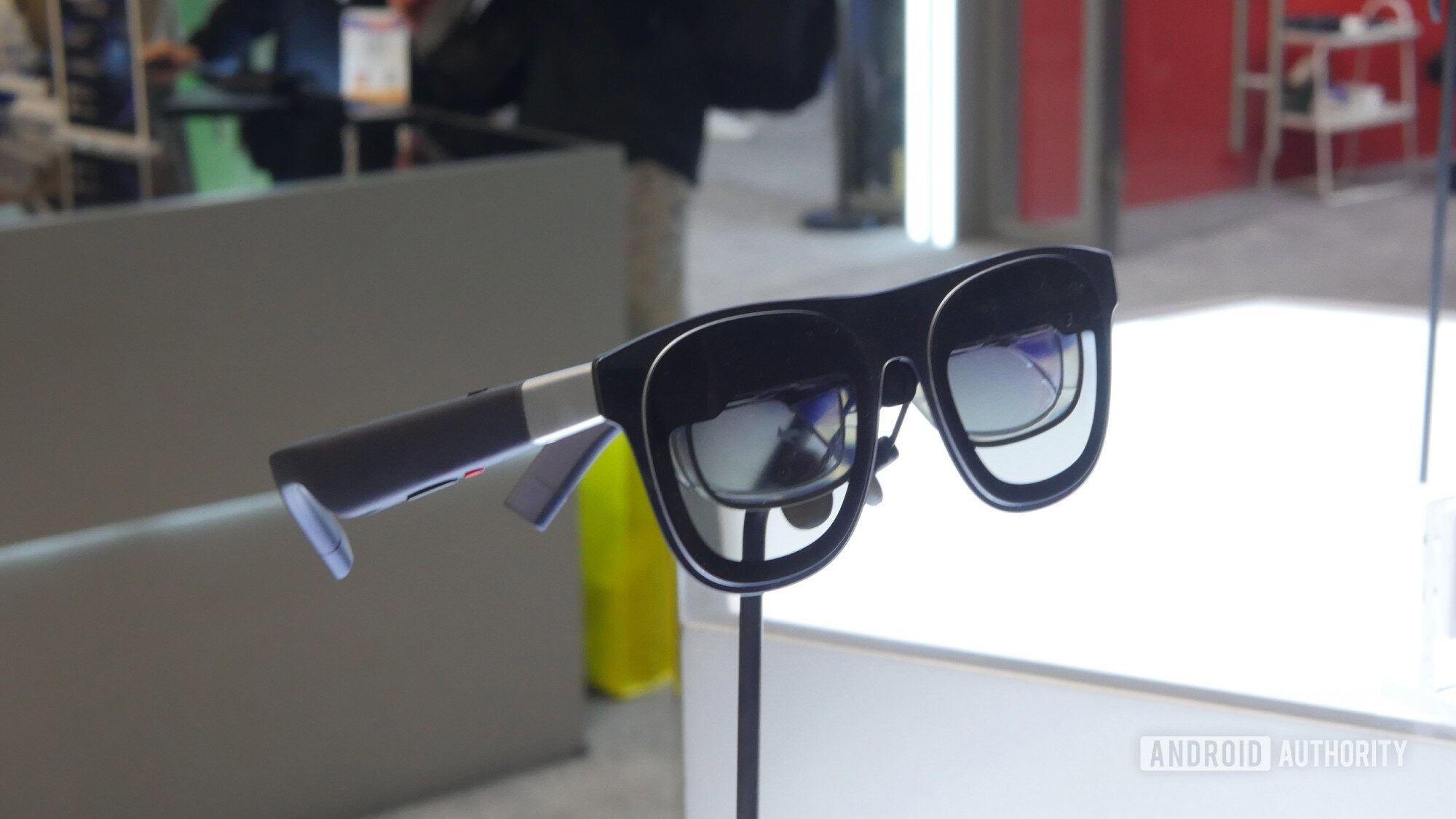
These kind of wearables just aren't for me.0%There’s “good,” and then there’s “this can replace your monitor” goodStephen Schenck / Android AuthorityWhat better place to start than top of the line? XREAL just unveiled its ROG XREAL R1 glasses with some eye-melting specs.These are built for gamers who are either looking for a little privacy or just want to enjoy the effect of a high-end gaming monitor wherever they go.To that end, XREAL has built these AR glasses with specs like a 240Hz refresh rate, 1080p resolution, and bright, responsive micro-OLED panels.Ever hear an early AR adopter brag about getting work done on an airplane by plugging in their glasses to view a big, virtual screen — and found it a little hard to believe? How could something small enough to fit into a frame still deliver an image with enough fidelity to handle fine text, let alone interacting with the precision of a cursor? Seeing the R1 in action for the first time feels slightly unreal.
Well: It can.It absolutely can, and seeing the R1 in action for the first time feels slightly unreal.I was expecting to be let down by the image quality, but it really does approach that of an actual monitor.
The biggest downside is arguably the viewing angle — it’s quite good, at 57 degrees, but even that’s still a bit short of fully immersive.I’ve also got to admit that XREAL nailed the look here.After all, these aren’t just regular AR glasses, and you can see how the company leaned into that ASUS ROG aesthetic: black everywhere, aggressive angular design, and RGB highlights.
That includes the ROG Control Dock, which makes it effortless to use the R1 glasses while switching between your PC and console.This is a product that knows its audience.When it comes to air gesture control, a pinch will doStephen Schenck / Android AuthorityOK, so we’ve got a high-quality screen we can take anywhere.
How are you going to interact with it? Well, you’ve already got a pointing device right on you; ten of them, actually.AR glasses can use cameras to track your hands and fingers, and we’ve seen pinch-to-click interactions emerge on devices like Apple’s Vision Pro.XREAL’s working on the same kind of thing, and I tried out some in-air gesture controls for myself.This is right about where I hit my first real learning curve: The camera on the glasses would pick up my hand and track its motion to control an on-screen cursor, but its position doesn’t align precisely with your fingers, and right away I got the sense that this was going to take a little practice to start really feeling natural.
Don’t want to miss the best from Android Authority? Set us as a favorite source in Google Discover to never miss our latest exclusive reports, expert analysis, and much more.You can also set us as a preferred source in Google Search by clicking the button below.Once you start getting over that hump, though, it’s easy to see how well this could work.
A pinch-and-release gesture acts as a single tap, while you can pinch-and-move to scroll.Sure, you might look a little funny from the outside, but this is about productivity, not vanity.Entering a new dimension, with familiar content Every so often, it feels like 3D content is going mainstream — and then the hype sort of fades.
This has been happening for decades now, but with the rise of smart glasses, are we finally hitting an inflection point? I wanted to check out the latest advancements in 3D media, so I went hands-on with XREAL’s new Real3D system for real-time 2D-to-3D conversion.All you need to do is connect your regular 2D video source to XREAL 1S or One Pro glasses — it can be your phone, a movie, or even a game console (the XREAL Neo video hub makes that connection a snap) — and the company’s X1 spatial computing chip starts processing that input, trying to work out depth cues.For a natural scene, that transforms flat mountains into ones that appear to stretch into the distance, while for something like your phone, UI windows appear to float atop each other.That this works at all is a small miracle, as converting 2D to 3D content can be a full-time, very manual job.
But the X1 chip does manage to pull off a passable job in real time — although some content seems to work better than others.Gaming in 3D with Real3D conversions makes it easy to get lost in the illusion of depth.The best way I can describe the effect, and where it fails, is that your scene can end up looking like a series of cardboard stand-ups: elements positioned in 3D space, but flat themselves.
For nature scenes, that can be a bit jarring — hills may roll out to the horizon, but each looks like a flat picture of a hill, stacked one behind another.Where Real3D was much more successful for me was when it was processing interior shots with lots of walls.Another 3D success: gaming.Using Real3D with a first-person console game is a heck of a lot of fun, and while there’s still that cardboard cutout effect, it’s much less noticeable when everything’s moving around so fast, and you just get lost in the illusion of depth.If you had no clue that miniaturized display tech for smart glasses had gotten this good, well — consider yourself educated.
These are not your daddy’s clunky old VR goggles, and the new wave of AR hardware from companies like XREAL combines power and high-quality screens in some eminently portable packages.Sure, things are always getting better, but this is the perfect time to get your first exposure.FeaturesARCES 2026Smart GlassesXREALFollowThank you for being part of our community.
Read our Comment Policy before posting.
Read More