Another day, another DLSS version sows discord among the gaming masses.It takes me right back to the release of the first public version of DLSS, and all the surrounding negativity.Yet, today, all but a vocal minority of gamers deny that DLSS has been the killer feature of the generation.
DLSS uses machine learning algorithms to intelligently upscale a rendered image so that it appears to be a higher resolution.This solved a major issue that happened because of the shift from CRT monitors (which can display any arbitrary resolution without scaling artifacts) to flat panel displays, which have a physical pixel grid.If you can't render your image at that "native" resolution, you need to apply a scaling solution, and before DLSS they all looked rather terrible.
As DLSS matured, it reached the point of providing image quality to "native" rendering combined with the popular Temporal Antialiasing (TAA) technique.With DLSS 4.5, NVIDIA polished the final rough edges of the technology.All but fixing issues with image stability and disocclusion artifacts.
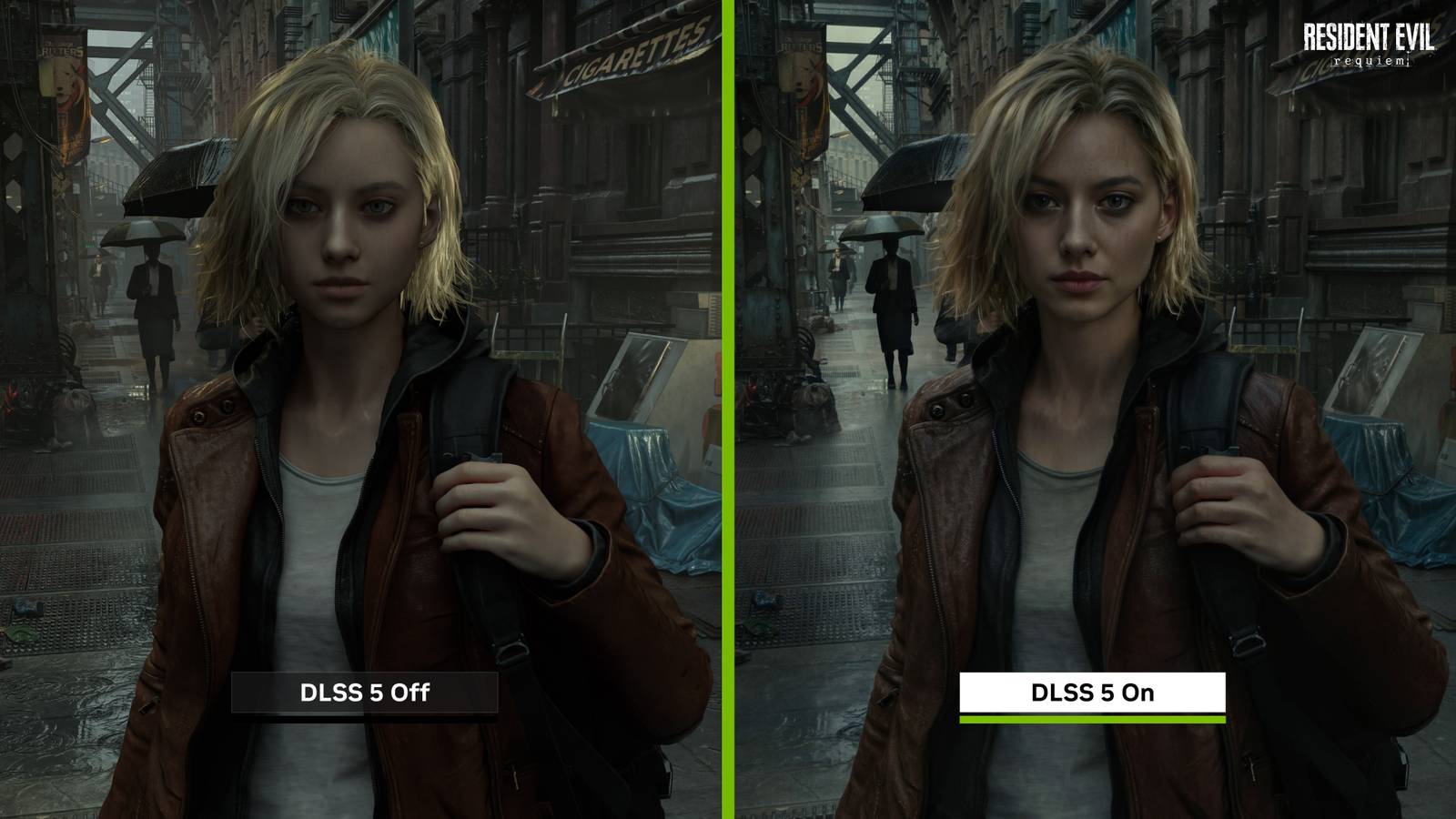
It was such a big leap that people wondered why it was just a point-five release, but it turns out the answer is way more radical than we could imagine.What is DLSS 5? Imagining a better (game) world DLSS 5 includes a new technology that uses AI to rework the lighting in a game so that it takes a major leap towards photorealism.It does not change the geometry or texture work, but "imagines" what the game would look like if rendered with extremely high-quality light.
You can see the examples in action below in NVIDIA's official release video.The end result is simply beyond anything that current hardware can achieve using traditional rendering methods.It pushes these real-time games into the realm of pre-rendered CG.
In this preliminary analysis video by Digital Foundry you can see that this is a real implementation in a real game.The results are consistent, and the game runs as normal, it just looks different.Just like real-time ray-tracing technology, this is using neural networks to make something possible that simply cannot be done by brute force at the moment.
Now, it's worth noting that this demo is using not one, but two RTX 5090 cards.One to run the game, and one to apply the DLSS pass to the graphics, but obviously the intent is for this technology to run on a single card when it's released to the public.Alienware 16 Area-51 (2025) 9 Brand Dell / Alienware Operating System Windows 11 Home (Pro upgradable) $2000 at Dell $3100 at Best Buy Expand Collapse Why are gamers complaining? New thing is scary The reaction to DLSS 5 online has been interesting, to say the least.
The most vocal reactions have been negative.The term "AI slop" was thrown around quite liberally as you might expect.However, the key theme here was about "artistic intent." The idea that DLSS 5 changes the art of the game so that it no longer looks the way the game developers intended it to look.
I can't argue that it doesn't make the games look different, but the implication that NVIDA just put out a bunch of demos using games by major studios without their consent or approval is laughable.Indeed, not only did studios like Bethesda and Capcom give their blessing, they worked on the DLSS 5 implementation in their games themselves! NVIDIA was also quick to point out in a pinned comment under the announcement video that DLSS 5 wasn't a "filter" or some magic on/off switch: Important to note with this technology advance - game developers have full, detailed artistic control over DLSS 5's effects to ensure they maintain their game's unique aesthetic.The SDK includes things like intensity, color grading and masking off places where the effect shouldn't be applied.
It's not a filter - DLSS 5 inputs the game’s color and motion vectors for each frame into the model, anchoring the output in the source 3D content.It essentially builds on what we've seen with ray reconstruction and the original denoising process for RTX.It provides another option for the lighting in the game.
Another complaint that I saw was the one leveled at generative AI products like Midjourney, where the idea is that the training was based on stolen work.Except that NVIDIA trains DLSS on extremely high-quality real-time rendering of game footage they generate themselves.It's NVIDIA's supercomputer resources that make DLSS what it is, not the GPU we buy that have simple tensor cores to run the resulting algorithms.
The results matter more than the methods It's all fake, my dudes Setting all of this scrambling to prejudgment aside, my biggest frustration is with the strange purism that some people in the gaming world express when it comes to how AI is being used.The "fake frames" and "fake pixels" camps railed against DLSS in its initial form.They only want raw, native pixels like nature intended, apparently.
Subscribe to the newsletter for DLSS 5 breakdowns Get clearer context - subscribe to the newsletter for in-depth, jargon-free analysis of DLSS 5 and AI-driven graphics, thoughtful takes on developer control and image-fidelity debates, and what it means for modern game visuals.Get Updates By subscribing, you agree to receive newsletter and marketing emails, and accept our Terms of Use and Privacy Policy.You can unsubscribe anytime.
This entire framing misses the point that the "real" game rendering technologies they are defending consist of a mountain of kludges and shortcuts game developers have invented over the years to get as close to their intent as possible.What does it matter what sort of math, or what type of processor is responsible for the image on screen? Related NVIDIA's big DLSS Super Resolution upgrade has arrived A major upscaling update is rolling out to everyone.Posts By Jorge A.
Aguilar A computer geek like me might be interested in the nuts and bolts, sure.But as a gamer, I care about the results above all.Does it look good? Does it play well? These are important questions.
And I care about whether I'm getting the intended experience.After all, I'm a guy who buys CRT monitors and TVs so that I can see what the games meant for those displays are supposed to look like.I think perhaps using existing games to showcase DLSS 5 could have been a mistake on NVIDIA's side.
It may have been better to show off a game that has been designed from the ground up to have DLSS 5 as part of its rendering solution.Either way, this is a smart solution to achieve a multi-generational leap in visual fidelity.The only question is whether the AMD-powered gaming consoles most people play on will once again feel outdated at launch, just as they did when NVIDIA blindsided AMD with RTX and DLSS at the same time as the launch of the PlayStation 5 and Xbox Series consoles.
Read More