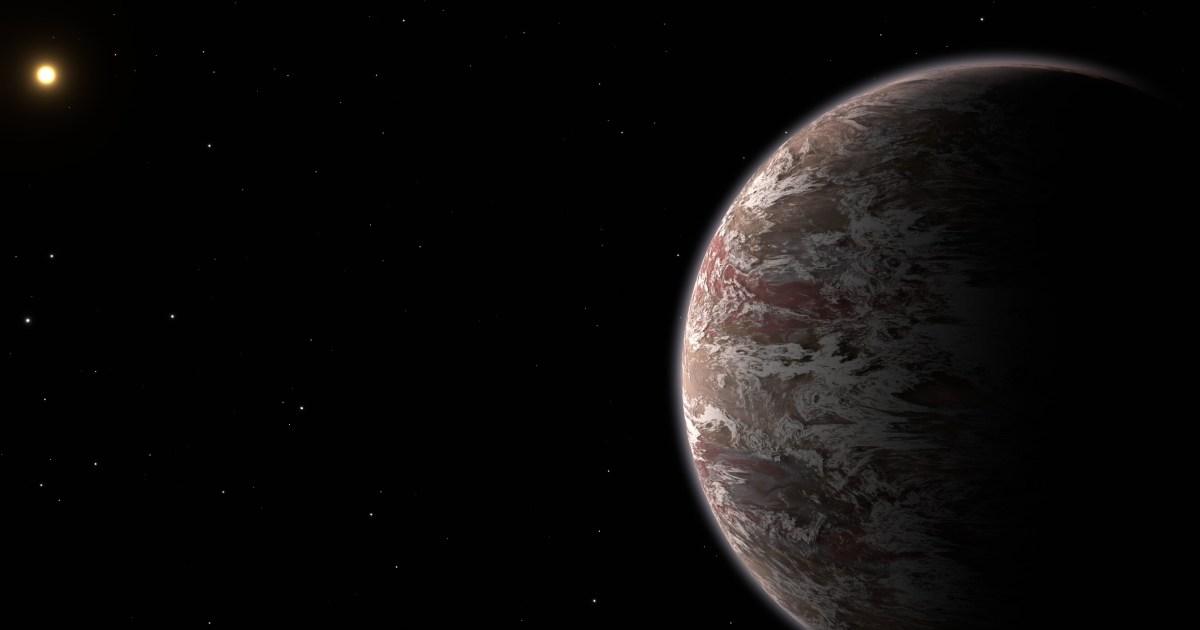
Astronomers have found a Jupiter-like planet several light years away which probably smells of urine.Epsilon Indi Ab has an ammonia atmosphere with clouds of water floating above the surface – and ammonia and water are the two primary components of urine.The pungent planet may not be top of the list for any colonisation plans by Elon Musk, but it has intrigued scientists studying it with the James Webb Space Telescope (JWST).
Elisabeth Matthews, from the Max Planck Institute for Astronomy, is the lead author of a new study.She said: ‘JWST is finally allowing us to study solar-system analogue planets in detail.If we were aliens, several light years away, and looking back at the Sun, JWST is the first telescope that would allow us to study Jupiter in detail.
‘For studying Earth in detail, we would need much more advanced telescopes, though.’ The team studied Epsilon Indi Ab using Webb’s mid-infrared instrument.They found it is around 7.6 times the mass of Jupiter but a similar size and orbits its star at a much greater distance than most exoplanets studied so far, giving it a relatively low temperature of between –70C and +20C.The discovery of the clouds of water were unexpected and not typical of many existing models of exoplanet atmospheres, as they are complex to simulate.
James Mang of the University of Texas at Austin said: ‘It’s a great problem to have, and it speaks to the immense progress we’re making thanks to JWST.Trending Now British woman with no illness to end life at Swiss assisted dying clinic this week UK 17 hours ago By Josh Milton Epsom 'gang rape' case closed as 'woman made confused report after banging head' Mum asks for prayers for influencer still fighting for life after being run over in Soho Trump stopped from ‘accessing nuclear codes' in furious row ‘What once seemed impossible to detect is now within reach, allowing us to probe the structure of these atmospheres, including the presence of clouds.‘This reveals new layers of complexity that our models are now beginning to capture, and opens the door to even more detailed characterisation of these cold, distant worlds.’ NASA’s planned Nancy Grace Roman Space Telescope, expected to launch later this decade, may be able to detect such reflective clouds more directly.
MORE: NASA finds 3,500,000,000-year-old chemicals on Mars crucial for origin of life MORE: Supermassive black holes in a ‘death spiral’ could collide – what impact will it have on Earth? MORE: How to see the Lyrid meteor shower in the UK as it peaks today Comments Add as preferred source News Updates Stay on top of the headlines with daily email updates.This site is protected by reCAPTCHA and the Google Privacy Policy and Terms of Service apply.Your information will be used in line with our Privacy Policy HomeNewsTech Related topics AustinElon MuskJames Webb Space TelescopeNasaSpace Supermassive black holes in a 'death spiral' could collide - what impact will it have? Tech 2 days ago By Rory McKeown How to see the Lyrid meteor shower in the UK as it peaks today Tech 2 days ago By Sarah Hooper
Read More